Oremus pro Antistite nostro Alexandro. Stet et pascat in fortitudine tua, Domine, in sublimitate nominis tui. (Let us pray for our Bishop Alexander. May he stand firm and shepherd his flock by Your strength, O Lord, in the majesty of Your name.)
Showing posts with label Vatican. Show all posts
Saturday, September 22, 2012
Vatican Nominations announced today
Announced today:
Cardinal George Pell, Archbishop of Sidney, has been nominated a Member of the Congregation for Bishops. So he will have a vote on the appointment of bishops.
And Dr Edward Peters, Professor of Canon Law in the "Edmund Cardinal Szoka Chair" at the Sacred Heart Seminary in Detroit, USA has been appointed an "expert" for the forthcoming 13th General Assembly of the Synod of Bishops. He also blogs at In the Light of the Law.
Tuesday, July 10, 2012
Licit and illicit episcopal ordinations in China
The Vatican's statement:
With regard to the episcopal ordination of the Reverend Joseph Yue Fusheng (pictured above), which took place in Harbin (Province of Heilongjiang) on Friday 6 July 2012, the following is stated:
1) The Reverend Joseph Yue Fusheng, ordained without pontifical mandate and hence illicitly, has automatically incurred the sanctions laid down by canon 1382 of the Code of Canon Law. [Latae sententiae excommunication reserved to the Apostolic See.] Consequently, the Holy See does not recognize him as Bishop of the Apostolic Administration of Harbin, and he lacks the authority to govern the priests and the Catholic community in the Province of Heilongjiang. The Reverend Yue Fusheng had been informed some time ago that he could not be approved by the Holy See as an episcopal candidate, and on several occasions he had been asked not to accept episcopal ordination without the pontifical mandate.
2) The Bishops who took part in the illicit episcopal ordination and have exposed themselves to the sanctions laid down by the law of the Church, must give an account to the Holy See of their participation in that religious ceremony.
3) Appreciation is due to those priests, consecrated persons and lay faithful who prayed and fasted for a change of heart in the Reverend Yue Fusheng, for the holiness of the Bishops and for the unity of the Church in China, particularly in the Apostolic Administration of Harbin.
4) All Catholics in China, Pastors, priests, consecrated persons and lay faithful, are called to defend and safeguard that which pertains to the doctrine and tradition of the Church. Even amid the present difficulties, they look to the future with faith, comforted by the certainty that the Church is founded on the rock of Peter and his Successors.
5) The Apostolic See, trusting in the concrete willingness of the Government Authorities of China to dialogue with the Holy See, hopes that the said Authorities will not encourage gestures contrary to such dialogue. Chinese Catholics also wish to see practical steps taken in this direction, the first among which is the avoidance of illicit celebrations and episcopal ordinations without pontifical mandate that cause division and bring suffering to the Catholic communities in China and the universal Church.
The ordination of the Reverend Thaddeus Ma Daqin as Auxiliary Bishop of the Diocese of Shanghai on Saturday 7 July 2012 is encouraging and is to be welcomed. The presence of a bishop who is not in communion with the Holy Father was inappropriate and shows a lack of consideration for a lawful episcopal ordination.
Wednesday, May 4, 2011
The other Bloggers Meeting
Hilary White, the organiser, summed it up: We had a great time!
It appears it was all very civilised and totally charitable!
Their guest of honour was Michael Voris, famous for his Vortex webcasts from Real Catholic TV. Here's his address:
And here's the Vatican's report on the bloggers meeting the Vatican itself organised:
It appears it was all very civilised and totally charitable!
Their guest of honour was Michael Voris, famous for his Vortex webcasts from Real Catholic TV. Here's his address:
And here's the Vatican's report on the bloggers meeting the Vatican itself organised:
Tuesday, May 3, 2011
Charity the big challenge for bloggers
Today's National Catholic Register daily update reports on the May 2nd meeting for Catholic Bloggers hosted by the Vatican.
The report gives bloggers much cause for thought, reflection and examination.
La Scalia's own reflections can be found at her blog.
The report gives bloggers much cause for thought, reflection and examination.
Elizabeth Scalia, who writes The Anchoress, said that while the mainstream media tend to view blogs as “little more than a means of self-promotion,” the Catholic blogs generally are real sources of “Catholic clarity.”
But bloggers can’t claim to be purveyors of clarity unless they do so with charity, she said.
“Charity is one of the biggest challenges we face,” she said, because “freedom is both a gift and a source of temptation for our egos.”
Scalia said that the Catholic blogosphere is host to too much “us and them” based on views of the Church.
As Catholics, she said, “we have no business fostering enemies.”
“The Church needs us,” Scalia said. “It needs us for evangelization. It needs us to disseminate information and often to correct information.”
“The Church needs us to be where the sheep are grazing,” but at the same time, bloggers need the Church and its pastors to remind them that God’s mercy reaches out to all people and that Jesus wants his followers to be united, she said.
La Scalia's own reflections can be found at her blog.
Monday, May 2, 2011
Osama Bin Laden dead - opportunity for reflection
I was glad to find the following statement from the Vatican News Service:
This occurred as we in this part of the world were concluding the feast of Divine Mercy.
"Osama Bin Laden, as is known, claimed responsibility for grave acts that spread division and hate among the peoples, manipulating religion to that end. A Christian never takes pleasure from the fact of a man's death, but sees it as an opportunity to reflect on each person's responsibility, before God and humanity, and to hope and commit oneself to seeing that no event become another occasion to disseminate hate but rather to foster peace".
This occurred as we in this part of the world were concluding the feast of Divine Mercy.
Wednesday, April 20, 2011
Who hasn't been invited to the Vatican blognic
Now, I know not everyone can be invited but the list of 150 invitees has been published. Anna Arco (Catholic Herald), Hilary White (Lifesite news and her own blog), Sandro Magister, are amongst those invited. I was particularly pleased to see James Bradley of the Ordinariate Portal on the list. He is one of the clerics of the Sevenoaks Ordinariate group who was to be received into full communion this week.
But, we do have some big hitters in the English speaking world and I should have thought that at least one of Fr Z, Father Tim Finigan and Father Ray Blake should have been invited. And what about my good friend Owl of the Remove? They do say names were put into a hat and drawn out. Maybe that's why.
But there's an alternative blognic...
Monday, January 17, 2011
Anglican Ordinariate - odd announcement from Vatican Information Services
Under OTHER PONTIFICAL ACTS:
All good news, of course. Why the inclusion of his Anglican cv (almost giving tacit recognition of his anglican orders: "ordained a priest") and nothing about his ordination as a Catholic priest on 15th January?
- Appointed Rev. Keith Newton as first ordinary of the new Personal Ordinariate of Our Lady of Walsingham in the territory of the Catholic Bishops' Conference of England and Wales. Rev. Newton was born in Liverpool, England in 1952 and ordained a priest in 1976 for the Anglican diocese of Chelmsford. In March 2002 he was ordained as suffragan bishop of Richborough.
All good news, of course. Why the inclusion of his Anglican cv (almost giving tacit recognition of his anglican orders: "ordained a priest") and nothing about his ordination as a Catholic priest on 15th January?
Wednesday, October 27, 2010
Killing Tarek Aziz will not help Iraq
Tarek Aziz may be guilty of being complicit in acts of genocide perpetrated by Sadam Hussein and in his suppression of religious political parties but I was deeply unhappy to learn that he has been sentenced to death. Now the Vatican has also issued a statement saying that his death will not help the process of peace and reconciliation in Iraq.
While American troops were on Baghdad's doorstep Aziz continued to maintain that Iraqi troops were defeating them when they were already hopelessly defeated. He seemed mildly pitiable. Let him serve a just sentence for crimes committed. He may even deserve to be executed. But I pray that this won't happen.
The Vatican statement reads:
Tweet
While American troops were on Baghdad's doorstep Aziz continued to maintain that Iraqi troops were defeating them when they were already hopelessly defeated. He seemed mildly pitiable. Let him serve a just sentence for crimes committed. He may even deserve to be executed. But I pray that this won't happen.
The Vatican statement reads:
The Catholic Church's position on the death penalty is well known. It is hoped, therefore, that the sentence against Tariq Aziz will not be implemented, precisely in order to favour reconciliation and the reconstruction of peace and justice in Iraq after the great sufferings the country has experienced. As concerns the possibility of a humanitarian intervention, the Holy See is not accustomed to operate publicly but through the diplomatic channels at its disposal.Acknowledgements: VIS, Zenit.
Tweet
Tuesday, October 12, 2010
New Pontifical Council for Promoting the New Evangelisation
The Vatican Information Service and the Catholic News Agency (CNA) reports today the promulgation of the Motu Proprio of Pope Benedict Ubicumque et semper (everywhere and always) by which he establishes a new Pontifical Council for Promoting the New Evangelisation.
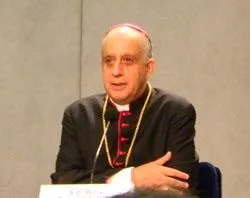
The president of tne newly established Council is Archbishop Rino Fisichella who gave a press conference about the motu proprio.
Here is the summary publshed today by VIS and currently available only in Latin and Italian:
Tweet
The president of tne newly established Council is Archbishop Rino Fisichella who gave a press conference about the motu proprio.
Here is the summary publshed today by VIS and currently available only in Latin and Italian:
Given below are extracts of "Ubicumque et semper", the Apostolic Letter "Motu Proprio data" by which Benedict XVI establishes the Pontifical Council for Promoting New Evangelisation.
"The Church has the duty to announce the Gospel of Jesus Christ always and everywhere. ... Over history this mission has assumed new forms and methods, depending on place, situation and historical moment. In our own time, one of its most singular characteristics has been that of having to measure itself against the phenomenon of abandonment of the faith, which has become progressively more evident in societies and cultures that were, for centuries, impregnated with the Gospel.
"The social transformations we have seen over recent decades have complex causes, the roots of which are distant in time and have profoundly modified our perception of the world. ... If, on the one hand, humanity has seen undeniable benefits from these transformations and the Church received further stimuli to give reasons for the hope she carries, on the other, we have seen a worrying loss of the sense of the sacred, even going so far as to call into discussion apparently unquestionable foundations, such as faith in the God of creation and providence; the revelation of Jesus Christ our only Saviour, the shared understating of man's fundamental experiences like birth, death and family life, and the reference to natural moral law".
"Among the central themes examined by Vatican Council II was the question of relations between the Church and the modern world. In the wake of this conciliar teaching, my predecessors dedicated further reflection to the need to find adequate forms to allow our contemporaries to still hear the Lord's living and eternal Word".
"Venerable Servant of God John Paul II made this demanding undertaking one of the pivotal points of his vast Magisterium, summarising the task awaiting the Church today in the concept of 'new evangelisation' (which he systematically developed in numerous occasions), especially in regions of age-old Christianity".
"Thus, in my turn, sharing the concern of my venerated predecessors, I feel it appropriate to offer an adequate response so that the entire Church, allowing herself to be regenerated by the Holy Spirit, may present herself to the modern world with a missionary vigour capable of promoting a new evangelisation".
"In Churches of ancient foundation, ... although the phenomenon of secularisation continues its course, Christian practice still shows signs of possessing vitality and profound roots among entire peoples. ... We also know, unfortunately, of areas which appear almost completely de-Christianised, areas in which the light of faith is entrusted to the witness of small communities. These lands, which need a renewed first announcement of the Gospel, seem particularly unreceptive to many aspects of the Christian message".
"At the root of all evangelisation there is no human project of expansion, but the desire to share the priceless gift that God wished to give us, sharing His life with us".
Tweet
Friday, July 16, 2010
Abuse of Minors. The Church's Response
Further to my previous post on the topic, I think the Vatican has gone out of its way to put into the public domain in an easily accessible format all the documents concerning this sad affair. Not only are all the canonical documents readily accessible, but all relevant pontifical comments on the matter.
The media now have easy access to all the documents to enable them to honestly assess the Church's response. Even the previously secret Crimen sollicitationis is available in an unofficial (most unusual for the Vatican) English translation.
I hope other bloggers and commentators will now stop barracking the Vatican. Of course, the Vatican presents this resource without spin and the media love spin.
The media now have easy access to all the documents to enable them to honestly assess the Church's response. Even the previously secret Crimen sollicitationis is available in an unofficial (most unusual for the Vatican) English translation.
I hope other bloggers and commentators will now stop barracking the Vatican. Of course, the Vatican presents this resource without spin and the media love spin.
Thursday, July 15, 2010
Vatican issues new norms of Grave Delicts
Today the Congregation for the Doctrine of the Faith has issued new norms, approved by the Holy Father on 21st May 2010, concerning clerics guilty of grave delicts concerning Faith, Sacraments (Eucharist, Penance, attempted ordination of women), and Morals.
It is these latter, delicts against morals, that the public is clearly most concerned about. And the statements from the Vatican do not fail to address this concern.
The statement from Father Federico Lombardi deals primarily with this aspect of the new norms:
The reason I have highlighed so prominently certain phrases in the above extract is that I feel that a very prominent British blogger has been rather unfairly damning of the Vatican's PR machine. It has its faults, but I think it behoves journalists to read the statements. Of course the latest document deals with other grave delicts and to that extent the new document can be considered a tidying up of law on different matters which are grave delicts. But the statement by Lombardi clearly shows that the Church is aware of the public's overriding concern with the sexual abuse scandal.
The Congregation for the Doctrine of the Faith's (CDF) Historical Introduction to the previous norms of 2001 gives an interesting and critical analysis of the problems that occurred in the period between 1965, the year the Second Vatican Council concluded, and 1983, the year when the new Code of Canon Law came into effect (my emphases):
The website of the Canon Law Society of America gives links to the full suite of documents issued today.
It is these latter, delicts against morals, that the public is clearly most concerned about. And the statements from the Vatican do not fail to address this concern.
The statement from Father Federico Lombardi deals primarily with this aspect of the new norms:
The serious crimes to which the (previous 2001) regulations referred concerned vital aspects of Church life: the Sacraments of the Eucharist and of Penance, but also sexual abuse committed by a priest against a minor under the age of eighteen.
The vast public echo this latter kind of crime has had over recent years has attracted great attention and generated intense debate on the norms and procedures applied by the Church to judge and punish such acts.
It is right, then, that there should be complete clarity concerning the regulations currently in force in this field, and that these regulations be presented organically so as to facilitate the work of the people who deal with these matters.
An initial clarification - especially for use by the media - was provided recently with the publication on the Holy See website of a brief "Guide to Understanding Basic CDF Procedures concerning Sexual Abuse Allegations". The publication of the new Norms is, however, quite a different thing, providing us with an official and updated legal text which is valid for the whole Church.
In order to facilitate the reading of the Norms by a non-specialist public, particularly interested in the problems of sexual abuse, we will seek to highlight a number of important aspects:
Among the novelties introduced with respect to the earlier Norms, mention must be made, above all, of measures intended to accelerate procedures, such as the possibility of not following the "judicial process" but proceeding by "extrajudicial decree", or that of presenting (in particular circumstances) the most serious cases to the Holy Father with a view to dismissing the offender from the clerical state.
Another Norm intended to simplify earlier problems and to take account of the evolution of the situation in the Church concerns the possibility of having not only priests but also lay persons as members of the tribunal staff, or as lawyers or prosecutors. Likewise, in order to undertake these functions it is no longer strictly necessary to have a doctorate in canon law, but the required competency can also be proved in another way; for example, with a licentiate.
Another aspect worthy of note is the increase of the statute of limitations from ten years to twenty years, with the possibility of extension even beyond that period.
Another significant aspect is establishing parity between the abuse of mentally disabled people and that of minors, and the introduction of a new category: paedophile pornography. This is defined as: "the acquisition, possession or disclosure" by a member of the clergy, "in any way and by any means, of pornographic images of minors under the age of fourteen".
Regulations concerning the secrecy of trials are maintained, in order to safeguard the dignity of all the people involved.
One point that remains untouched, though it has often been the subject of discussion in recent times, concerns collaboration with the civil authorities. It must be borne in mind that the Norms being published today are part of the penal code of canon law, which is complete in itself and entirely distinct from the law of States.
On this subject, however, it is important to take note of the "Guide to Understanding Basic CDF Procedures concerning Sexual Abuse Allegations", as published on the Holy See website. In that Guide, the phrase "Civil law concerning reporting of crimes to the appropriate authorities should always be followed" is contained in the section dedicated to "Preliminary Procedures". This means that in the practice suggested by the Congregation for the Doctrine of the Faith it is necessary to comply with the requirements of law in the various countries, and to do so in good time, not during or subsequent to the canonical trial.
Today's publication of the Norms makes a great contribution to the clarity and certainty of law in this field; a field in which the Church is today strongly committed to proceeding with rigour and transparency so as to respond fully to the just expectations of moral coherence and evangelical sanctity nourished by the faithful and by public opinion, and which the Holy Father has constantly reiterated.
Of course, many other measures and initiatives are required from the various ecclesiastical bodies. The Congregation for the Doctrine of the Faith is currently examining how to help the bishops of the world formulate and develop, coherently and effectively, the indications and guidelines necessary to face the problems of the sexual abuse of minors, either by members of the clergy or within the environment of activities and institutions connected with the Church, bearing in mind the situation and the problems of the societies in which they operate.
This will be another crucial step on the Church's journey as she translates into permanent practice and continuous awareness the fruits of the teachings and ideas that have matured over the course of the painful events of the "crisis" engendered by sexual abuse by members of the clergy.
The reason I have highlighed so prominently certain phrases in the above extract is that I feel that a very prominent British blogger has been rather unfairly damning of the Vatican's PR machine. It has its faults, but I think it behoves journalists to read the statements. Of course the latest document deals with other grave delicts and to that extent the new document can be considered a tidying up of law on different matters which are grave delicts. But the statement by Lombardi clearly shows that the Church is aware of the public's overriding concern with the sexual abuse scandal.
The Congregation for the Doctrine of the Faith's (CDF) Historical Introduction to the previous norms of 2001 gives an interesting and critical analysis of the problems that occurred in the period between 1965, the year the Second Vatican Council concluded, and 1983, the year when the new Code of Canon Law came into effect (my emphases):
The reforms proposed by the Second Vatican Council required a reform of the 1917 Code of Canon Law and of the Roman Curia. The period between 1965 and 1983 (the year when the new Latin Code of Canon Law appeared) was marked by differing trends in canonical scholarship as to the scope of canonical penal law and the need for a de-centralized approach to cases with emphasis on the authority and discretion of the local bishops. A “pastoral attitude” to misconduct was preferred and canonical processes were thought by some to be anachronistic. A “therapeutic model” often prevailed in dealing with clerical misconduct. The bishop was expected to “heal” rather than “punish”. An overoptimistic idea of the benefits of psychological therapy guided many decisions concerning diocesan or religious personnel, sometimes without adequate regard for the possibility of recidivism.It is to be hoped that these very stringent norms will enable any future cases of alleged offence to be dealt with justly and efficiently and that they may be the deterent that, sadly, may be required by some clerics to keep them, given the fallen human condition of mankind, from straying onto the path of immoral behaviour.
The website of the Canon Law Society of America gives links to the full suite of documents issued today.
Wednesday, February 17, 2010
Pontifical Academy for Life members call for removal of Fisichella
Lifesite news reports on the disquiet within the Pontifical Academy for Life to which I have referred in a previous post. Five members have published a statement which refers to conerns about integrity within the Vatican curia as well as the fact that the Academy's president Archbishop Fisichella has undermined greatly the Church's ability to witness to the sanctity of life.
As lifesite news reports:
Read the full report and the full statement of the members, two of whom are from England: Professor Luke Gormally Professor Luke Gormally, Ordinary Member of the Academy and former Director (1981-
2000) of The Linacre Centre for Healthcare Ethics, London, UK, and Dr Thomas Ward, Corresponding Member of the Academy,President of The National Association of Catholic Families and a Retired General Practitioner, UK.
UPDATE: See John Smeaton of SPUC.
As lifesite news reports:
The statement says that members held back from a direct confrontation last week, believing that an open challenge at the time would have merely caused the Vatican’s Curia to “close ranks” around one of their own “because of the clericalist culture of that body” and despite the “lack of support” for Fisichella himself.
“There is credible information that Fisichella is widely perceived in the Curia to be an inappropriate President of PAV and there is a reasonable hope that the Holy Father will recognise the need to provide him with an occupation better suited to his abilities,” the statement said.
The statement’s signatories include Monsignor Michel Schooyans, Professor Emeritus of the University of Louvain, Belgium; Professor Luke Gormally, the former director of the Linacre Centre for Healthcare Ethics; Christine de Marcellus de Vollmer, head of the Alliance for the Family in Venezuela; Dr. Maria Smereczynska a corresponding member from Poland and Dr. Thomas Ward, president of the National Association of Catholic Families.
It says that Fisichella’s claim that the Academy “is moving forward and working to speak as a united body” is belied by the reality and that it gives a distorted and false impression to the Church at large of the situation in the Academy.
They call it “absurd” that the Vatican’s Pontifical Academy for Life, is “being led by an ecclesiastic who does not understand what absolute respect for innocent human lives entails.” The situation is one that can “be rectified only by those who are responsible for his appointment as President.”
Read the full report and the full statement of the members, two of whom are from England: Professor Luke Gormally Professor Luke Gormally, Ordinary Member of the Academy and former Director (1981-
2000) of The Linacre Centre for Healthcare Ethics, London, UK, and Dr Thomas Ward, Corresponding Member of the Academy,President of The National Association of Catholic Families and a Retired General Practitioner, UK.
UPDATE: See John Smeaton of SPUC.
Monday, February 8, 2010
Crisis talks at the Pontifical Academy for Life
Many pro-lifers were shocked and scandalised a year or so ago when Archbishop Fisichella published an article condemning the declarations of excommunications made by Archbishop Cardoso of Olinda and Recife, thereby appearing to condone those who conspired to abort the twins being carried by a nine year old girl from Recife in Brazil. The pro-abortion lobby certainly saw the significance of Fisichella's statement: Catholics could, after all, co-operate in abortion in these 'hard' cases.
This year's annual congress of the Pontifical Academy for Life of which Archbishop Fisichella is president is to be held behind closed doors rather than in public.
For the Academy to survive surely there is only one solution, and that is for Fisichella to stand down or, as sometimes happens in the Vatican, to be 'promoted' out of the Pontifical Academy for Life to some other post where he can do no harm.
See Lifesitenews for more.
This year's annual congress of the Pontifical Academy for Life of which Archbishop Fisichella is president is to be held behind closed doors rather than in public.
For the Academy to survive surely there is only one solution, and that is for Fisichella to stand down or, as sometimes happens in the Vatican, to be 'promoted' out of the Pontifical Academy for Life to some other post where he can do no harm.
See Lifesitenews for more.
Friday, October 30, 2009
Cardinal Murphy O'Connor appointed to Congregations of Bishops and Evangelisaion of Peoples

Pope Benedict has appointed Cardinal Murphy O'Connor to the Congregation of Bishops and the Congregation for the Evangelisation of Peoples. According to the press release from the Catholic Communications Network, he will have an important role in selecting Bishops for the many dioceses around the world.
In his new role, Cardinal Cormac will be directly involved in the appointment of Bishops for England, Wales, Scotland and Ireland, as well for countries in Africa, Asia, Europe, the Americas and Oceania.The press release says that these appointments illustrate the enormous esteem in which the Holy Father holds the Cardinal.
In a mark of extraordinary esteem, Pope Benedict XVI has appointed Cardinal Cormac Murphy O’Connor to two important Vatican congregations that select bishops for most dioceses of the Latin-rite Catholic Church worldwide.and
It is highly unusual for the pope to appoint a retired bishop or cardinal to such positions for the first time. That Pope Benedict has decided to name Cardinal Cormac to these two important posts is an indicator of the great respect and high esteem which he enjoys with both the pope and senior Vatican officials.and
Pope Benedict has given him a role of great importance which will have an impact on the future of the Universal Church in many lands. It also takes him deep inside the corridors of power in the Vatican.The Cardinal will hold these posts until he reaches his 80th birthday on 24th August 2012, unless the Holy Father's esteem is such that he asks him to remain in office.
Labels:
Cardinal Murphy O'Connor,
Roman Curia,
Vatican
Subscribe to:
Posts (Atom)