Showing posts with label SSPX. Show all posts

Saturday, October 27, 2012

SSPX and unity: more patience needed.


From the Vatican Press Office today:
The Pontifical Commission "Ecclesia Dei" takes this occasion to announce that, in its most recent official communication (6 September 2012), the Priestly Fraternity of St. Pius X has indicated that additional time for reflection and study is needed on their part as they prepare their response to the Holy See’s latest initiatives.

The current stage in the ongoing discussions between the Holy See and the Priestly Fraternity follows three years of doctrinal and theological dialogues during which a joint commission met eight times to study and discuss, among other matters, some disputed issues in the interpretation of certain documents of Vatican Council II. Once these doctrinal dialogues were concluded, it became possible to proceed to a phase of discussion more directly focused on the greatly desired reconciliation of the Priestly Fraternity of St. Pius X with the See of Peter.

Other critical steps in this positive process of gradual reintegration had already been taken by the Holy See in 2007 with the extension of the Extraordinary Form of the Roman Rite to the Universal Church by the Motu Proprio Summorum Pontificum and in 2009 with the lifting of the excommunications. Just a few months ago, a culminating point along this difficult path was reached when, on 13 June 2012, the Pontifical Commission presented to the Priestly Fraternity of St. Pius X a doctrinal declaration together with a proposal for the canonical normalization of its status within the Catholic Church.

At the present time, the Holy See is awaiting the official response of the superiors of the Priestly Fraternity to these two documents. After thirty years of separation, it is understandable that time is needed to absorb the significance of these recent developments. As Our Holy Father Pope Benedict XVI seeks to foster and preserve the unity of the Church by realizing the long hoped-for reconciliation of the Priestly Fraternity of St. Pius X with the See of Peter – a dramatic manifestation of the munus Petrinum in action – patience, serenity, perseverance and trust are needed.
Meanwhile, the SSPX expels Bishop Williamson.

Thursday, June 14, 2012

CDF meeting with Bishop Felay - SSPX to reply soon

This from the Vatican News Service:

On the afternoon of Wednesday 13 June, Cardinal William Levada, prefect of the Congregation for the Doctrine of the Faith and president of the Pontifical Commission 'Ecclesia Dei', met with Bishop Bernard Fellay, superior general of the Society of St. Pius X who was accompanied by an assistant. Also present at the encounter were Archbishop Luis Ladaria S.J., secretary of the Congregation for the Doctrine of the Faith, and Msgr. Guido Pozzo, secretary of the Pontifical Commission 'Ecclesia Dei'.


The purpose of the meeting was to present the Holy See's evaluation of the text submitted in April by the Society of St. Pius X in response to the Doctrinal Preamble which the Congregation of the Doctrine of the Faith had presented to the Society on 14 September 2011. The subsequent discussion offered an opportunity the provide the appropriate explanations and clarifications. For his part, Bishop Fellay illustrated the current situation of the Society of St. Pius X and promised to make his response known within a reasonable lapse of time.

Also during the meeting, a draft document was submitted proposing a Personal Prelature as the most appropriate instrument for any future canonical recognition of the Society.

As was stated in the communique released on 16 May 2012, the situation of the other three bishops of the Society of St. Pius X will be dealt with separately and singularly.

At the end of the meeting the hope was expressed that this additional opportunity for reflection would also contribute to reaching full communion between the Society of St. Pius X and the Apostolic See.

Wednesday, June 13, 2012

Could the SSPX and the Holy See be reconciled Friday?

Many, many people are praying that this may be so. See Rorate Caeli for further information. The autor quotes from Italy's La Stampa:
After having studied with attention the text of the doctrinal preamble, with the modifications requested by the Superior of the Society of Saint Pius X, Benedict XVI would have made his decision and had delivered it to Cardinal William Levada, Prefect of the Congregation for the Doctrine of the Faith, and to the Secretary of the same Dicastery, Archbishop Luis Ladaria Ferrer, during the audience granted to both last Saturday.

The text of the doctrinal declaration is a top secret, but it will be published - this was assured from the beginning - if an agreement between the Holy See and the Society founded by Archbishop Lefebvre is formalized. It is not possible to know, therefore, if modifications or clarifications were added to the text that Bishop Bernard Fellay had sent to Rome in mid-April and that the Cardinals had examined and discussed on May 15, in the Feria Quarta [Wednesday meeting] of the Congregation for the Doctrine of the Faith. In the upcoming hours, the papal response may be delivered to the Lefebvrian superior. It will be up to him to give final assent to the preamble. ... If Fellay, after having received the Vatican response, signs the doctrinal declaration, the agreement will be officially announced.
Do join with your prayers for this intention. Friday is the Solemnity of the Sacred Heart, the Day of Prayer for the Sanctification of Priests.

Tuesday, May 22, 2012

Wednesday, May 16, 2012

Pray for the talks between the Vatican and SSPX


The Vatican Information Service published this notice today:

Vatican City, 16 May 2012 (VIS) - Early this afternoon, the Holy See Press Office issued the following communique regarding the Society of St. Pius X:

"As reported by news agencies, today, 16 May 2012, an Ordinary Session of the Congregation for the Doctrine of the Faith met to discuss the question of the Society of St. Pius X.

In particular, the text of the response of Bishop Bernard Fellay, received on 17 April, 2012, was examined and some observations, which will be considered in further discussions between the Holy See and the Society of St. Pius X, were formulated.

Regarding the positions taken by the other three bishops of the Society of St. Pius X, their situations will have to be dealt with separately and singularly".
Further comment at Catholic News Service.

Let us pray for unity in these days leading up to Pentecost.

Saturday, May 12, 2012

SSPX unity with Rome increasingly likely?


The Superior General of the SSPX is openly admitting that the Society could split over his attempts to restore communion with Pope Benedict. Bishop Fellay appears to be trusting of Pope Benedict and looking favourably upon the Pope's attempts to restore discipline in the Church, whereas the other three bishops and others within the Society are maintaining their "Rome has lost the Catholic Faith" position.

The fact that Bishop Fellay is talking about splits paradoxically increases my hope that he - and hopefully and sizeable majority - will be restored to communion with the Pope. It appears to be a sacrifice he is willing to make.

There are some insightful posts at

Fr Z: Bp Felly speaks with Catholic News Service

The Sensible Bond: SSPX Superior in France Foments Division; Letters between SSPX Bishops and SSPX General Council

A split would obviously be regrettable, but is probably inevitable.

Saturday, April 14, 2012

SSPX shows more respect for the authority of Vatican II than most religious orders

Or, as Fr Tim Finigan puts it, SSPX accept more of Vatican II's teaching than modernist theologians.

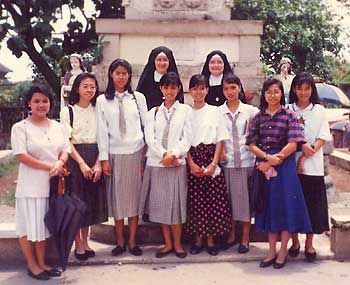
The above picture (from the SSPX District of Asia website) is probably not the kind of image most people would conjure up when thinking about the "traditionalist" SSPX (Society of St Pius X). They are normally potrayed as an eccentric bunch of traditionalist priests who will not accept Vatican II.

Sandro Magister (For the Lefebvrists, It's the Last Call to the Sheepfold) asks:
But what exactly is the doctrinal cause of the division? And why is there a fracture between Rome and the Lefebvrists over their rejection of some of the teachings of Vatican Council II, while at the same time other Catholic currents of the opposite nature continue to inhabit the Church undisturbed, in spite of the fact that they too reject essential teachings of the same Council?
In other words, there appears not to be a level playing field here.

Not that we would want to excuse rejection of the Sacred Magisterium of the Church on the part of the SSPX. In an essay by Dr John R.T. Lamont, Gifford Research Fellow at the University of St Andrews, UK, entitled A Theologian's Questions written expressly for Magister's www.chiesa.espressonline.it blog, Lamont considers teachings of Vatican II on Divine Revelation (Dei Verbum), the nature of the Church (Lumen Gentium), the Church in the Modern World (Gaudium et Spes) and contends that
The vast majority of theologians in Catholic institutions in Europe, North America, and Australasia would reject most or all of these teachings [that Lamont quotes as examples]... The texts above are only a selection from the teachings of Vatican II that are rejected by these groups; they could be extended to many times the number.

Such teachings however form part of the 95% of Vatican II that the FSSPX accepts. Unlike the 5% of that council rejected by the FSSPX, however, the teachings given above are central to Catholic faith and morals, and include some of the fundamental teachings of Christ himself.
Lamont points out that
In judging the doctrinal position of the FSSPX, it must be remembered that there is an essential difference between the position of the FSSPX on Vatican II and the position of those elements within the Church who reject the teachings from "Dei Verbum," "Lumen gentium," and "Gaudium et spes" listed above. The latter group simply holds that certain doctrines of the Catholic Church are not true. They reject Catholic teaching, full stop. The FSSPX, on the other hand, does not claim that the teaching of the Catholic Church is false. Instead, it claims that some of the assertions of Vatican II contradict other magisterial teachings that have greater authority, and hence that accepting the doctrines of the Catholic Church requires accepting these more authoritative teachings and rejecting the small proportion of errors in Vatican II. It asserts that the actual teaching of the Catholic Church is to be found in the earlier and more authoritative statements.
It should be borne in mind that Vatican II made no explicitly infallible statements whereas previous magisterial teachings were taught in an extremely solemn manner. As Lamont says:
These are all magisterial pronouncements of great authority, and in some cases they include infallible dogmatic definitions – which is not the case with the Second Vatican Council itself.
A further question Lamont raises is the matter of secrecy. If the discussions between the SSPX and the Holy See were concerning a precise canonical structure for the Society, it would be well that these would be kept secret for the time being.  But...
The nature of the teaching of the Catholic Church on religious freedom, ecumenism, the Church, and collegiality, is of great importance to all Catholics. The questions raised by the discussions between the Holy See and the FSSPX thus concern the whole Church, not merely the parties to the discussion.
I for one am praying for the rehabilitation of the Society and to healthy dialogue with its members as equal brothers (and sisters) in the communion of the One, Holy, Catholic and Apostolic Church.

LinkWithin

Related Posts Plugin for WordPress, Blogger...