Showing posts with label Tradition. Show all posts

Tuesday, September 18, 2012

Liverpool institutes lay-led funerals

Shouldn't we get back to this kind of solemnity for funerals?
The Archbishop of Liverpool has commissioned 22 lay people to preside at funerals in the absence of a priest, the first UK diocese to do so. (Catholic News Service)
"In some of our parishes in the diocese priests are being asked to celebrate over 120 funerals each year," Archbishop Kelly wrote.

"That does not neatly work out at two or three times a week," he wrote. "Some weeks there can be six or seven."
I can see the difficulty, and as a priest I know how much stress celebrating a number of funerals a week can be. One is dealing with people at a very emotional time and situation. The fact that the Church has so many options in the liturgy adds to the stress as people ask for their favourite songs, and eulogies, and other strange things to be inserted into the liturgy. Sometimes they don't like Scripture readings that refer to judgement, etc. etc.

But to celebrate a funeral is a unique opportunity for the priestly office to be exercised in providing pastoral care for the bereaved but, more importantly to enable the celebration of the Eucharistic Sacrifice for the repose of the souls of those who have died.

I have consulted the archdiocesan website and have counted roughly 310 priests. Now, some of these priests are retired, some will be abroad studying, etc.  The news item from CNS News quoted above states the number of priests as 170 (with a projected reduction to 100 by 2015). So I don't know what the situation with the other 140 priests is. I wonder if any of the retired clergy or others from those 140 could be called upon to celebrate funeral Masses.

I also tried to find a list of deacons but couldn't locate it on the diocesan website. Could (and should) they not be called upon in preference to lay people?

We also read:
The move was announced through a brochure, "Planning a Catholic Funeral," published recently by the archdiocese. The brochure described a funeral as the "community's main celebration and prayer for the deceased."
I have often wondered about the community aspect of a funeral. What about having a funeral Mass for more than one person? I know this would be a huge cultural shift for many people and perhaps it would be something of an innovation. But I'm not sure what the significance of emphasising the funeral as the "community's main celebration and prayer for the deceased" is about. It is the prayer of Christ and His Sacrifice offered through the ministry of the priest that is of the utmost importance, not the "community's ... celebration and prayer".

One must trust the fact that the Archbishop has consulted his Council of Priests and taken their advice, but I can't help thinking this is a retrograde step and will do little to promote vocations to the priesthood.

What I'll be doing is praying for an increase in vocations to the priesthood for Liverpool so that the beloved departed might have the funeral Mass that the Church foresees as the norm.

I realise now that I am very much behind the curve. See A Reluctant Sinner for his take on it. I am certainly in agreement with him that the main pastoral consideration at a funeral is not the mourners but the deceased. It is for him/her that the rites are being celebrated. The advantage with the more traditional (extraordinary) form of the Church's liturgy is that the participation or otherwise of those present was of no consequence to the effective celebration of the liturgy and the application to the departed of the merits of the Holy Sacrifice. And with a good choir and servers, it had/has a dignity that cannot be matched.

I celebrated the Requiem Mass for a Catholic in a beautiful medieval Anglican church in Kent. Most of the mourners were not Catholic but the local choral society got together to rehearse the chant, and added a few lovely motets, and did a beautiful job. This was probably the first time the Traditional Mass had been celebrated in this church since the reformation. All commented on the beauty of the ceremonies. (And no homily was given, at the request of the widow who was not a Catholic. And the older form anyway does not allow for a homily during the funeral Mass, only the possibility of an address before the final commendation. At first I felt put out at the request for no homily but then realised that there was nothing that needed to be said. The Liturgy spoke for itself!)

Saturday, July 21, 2012

Bishop Sample ordains deacons and subdeacons


Bishop Sample (the Bishop of Marquette where I am currently serving) recently ordained deacons and subdeacons for the Institute of Christ the King Sovereign Priest in Florence. Many wonderful photographs can be seen the the Institute's website.

Bishop Sample has a facebook page where you can keep up with his teachings and activities. On that page he also draws our attention to this CNS video on The Call of Beauty, an interview with Cardinal Burke in which he speaks of the strong sense of the transcendent in the Extraordinary Form of the Mass.


Wednesday, June 13, 2012

Could the SSPX and the Holy See be reconciled Friday?

Many, many people are praying that this may be so. See Rorate Caeli for further information. The autor quotes from Italy's La Stampa:
After having studied with attention the text of the doctrinal preamble, with the modifications requested by the Superior of the Society of Saint Pius X, Benedict XVI would have made his decision and had delivered it to Cardinal William Levada, Prefect of the Congregation for the Doctrine of the Faith, and to the Secretary of the same Dicastery, Archbishop Luis Ladaria Ferrer, during the audience granted to both last Saturday.

The text of the doctrinal declaration is a top secret, but it will be published - this was assured from the beginning - if an agreement between the Holy See and the Society founded by Archbishop Lefebvre is formalized. It is not possible to know, therefore, if modifications or clarifications were added to the text that Bishop Bernard Fellay had sent to Rome in mid-April and that the Cardinals had examined and discussed on May 15, in the Feria Quarta [Wednesday meeting] of the Congregation for the Doctrine of the Faith. In the upcoming hours, the papal response may be delivered to the Lefebvrian superior. It will be up to him to give final assent to the preamble. ... If Fellay, after having received the Vatican response, signs the doctrinal declaration, the agreement will be officially announced.
Do join with your prayers for this intention. Friday is the Solemnity of the Sacred Heart, the Day of Prayer for the Sanctification of Priests.

Monday, June 11, 2012

Corpus Christi Procession, Gwinn


I hope you enjoy this slideshow of our parish Corpus Christi Procession yesterday. It kicked off a week of celebration of the centennial of the first Mass celebrated in the basement of the still uncompleted church and was followed by Benediction in the Peter Nordeen Park and luncheon.

There seems to be a problem with creating a slideshow on picasa currently. Click on the image below to view the photographs.

Saturday, April 14, 2012

SSPX shows more respect for the authority of Vatican II than most religious orders

Or, as Fr Tim Finigan puts it, SSPX accept more of Vatican II's teaching than modernist theologians.

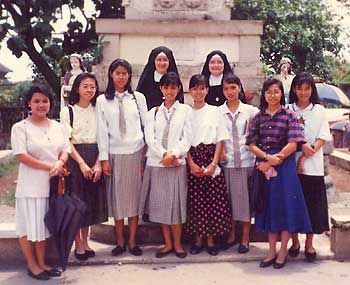
The above picture (from the SSPX District of Asia website) is probably not the kind of image most people would conjure up when thinking about the "traditionalist" SSPX (Society of St Pius X). They are normally potrayed as an eccentric bunch of traditionalist priests who will not accept Vatican II.

Sandro Magister (For the Lefebvrists, It's the Last Call to the Sheepfold) asks:
But what exactly is the doctrinal cause of the division? And why is there a fracture between Rome and the Lefebvrists over their rejection of some of the teachings of Vatican Council II, while at the same time other Catholic currents of the opposite nature continue to inhabit the Church undisturbed, in spite of the fact that they too reject essential teachings of the same Council?
In other words, there appears not to be a level playing field here.

Not that we would want to excuse rejection of the Sacred Magisterium of the Church on the part of the SSPX. In an essay by Dr John R.T. Lamont, Gifford Research Fellow at the University of St Andrews, UK, entitled A Theologian's Questions written expressly for Magister's www.chiesa.espressonline.it blog, Lamont considers teachings of Vatican II on Divine Revelation (Dei Verbum), the nature of the Church (Lumen Gentium), the Church in the Modern World (Gaudium et Spes) and contends that
The vast majority of theologians in Catholic institutions in Europe, North America, and Australasia would reject most or all of these teachings [that Lamont quotes as examples]... The texts above are only a selection from the teachings of Vatican II that are rejected by these groups; they could be extended to many times the number.

Such teachings however form part of the 95% of Vatican II that the FSSPX accepts. Unlike the 5% of that council rejected by the FSSPX, however, the teachings given above are central to Catholic faith and morals, and include some of the fundamental teachings of Christ himself.
Lamont points out that
In judging the doctrinal position of the FSSPX, it must be remembered that there is an essential difference between the position of the FSSPX on Vatican II and the position of those elements within the Church who reject the teachings from "Dei Verbum," "Lumen gentium," and "Gaudium et spes" listed above. The latter group simply holds that certain doctrines of the Catholic Church are not true. They reject Catholic teaching, full stop. The FSSPX, on the other hand, does not claim that the teaching of the Catholic Church is false. Instead, it claims that some of the assertions of Vatican II contradict other magisterial teachings that have greater authority, and hence that accepting the doctrines of the Catholic Church requires accepting these more authoritative teachings and rejecting the small proportion of errors in Vatican II. It asserts that the actual teaching of the Catholic Church is to be found in the earlier and more authoritative statements.
It should be borne in mind that Vatican II made no explicitly infallible statements whereas previous magisterial teachings were taught in an extremely solemn manner. As Lamont says:
These are all magisterial pronouncements of great authority, and in some cases they include infallible dogmatic definitions – which is not the case with the Second Vatican Council itself.
A further question Lamont raises is the matter of secrecy. If the discussions between the SSPX and the Holy See were concerning a precise canonical structure for the Society, it would be well that these would be kept secret for the time being.  But...
The nature of the teaching of the Catholic Church on religious freedom, ecumenism, the Church, and collegiality, is of great importance to all Catholics. The questions raised by the discussions between the Holy See and the FSSPX thus concern the whole Church, not merely the parties to the discussion.
I for one am praying for the rehabilitation of the Society and to healthy dialogue with its members as equal brothers (and sisters) in the communion of the One, Holy, Catholic and Apostolic Church.

Thursday, December 1, 2011

Extraordinary Form of the Mass at Gwinn - and a request

Bishop Sample celebrating Mass in the Extraordinary Form
at St Peter Cathedral
I celebrated the Extraordinary Form of the Mass for the first time in the parish this evening. A goodly congregation was present considering some serious snow had fallen - 14 communicants, plus some little children. Two of our young servers did extremely well considering they had only had one hour's practice yesterday. They were assisted by an adult who regularly attends the weekly EF Mass at St Peter Cathedral in Marquette.

My intention is to celebrate this form of the Mass on the evenings of my day off, Thursday, and maybe on other occasions if the faithful request it.

This evening I celebrated with my small travel edition of the Missale Romanum which I brought with me from England and which you can find reviewed by Fr Z.

Whilst I don't mind celebrating with this Missal privately - it is a very worthy  publication - for a public Mass it has its drawbacks. I did not notice any damage to the tabs as Fr Z did but the glue binding the tabs to the page also binds pages to pages, so that one has to use two hands to carefully separate the pages during the celebration of Mass. This evening I slightly tore one of the pages of the Canon. Also, I now notice my age: my sight is not as good as it was and I found myself struggling with the smaller print.

So, I need to buy a new Missal.

I could get the 1962 Missal published with the approval of the late Cardinal O'Connor. The lowest price I have found it available for is $110.00 (s/h included) from Roman Catholic Books or $99.99 plus $12.25 s/h from Fraternity Publications i.e. the Priestly Fraternity of St Peter (FSSP). This is the Missal I bought for (and donated to) my previous parish in South Ashford, England. My verdict on this Missal is that is quite adequate - it does the job and would be fine.

However, there is a much nicer one: a 2008 reprint of the well-known and beautiful Benziger Brothers Missal approved by the late Cardinal Spelman, with ad libitum prefaces that were approved in July 1962, including a restored Advent preface, and Masses approved for use in the dioceses of the USA.
Fr Z reviews it here.

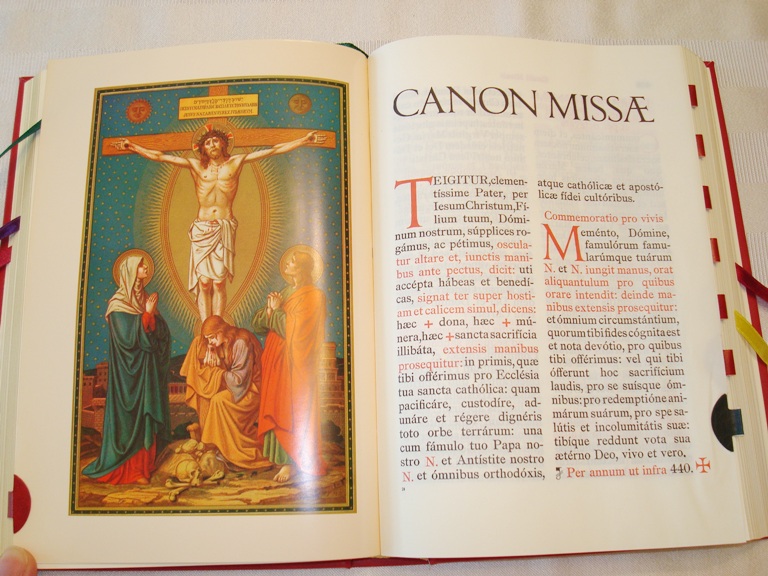
The lowest price I have found it available for is $320.00 plus $17.00 s/h from Preserving Christian Publications. The website of Biretta Books gives further details, including examples of the beautful type setting and artwork (far superior to the O'Connor Missal above) shown below:


My question: would anyone like to help me get either of these Missals for the parish? See About Me if you would like to email me.

Wednesday, November 30, 2011

No holding hands during the "Our Father" - Bishop decrees.


I am grateful to a correspondent who has drawn my attention to The Deacon's Bench blog reporting the letter and decree of the Bishop of Covington, the Most Reverend Roger J Foys, issued on the occasion of the implementation of the new English translation of the Roman Missal.

In his letter the Bishop points out that
The rituals of the Roman Church, of which we are a part, call for specific words to be used as well as particular actions and gestures, both on the part of the priest and the faithful who join their hearts with his in their worship of God.

He reminds his people:
As we continually give ourselves to the Lord, to His Word and to His Church, as your bishop I ask for your cooperation with the implementation process and to take to heart the teachings of the Second Vatican Council, in the decree Sacrosanctum Concilium (The Constitution on the Sacred Liturgy), that no one on their own authority, for any reason, may add to, remove or change anything in the Sacred Liturgy (emphasis added).

In a recent memo to priests in his diocese, Bishop Alexander K Sample of Marquette also reminded us of this very point. Bishop Sample is currently preparing a pastoral letter on the liturgy.

Amongst some of the points in Bishop Foys' decree that I was glad to read:

The music used in the Sacred Liturgy be theologically sound and properly composed in accord with the teaching of the Church on Sacred Music.
Would this seem to imply that not all hymns in our hymnals fulfill this condition? I have already given my parish music director a list of hymns from our hymnal that I do not consider appropriate.
Music for the Ordinary Parts of the Mass (also known as Service Music – e.g. Kyrie, Gloria, Sanctus, Agnus Dei) must have the approval from the Diocesan Office of Worship and Liturgy.
i. From November 27, 2011, until June 30, 2012, only the following three English settings are permitted for use:
1. The Chant Mass of the 3rd Edition of the Roman Missal (mandatory)
a. This one setting is mandatory so as to foster a unified participation of the faithful at Mass throughout the Diocese.
2. The Heritage Mass (optional)
3. The Mass of Renewal (optional)
ii. Other Mass Settings will be approved for use on July 1, 2012.
iii. Please note: Hymns that are theologically sound and properly composed are not restricted.
Note that the bishop is only speaking about the English settings. All the Latin Gregorian Chant settings are permitted, nay encouraged, by the universal law of the Church and have been repeatedly proposed for use by the Supreme Pontiffs before and after Vatican II.

In Marquette, Bishop Sample has asked all parishes to learn the Mass of Resurrection, in addition to the chant settings.

Bishop Foys reminds the faithful that
“Songs or hymns may not be used in place of the responsorial Psalm.”(GIRM 61)
(How often has one heard hymns in stead of the psalm, or paraphrasing of the psalms - Because the Lord is my shepherd...)

He reminds people that the people should kneel from the end of the Sanctus through to the end of the Eucharistic Prayer, that deacons are to kneel from the epiclesis through to the showing of the Chalice, that priests (presumably concelebrants - for it is normally the case that priests and other clergy attending in choir kneel when the people kneel) should remain standing, and that the people should kneel after the Agnus Dei.

Concerning the Our Father, the bishop writes:
Special note should also be made concerning the gesture for the Our Father. Only the priest is given the instruction to “extend” his hands. Neither the deacon nor the lay faithful are instructed to do this. No gesture is prescribed for the lay faithful in the Roman Missal; nor the General Instruction of the Roman Missal, therefore the extending or holding of hands by the faithful should not be performed.

The bishop makes these important observations about silence:

The General Instruction of the Roman Missal reminds us: “Sacred silence also, as part of the celebration, is to be observed at the designated times…. Even before the celebration itself, it is commendable that silence is observed in the church, in the sacristy, in the vesting room, and in adjacent areas, so that all may dispose themselves to carry out the sacred action in a devout and fitting manner.” (GIRM 45) Silence following the Mass is also encouraged for those who might want to remain in the church to pray.

I am very pleased to say that in this parish there is always a reverent silence before Mass. However, since I have arrived a number of people have brought my attention to the rather noisy atmosphere afterwards, hoping that I will "do something about it". A group of parishioners has organized coffee in an adjacent room to encourage visiting there rather than in the church. I haven't yet preached on this matter but the time is coming soon when I shall do so. The fact that a bishop has mentioned this point obviously adds some strength to my position.

Other things I have drawn attention to here in this parish are:

  • the striking of the breast during the I confess
  • the bowing during the words referring to the incarnation in the Creed
  • the sign of peace to be made in a sober fashion and only with persons next to you, the words "The peace of the Lord be with you always" being permitted with the reply "Amen"
  • that communicants receive on the tongue or, in those places where it is permitted, on the hand, and how communion on the hand is to be received.
It is most encouraging to hear news from so many places that the liturgy is being restored to what was really intended by the Second Vatican Council.

Monday, October 24, 2011

Bishop Alexander Sample on the Orientation of the Sacred Liturgy


Bishop Sample preached this homily during the celebration of the Extraordinary Form Mass at St Peter Cathedral Marquette on September 4th.

Monday, October 3, 2011

New Personal Parish for the Traditional Mass and Sacraments

From Rorate Caeli:
America is fast becoming the nation of Personal Parishes for the Traditional Roman Mass and Sacraments. This Sunday, the creation a new Personal Parish, to be established by the Ordinary of Fort Wayne-South Bend, was announced - a decision of Bishop Kevin Rhoades, as foreseen by Summorum Pontificum, art. 10. As reported by D. Werling, the existing Sacred Heart parish will cease being a territorial parish and is to become a personal parish for those attached to the "Extraordinary Form of the Roman Rite" in Fort Wayne, Indiana (with its former territory attached to that of another territorial parish).
The parish will be administered by the Priestly Fraternity of St Peter (FSSP).

Sunday, September 18, 2011

Born again by water and the Holy Spirit


Congratulations to Mary Beth and David Patrick Langin on the baptism of their son Hunter Patrick today. Hunter was baptised using the Extraordinary Form of the Roman Rite in the presence of his parents, godparents (pictured above), grandparents, great grandparents, and members of our parish youth group who have just begun to meet on Sundays. Mr Langin teaches some of them sports in the local high school.

Saturday, September 17, 2011

New birth in Christ


Congratulations to Doctor Michael and Mrs Amanda Harl on the baptism today of their daughter Emory Grace. Emory Grace was baptised in the Extraordinary Form and so benefits from the exorcisms and blessings administered during the ceremony. In the picture are Emory's parents and Godparents, and her proud brother (who held the salt as it was being blessed and exorcised) and sister.

Sunday, August 28, 2011

Excellent series on Tradition and the Missals of Pius V and Paul VI

John Hunwicke (Fr Hunwicke's Liturgical Notes), a former anglican clergyman now hoping for ordination as a priest in the Ordinariate of Our Lady of Walsingham and a liturgical scholar has written a great series of posts on "Ratzinger and Liturgical Law." He explainst that the Pope is the servant of Tradition, that a form of Liturgy that has had centuries of usage simply cannot be abrogated by the Pope, and so he explains how Pope Benedict XVI was able to say that the Missal of Pius V (as modified by Pope John XXIII in 1962) was not abrogated by Pope Paul VI.

Even if you are not a liturgical scholar yourself, I urge you to read carefully these excellent articles (and don't worry about the Latin):

Ratzinger on Liturgical Law (1)
Ratzinger on Liturgical Law (2)
Ratzinger on Liturgical Law (3)
Ratzinger on Liturgical Law (4)
Ratzinger on Liturgical Law (5)

And do keep John in your prayers.

Monday, August 8, 2011

Mutual Enrichment of the Ordinary Form at Father Charles Briggs' Silver Jubilee

From the Southwark Archdiocese website (reproduced here in full since it is not possible to link to individual posts):
Father Charles with Archbishop Kevin, clergy and servers after his
Jubilee Mass
Father Charles Briggs, Parish Priest of Saint Mary's, Chislehurst, and the diocesan Archivist, celebrated twenty-five years as a priest on Tuesday, 2nd August 2011, with a High Mass of Thanksgiving at St Mary's.

Father Charles was assisted by Father Timothy Finigan as deacon and Deacon John Harrison as subdeacon. Archbishop Kevn, who gave the homily, was among the large number of clergy from the diocese and beyond who were present. Eight servers competently served the High Mass, which was in the Extraordinary Form of the Roman Rite. At the end of Mass a Solemn Te Deum was sung in thanksgiving.


Note: Ordinary Form Mass with deacons and concelebrating priest, deacons raising the chasuble as the celebrant elevates the Host. Mass ad orientem. (My comment.)

Father Charles offered a further Mass on Saturday, 6th August, when he was joined, among others, by Provost Joseph Collins and Father Philip Glandfield
And from the Archivist's personal archive:
Father Charles is ordained by Bishop John Jukes in August 1986

Friday, July 29, 2011

Recent events at St Anthony's

Making my Profession of Faith and taking the Oath of Fidelity

I was installed as parochial administator last Sunday July 24th by Father Ronald Browne, Moderator of the Curia. Thanks to all who helped in any way to make it such a joyous occasion. (Photos of the installation Mass taken by Kelly Matthews.)

Before the Mass

Father Browne adds incense to the thurible.

Entrance procession.

Father Browne incenses the altar at the start of Mass.

Before Holy Communion.

Reverencing the Cross after Mass.

Our servers.
On Wednesday July 27th we had a Youth Pizza Evening in the rectory so the youth of the parish could meet their new pastor.


My thanks to Len McKeen, our parish DRE, and all the other adults who came with food, cooked, and showed their support for the youth in so many ways. You can see more photos at my facebook page.

And yesterday, the baptism of Philip Joseph Winkler, ninth child of Denyl and Michael Winkler (who appears above with the dark glasses) which was celebrated in the Extraordinary Form of the Roman Rite. So he is well protected from the devil.


Philip Joseph in the arms of his godmother Dr Catherine Kroll and with godfather, Catherine's husband Michael Prokopowicz. Parents Denyl and Michael Winkler at either end (with one of their daughters).


Monday, June 27, 2011

Auxiliary Bishop's shock as a child when seeing Communion given in the hand

and how the Holy Spirit guided the Church to the practice of Communion on the tongue.

Sunday, June 5, 2011

Priests' Training Course in Extraordinary Form USA 12-16 September


From Fr Z, I have found this information about a forthcoming training course offered by the Priestly Fraternity of St Peter (FSSP) 12th - 16th September at Our Lady of Guadalupe Shrine, Denton, Nebraska. This appears to be a Low Mass training seminar.

Details here.

I would heartily recommend any priest remotely interested in learning the Extraordinary Form to attend such a training seminar. I attended one organised by the Latin Mass Society in Oxford, England a number of years ago. The fraternity alone was well worth it and, although I am now fairly proficient at Low Mass and Missa Cantata, it is this - and the interest in visiting the Our Lady of Guadalupe Seminary - that would tempt me to attend this one...

Sunday, May 15, 2011

Usus Antiquior celebrated in St Peter's Basilica


The Extraordinary Form of the Roman Rite was celebrated at the Altar of the Chair today at St Peter's Basilica. It just happened to conclude a conference on Summorum Pontificum, which just happened to coincide with the publication of the Instruction Universae Ecclesiae.

You will find lots of pictures at Orbis Catholicus together with this youtube video:


In the mind of "modernisers" this probably just should not be happening. And yet future generations eventually find that which is truly theirs. See the many young relgious clerics in the procession!

The Church has a bright future ahead of it and this celebration shows in action what Universae Ecclesiae stated: the ordinary and extraordinary forms of the Roman Rite "are two usages of the one Roman Rite, one alongside the other." (no. 6)

On a related matter, Fr Z is conducting a survey of seminarians as to which form they would prefer to be ordained in, ordinary or extraordinary. At the current time there is a clear majority in favour of ordination in the extraordinary form, which possibility is not permitted under Universae Ecclesiae. But this too could change.

What is wrong with these young people???

Saturday, May 14, 2011

Off on vacation tomorrow!


Will be taking my post-Easter break tomorrow afternoon, heading to Green Bay, WI, to spend a couple of nights with a priest friend and visiting the shrine of Our Lady of Good Help and then to Chicago for a couple of nights. So I was mighty pleased to find Fr Ray Blake's post about St John Cantius parish in Chicago. Fr Ray in turn links to Fr Simon Henry who writes the Offerimus Tibi Domine blog.

Here's a video about the restoration of the Church:


Fr Henry describes the transformation that has occurred since the Fathers and Brothers of the Canons Regular took over:
Fr Frank Phillips took over a failing church and parish in downtown Chicago in 1988 when there were only 40 families attending Mass and has transformed the parish into an active and thriving community with a Mass attendance of 2,500 and in 1998 formed a community following the rule of St Augustine of 26 priests and brothers.

Mass is offered in both forms with the Novus Ordo in both Latin and English. Fr Phillips believes that a concern with celebrating the liturgy beautifully and in full conformity with the rubrics of the Church is important and his conviction certainly seems to have borne much fruit. The community pray the Divine Office in full and certainly the community members I met were very impressive, dedicated, young and serious about the Religious Life - but not stuffy or lacking a sense of humour.
Fr Blake posits this as a model for the "new evangelism".

Friday, May 13, 2011

One priest's reason to be grateful for Universae Ecclesiae

Catholic News Agency writes today about Glasgow priest Father Stephen Dunn's experience and his reasons for being grateful that the 1962 Mass is fully part of the life of the Church:
Father Stephen Dunn had a very personal reason for wanting to learn the Tridentine Mass.

“My father, who attends the Tridentine Mass every Sunday, has stipulated in his will that he is to be buried to the Tridentine Mass and no other Mass. So as his only son who’s a priest I hated to think I couldn’t bury my father through incompetence and lack of knowledge of the traditional Mass of the Church.”

So when Pope Benedict XVI called for a more generous provision of the Tridentine Mass in his 2007 document “Summorum Pontificum” Fr. Dunn thought the time had finally come to learn the traditional liturgy. Hence the priest from Glasgow, Scotland, quickly signed up for a course in Oxford, England, organized by the Latin Mass Society.

Crucially “Summorum Pontificum” lifted the requirement upon priests to receive episcopal approval before saying the old Mass. However, Fr. Dunn explained, soon all the priests in Glasgow received a four page advisory document drafted by the chancellor of the archdiocese, Monsignor Peter Smith.

Fr. Dunn said the advisory note seemed to interpret the Pope’s instructions in a way that effectively turned many of them on their head. In fact, the renowned blogger Fr. John Zuhlsdorf described the advisory document’s interpretation of “Summorum Pontificum” as the “coldest, most hostile I have read so far.”

“There were three Glasgow priests signed up to the course in Oxford. After that note came round, two dropped out. They felt really intimidated. My own response, though, was to stick it out and attend.

“Archbishop Vincent Nichols of Westminster said the first Mass. [Comment: he did so in the novus ordo] When I told him I was from the Archdiocese of Glasgow he said, ‘My goodness, you’re a brave boy’.”

That’s why Fr. Dunn welcomes today’s official clarification from the Vatican as to how “Summorum Pontificum” should be authentically interpreted and applied. So much so that he’s traveled to Rome for its publication and to attend the first traditional liturgy celebrated at the high altar of St Peters Basilica since 1969.

The Mass will take place this weekend.

“It’s really great. The fact that Rome is being so clear and precise about what the document really means. There now has to be obedience on all sides. It gives me great cause for hope and I pray by the grace of the Holy Spirit and through the intercession of Our Lady that Pope Benedict and his advisors are firm in applying this to bishops around the world and don’t accept any wavering.”

There are now only two parishes in Glasgow offering the Tridentine Mass but Fr. Dunn says that five other priests are now learning how to say the traditional liturgy.

Meanwhile, the Mass at St. Peter’s Basilica will be offered this Sunday morning by Cardinal Antonio Canizares Llovera, the prefect of the Congregation for Divine Worship.
And that public celebration in St Peter's will be very significant. Will the Pope do so one day? It would be a very powerful message to send to the whole Church. Given sufficient notice, I shouldn't be surprised if it might need to be celebrated outside!

"The Missal of Blessed John XXIII is our secure foundation, our doctrinal certainty, our beacon of light and faith in the dark night of Holy Mother Church."


This is the claim made by Leo Darroch, Executive President of Una Voce, in a talk given in Poland on 9th April. His talk, which can be found here, is all the more worth reading in the light of today's promulgation of the Instruction Universae Ecclesiae by the Pontifical Commission Ecclesia Dei.

Darroch suggests that the root cause of the crisis in the liturgical reform was the appointment of a Consilium to interpret the mind of the Fathers of Vatican II, removing this responsibility from the Congregation for Rites, the dicastery of the curia responsible for the regulation of the Sacred Liturgy. Darroch claims:
Despite the fact that the Consilium was merely an advisory body, it is now clear that the leading members had their own agenda and were given the freedom to impose their own ideas of the faith on to an unsuspecting Church at the time.
Whereas the Council voted for a moderate revision of the liturgical books, what resulted were
such spectacular changes that the public worship, in the new form of Mass, was unrecognisable to that which it replaced.
The problems were spotted very early on. Already in 1964 the Latin Mass Society had been formed in England and Wales in response to the concerns felt by members of the laity.

Darroch writes that, on 3rd September 1969, five months after the promulgation of the Apostolic Constitution Missale Romanum which introduced the new form of Mass, Cardinal Ottaviani, fromer pro-Prefect of the Congregation for the Doctrine of the Faith, and Cardinal Bacci, a leading Latin expert, took it upon themselves to warn Pope Paul VI:
To abandon a liturgical tradition which for four centuries was sign and pledge of unity of worship and to replace it with another which can only stand for division, given the endless licence it implicitly authorises and which teems with oblique attacks and downright errors against the integrity of the Catholic faith, can only be described – in the most restrained terms – as a mistake likely to have incalculable consequences.
In a talk given by Cardinal Ratzinger in October 1988, His Eminence said:
Were one to shun these essential rules and put to one side the normae generales which one finds in numbers 34 – 36 of the Constitution De Sacra Liturgia (SL), in that case one would indeed be guilty of disobedience to the Council.
Did he think such disobedience had been committed? Here are those numbers of Sacrosanctum Concilium:
Wherefore, in the revision of the liturgy, the following general norms should be observed:

34. The rites should be distinguished by a noble simplicity; they should be short, clear, and unencumbered by useless repetitions; they should be within the people's powers of comprehension, and normally should not require much explanation.

35. That the intimate connection between words and rites may be apparent in the liturgy:

1) In sacred celebrations there is to be more reading from holy scripture, and it is to be more varied and suitable.

2) Because the sermon is part of the liturgical service, the best place for it is to be indicated even in the rubrics, as far as the nature of the rite will allow; the ministry of preaching is to be fulfilled with exactitude and fidelity. The sermon, moreover, should draw its content mainly from scriptural and liturgical sources, and its character should be that of a proclamation of God's wonderful works in the history of salvation, the mystery of Christ, ever made present and active within us, especially in the celebration of the liturgy.

3) Instruction which is more explicitly liturgical should also be given in a variety of ways; if necessary, short directives to be spoken by the priest or proper minister should be provided within the rites themselves. But they should occur only at the more suitable moments, and be in prescribed or similar words.

4) Bible services should be encouraged, especially on the vigils of the more solemn feasts, on some weekdays in Advent and Lent, and on Sundays and feast days. They are particularly to be commended in places where no priest is available; when this is so, a deacon or some other person authorized by the bishop should preside over the celebration.

36. 1. Particular law remaining in force, the use of the Latin language is to be preserved in the Latin rites.

2. But since the use of the mother tongue, whether in the Mass, the administration of the sacraments, or other parts of the liturgy, frequently may be of great advantage to the people, the limits of its employment may be extended. This will apply in the first place to the readings and directives, and to some of the prayers and chants, according to the regulations on this matter to be laid down separately in subsequent chapters.

3. These norms being observed, it is for the competent territorial ecclesiastical authority mentioned in Art. 22, 2, to decide whether, and to what extent, the vernacular language is to be used; their decrees are to be approved, that is, confirmed, by the Apostolic See. And, whenever it seems to be called for, this authority is to consult with bishops of neighboring regions which have the same language.

4. Translations from the Latin text into the mother tongue intended for use in the liturgy must be approved by the competent territorial ecclesiastical authority mentioned above.
Were these norms to have been observed, I don't think there would have been the dramatic change in the liturgy that in fact resulted.

One of the Consilium members who was unhappy with what was going on in the revision of the Mass was Father (later Cardinal) Ferdinando Antonelli. He kept a journal and, in 1967, wrote about the lack of concern for true piety amongst the Consilium members:
No one has any longer an awareness of the sacred and binding character of liturgical law. The work of desacralization, which is now called secularization, continues on a grand scale. It is clear from this that the liturgical question is part of a far bigger set of problems, which are fundamentally doctrinal, so the big crisis is the crisis of traditional doctrine and the magisterium.
Fr Antonelli also wrote:
[they] have no love, no veneration for what has been transmitted to us. [My emphasis.] Right from the start they despise everything which exists at present. This is an unjust and poisonous negative mentality. Unfortunately, even Pope Paul VI has something of this attitude. They all have the best of intentions, but, given this mentality, they are bound to demolish, not to restore.
Later in his paper, Darroch speaks about Una Voce's work in securing the retention by the older form of the liturgy of its full right of citizenship in the Church, two forms of the Roman Rite on an equal footing. This goal has clearly been secured by the promulgation today of Universae Ecclesiae.

Back in 1970, the first president of Una Voce, Dr Eric de Saventhem foresaw a renaissance that is now occurring with the flowering of new movements, congregations, fraternities, orders of young people giving themselves to a radical dedication to the Lord inspired by the treasure of a truly sacred liturgy.

The desire of the members of the International Federation Una Voce are summed up toward the end of the paper as follows:
For the International Federation Una Voce, the Missal of 1962, of Blessed John XXIII, is our secure foundation, our doctrinal certainty, our beacon of light and faith in the dark night of Holy Mother Church. The members of the Federation all over the world wish to attend Mass according to this venerable and ancient usage; untouched, and without modification or adaptation unless authorised by the Supreme Legislator. [Comment: and the Supreme Legislator will be authorising modifications and adaptations such as new Prefaces, the inclusion of new Saints, etc. See Universae Ecclesiae 25. He already authorised a change in the Good Friday prayer for the Jewish people.] Our concern is for the Catholic faith, for the supremacy of Peter, and to ensure that the faith of our forebears is handed down in its fullness to our children and grandchildren. The pearl of great price is one that we wish to hand on to our successors in the way that it has been handed down to us. It is this Missal that will undoubtedly be the remedy for the crisis in the Church.
This is an excellent paper. I hope that what I have quoted above will lead you to want to read it for yourself.

LinkWithin

Related Posts Plugin for WordPress, Blogger...