Showing posts with label Mary. Show all posts
Showing posts with label Mary. Show all posts
Monday, September 3, 2012
Virgin of Revelation, a Nun from Manchester, Ecumenism, Art, Beauty
Language of Love Produces Purpose, Beauty, and Vocations in England from OneBillionStories.com on Vimeo.
Here's a lovely account of the wonder of God's love manifested through art and beauty, given by a woman from Manchester inspired by the message of the Virgin of Revelation.
See also OneBillionStories.com.


Saturday, February 11, 2012
Our Lady of Lourdes - Day of Prayer for the Sick

He who in suffering and illness prays to the Lord is certain that God’s love will never abandon him, and also that the love of the Church, the extension in time of the Lord’s saving work, will never fail. (Pope Benedict, Message for World Day of the Sick 2012)
 |
| With parishioners from St Simon Stock parish, South Ashford, Oct. 2007 |
Saturday, December 31, 2011
New Year Blessing

May the Lord bless you and keep you.
May the Lord let his face shine on you and be gracious to you.
May the Lord uncover his face to you and bring you peace.”
Wednesday, December 28, 2011
It isn’t possible to be Christocentric if we are not solidly Marian. Mary: destroyer of all heresies.
 |
| Photo from eclectic imaging. Lady altar of the Church of San Carlo in Corso with a variation on the antiphon quoted in this post. "You only have destroyed all heresies." |
The letter quotes the antiphon from the old Roman Breviary and the Tract in the Mass Salve sancte parens from the 1962 Roman Missal:
‘Gaude, Maria Virgo, cunctas haereses tu sola interemisti in universo mundo – Rejoice, O Virgin Mary, thou only hast killed all heresies in the universal world’.But here is the letter in full (with some addedcemphases):
The connection between the Lord’s birth and Mary’s Divine maternity is clearly expressed in one of St Cyril of Alexandria’s (†444) twelve anathemas, which was accepted by the Council of Ephesus (431) and defined the dogma of the faith that Mary of Nazareth is the Mother of God: ‘If anyone does not confess that Emmanuel is God in truth, and therefore that the Holy Virgin is the Mother of God, for she bore in a fleshly way the Word of God made flesh, let him be anathema’. (Denz-Schonm, 252 - www.clerus.org/bibliaclerusonline/en/dfi.htm#cg ) Only a few days ago we adored the presence of the Word Incarnate in the humble manager at Bethlehem. Now, the Church invites us to turn our gaze towards that other magnificent figure in the crib, the Mother of God, God made flesh.
In recent times the devotion to the Mother of God has weakened in some sectors of the Church. There were concerns, by some, that honouring Mary too much may turn our attention from the adoration of Christ. It was therefore deemed appropriate the radicalise the Christo centricity, highlighting only the uniqueness of Christ’s salvific mediation to the detriment of the participative mediation of the angels, saints and the Mother of God. In doing so they have forgotten the ancient adage: ad Jesum per Mariam – ‘to Jesus through Mary’. The Mother always leads us towards her Son, and never further away from Him. The II Vatican Council expressed this teaching through the following words: : ‘For all the salvific influence of the Blessed Virgin on men originates, not from some inner necessity, but from the divine pleasure. It flows forth from the superabundance of the merits of Christ, rests on His mediation, depends entirely on it and draws all its power from it. In no way does it impede, but rather does it foster the immediate union of the faithful with Christ.’ (Lumen Gentium, n.60 www.clerus.org/bibliaclerusonline/en/8cjb1.htm ).
In reality we must recognise that Mary’s role does not constitute an obstacle, but rather is an efficacious aid the admission of faith in Christ. The Mother of God, with her virginal purity also represents and defends the purity of Christian doctrine. The following beautiful Marian antiphon is found in the breviary: ‘Gaude, Maria Virgo, cunctas haereses tu sola interemisti in universo mundo – Rejoice, O Virgin Mary, thou only hast killed all heresies in the universal world’. The renowned biblical scholar, Ignatius de la Potterie, commented on this antiphon as follows: ‘It is not that Mary had done something in her life against heresies, but the recognition of Mary in the Marian dogmas, that is a sign and bulwark of the steadfastness of the faith’.
Cardinal Ratzinger, in his book-interview with Vittorio Messori, (Report on the faith) highlighted that ‘Mary triumphed over every heresy’. If we grant Mary the place that is suggested in Tradition and dogma, we find her already truly central to the Christology of the Church. The first dogmas, regarding her perpetual virginity and divine maternity, and also the ultimate dogmas (the Immaculate Conception and her bodily Assumption into heavenly glory), are the secure basis for the Christian faith in the incarnation of the Son of God. The Marian Dogmas implicitly confess both faith in the living God, who can intervene in the material world, and also, the faith regarding the ultimate realities (resurrection of the flesh and therefore the transfiguration of the same material world). Also, one hopes for the realisation of the project to re-introduce, preferably on the feast of Mary’s bodily Assumption to heaven on the 15th August, the beautiful antiphon put aside for the liturgical reform.’ (in 30 Giorni, 12 [October 1995], p.71).
It isn’t possible to be Christocentric if we are not solidly Marian. In these days the Church prays in a particular way for peace. It is appropriate that the faithful turn to the ever Virgin Mother of God, to obtain from the Lord, through her intersession, the gift of peace for every one of us, for the Church, and the world.
Sunday, November 27, 2011
How did the new English Mass go today?
 |
| The Regal Edition of the Roman Missal available from Midwest Theological Forum. |
The language is uplifting and - as sacred language should - veils the mystery that we must penetrate with the eyes of faith through prayer and contemplation.
For me, the Mass will never be the same again.

Today we veiled the Tabernacle with a new purple veil made by our parishioner Bonnie Hurkmans. Bonnie is also going to make veils in the other liturgical colours: white, green and red. We are blest to have people like her - and many others in the parish - who put their talents at the service of the Lord. Rosie King has made linen cloths to go under the top altar cloth and on the credence table, and she is working on one for the shelf on which the tabernacle rests. As I mentioned in my homily this morning, the veil over the Tabernacle indicates that there is Mystery beyond the veil that we are called to meditate upon, a Mystery that the Lord will reveal to those who keep silence before it in reverence and awe.
It is a beautiful Tabernacle in itself, as you can see from this previous photograph:

The new purple vestments got their first proper outing today.
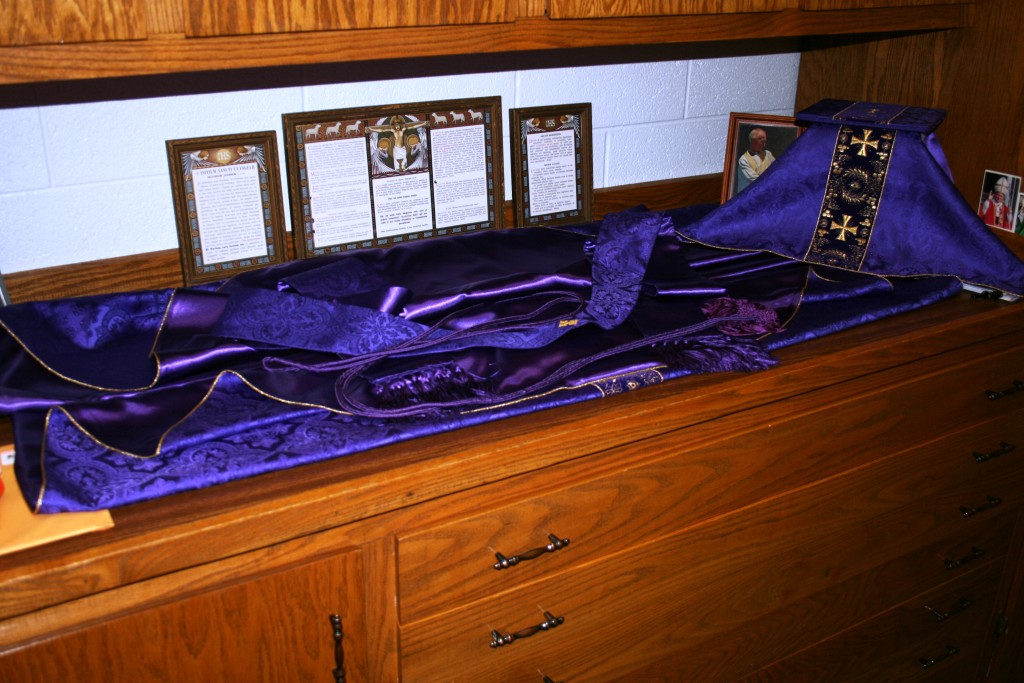 |
| Although they look a bit blue in this picture, this is the effect of night lighting and flash. See the tabernacle above for a better idea of the colour. |
The tabernacle veil is made from the same material. The vestments were purchased from House of Hansen with money donated by parishioners and include all the five parts: chasuble, stole, maniple, chalice veil and burse (these last three are not included in the price shown at the House of Hansen website). I shall use them in the Extraordinary Form for the first time this coming Thursday evening at 7pm. Parishioners have generously funded the purchase of new rose vestments which have been purchased from Luzar Vestments and red vestments which are now on order from House of Hansen. We have also received donations towards a new white set and these are now also on order from House of Hansen. Thank you to all our generous parishioners.
During this time of Advent, we consider the Mystery concealed within Mary and await - in silent conemplation - Its revelation.
I was struck by - and preached on - the orations (Collect, Prayer of the Offerings, Prayer after Communion) of today's Mass.
Prayer after Communion:
May these mysteries, O Lord,By what does the Lord teach us "to love the things of heaven"? By "these mysteries" or by our "walk amid passing things"? Probably the former, but the passing things of this world are also created by God and should lead us beyond them to the appreciation of the beauty of their Creator and Lord.
in which we have participated,
profit us, we pray,
for even now, as we walk amid passing things,
you teach us by them to love the things of heaven
and hold fast to what endures.
Through Christ our Lord.
Indeed, the sacraments, too, are "passing things". A time will come when there is no time and no sacraments. We will no longer see Christ veiled in the Eucharistic "vestments" of the appearances of bread and wine but we shall see Him "immediately", without the mediation of sense, sign or symbol. As ecstatic as our union with the Lord in Holy Communion can be, it is a mere foretaste of the heavenly union.
The new, more sacral language, also veils a mystery. If we now find some words of the Mass a little more difficult to "get" at first, this might indicate that perhaps the previous translation was not up to the mark in showing forth the mysterious nature of the Mass. If, now, we must exert ourselves in thinking and - preferably - contemplating in prayer, this is a grace given us by the Lord. As we prayed in the Collect today:
Grant your faithful, we pray, almighty God,We are called to "run forth" out of our comfort zone, out of our worldly way of seeing things, into the realm of mystery through prayer and contemplation. There are many "righteous deeds" that we can accumulate in readiness for the coming of the Father's Christ, but perhaps prayer and contemplation are the more important.
the resolve to run forth to meet your Christ
with righteous deeds at his coming...
Wishing everyone a blessed Advent.
Wednesday, June 1, 2011
Our Lady of Controversy
The Amazon website has become a bit like a blog in its comments concerning this book, the cover of which is a very offensive parody of Our Lady of Guadalupe as a rather butch looking woman in boxing gloves with her private parts covered by flowers. I haven't read the book so cannot comment on its contents but, along with one of the reviewers on Amazon's site, on this occasion it may be justifiable to judge a book by its cover.
Another reviewer writes: "As one lesbian writer says, 'it is our virgen too.'"
A number of people have closed their Amazon accounts in protest.
I shall renew my love for the Virgen of Guadalupe, the patroness of the Americas. Mother of the Civilisation of Love, Star of the New Evangelisation. Our Lady of Guadalupe is an image of femininity if ever there was one.
Another reviewer writes: "As one lesbian writer says, 'it is our virgen too.'"
A number of people have closed their Amazon accounts in protest.
I shall renew my love for the Virgen of Guadalupe, the patroness of the Americas. Mother of the Civilisation of Love, Star of the New Evangelisation. Our Lady of Guadalupe is an image of femininity if ever there was one.
Monday, May 30, 2011
Priests appointed to Our Lady of Good Help shrine, Champion, WI

The diocese of Green Bay, WI has recently announced that the Fathers of Mercy will assume pastoral care of the shrine of Our Lady of Good Help as from July 7th:
Two Fathers of Mercy from Auburn, Ky., will begin serving on July 7, 2011, at the Shrine of Our Lady of Good Help in Champion, Bishop David Ricken announced. One priest will serve as the Shrine's rector and the other as chaplain.Read more at the diocesan website.
The two priests will serve pilgrims to the Shrine by offering Masses, hearing confessions, and performing other priestly duties as needed.
Saturday, May 28, 2011
In praise of England

Who could fully tell the joy that has sprung up in the hearts of all the faithful because the race of the Angles, through the grace of Almight God and the labours of your brotherhood, has had the light of holy faith poured out on it and the darkness of error driven away? Now in purity of mind they trampmle down those idols which previously they served in insane fear. They worship Almighty God with pure hearts, and by the rules that they have learnt from the holy preaching they are restrained from falling into evil deeds. With their souls they serve the divine commandments and in their minds they are raised up by them. They bow down to the ground continually in prayers, that their minds may not lie prostrate on the earth. Whose work is this, if not the work of him who says: 'May father is working even now, and I am working'?
(From the letters of Pope St Gregory the Great, the Apostle of the English, presumably written to St Augustine of Canterbury, Liturgy of the Hours, Office of Readings 27th May)
Perhaps we need to pray that this may once again be the case.
Today I celebrated Mass in the Extraordinary Form. In that calendar today is the feast of St Augustine of Canterbury. I found the prayers of the Extroardinary Form very moving - reference to Augustine's preaching and miracles, prayers for those who have gone astray that they may be brought back to unity of faith, for sheep who have been lost that they may return to the true fold, all very appropriate for post-Reformation and post-Christian England - and thought how before the reform of the liturgy, these prayers were offered by the Universal Church as a 3rd class feast rather than the Optional Memorial that it now is. The whole Catholic Church was praying for England.
The Collect:
Deus, qui Anglorum gentes praedicatione et miraculis beati Augustini Confessoris tui atque Pontificis, verae fidei luce illustrare dignatus es: concede; ut, ipso interveniente, errantium corda ad veritatis tuae redeant unitatem, et nos in tua simus voluntate concordes. Per Dominum.
O God, who by the preaching and miracles of blessed Augustine, Thy confessor and bishop, dist vouchsage to enlighten the English nation with the light of the true faith; moved by his prayers, vouchsage that the hearts of those who have gone astray may return to the unity of Thy truth, and that we may ever be of one mind in doing Thy will. Through our Lord.
(Translation from the St Andrew Daily Missal)
The Secret:
Sacrificium tibi offerimus, Domine, in solemnitate beati Augustini Pontificis et Confessoris tui, humiliter deprecantes: ut oves, quae perierunt, ad unum ovile reversae, hoc salutari pabulo nutriantur. Per Dominum.
Very humbly, O Lord, on this fesival-day of blessed Augustine, Thy bishop and confessor, we offer up our sacrifice to Thee: beseeching that those sheep which have been lost, may once more be gathered into the one fold, and fed with this food of salvation. Through our Lord.
The Postcommunion:
Hostia salutari refecti: te, Domine, supplices exoramus; ut eadem, beati Augustini interveniente suffagio, in omni loco nomini tuo jugiter immoletur. Per Dominum.
We who are strengthened by this Victim of salvation, humbly beseech Thee, O Lord, that by the prayers of blessed Augustine, this sacrifice may be offered in every place to the glory of Thy name. Through...
The texts from the English Missal (Ordinary Form) read:
Opening Prayer:
Father, you sent Saint Augustine to be the first apostle to the people of England. May the work he began be renewed in his land and continue to prosper.
Prayer over the Gifts
Lord, accept the gifts we present to you in honour of Saint Augustine, whose life of innocence and simplicity converted many people to you.
Prayer after Communion
Lord, strengthen us by the sacrament we have received. Just as Saint Augustine perservered to the end in the fulfilment of his mission, so may we not falter in our work for Christian unity.
PRAYER FOR ENGLAND

O Blessed Virgin Mary, Mother of God and our most gentle Queen and Mother look down in mercy upon England, thy dowry, and upon us who greatly hope and trust in thee.
By thee it was that Jesus, our Saviour and our hope was given unto the world; and He has given thee to us that we might hope still more.
Plead for us thy children, whom thou didst receive and accept at the foot of the cross, O Sorrowful Mother, Intercede for our separated brethren, that with us in the one true fold, they may be united to the Chief Shepherd, the Vicar of thy Son.
Pray for us all, dear Mother, that by faith, fruitful in good works we may all deserve to see and praise God, together with thee in our heavenly home.
Monday, October 4, 2010
Do we hear their cry? Homily for Respect Life Sunday


‘O Lord, how long shall I cry for help and you will not hear? Or cry to you “Violence” and you will not save?’ These words from the prophet Habakkuk remind me of the documentary film ‘The Silent Scream’ which features the testimony of a former abortionist, Bernard Nathanson, who had performed thousands of abortions before realising the evil he had been committing. By means of ultrasound film, Nathanson demonstrates how the child in the womb recoils from the instruments that are used to pull it from its place of safety and destroy it. The film even shows the mouth of the unborn baby apparently screaming – a silent scream unheard outside the womb, a scream noiseless because of the fluids that still fill the developing lungs, a scream of pain and fear that cries for protection against the attack upon what should be its sacred sanctuary, the safest place for a child on the planet, its mother’s womb.
This ‘cry for help’ has been rising to heaven probably since the days sin first entered the world, but never so often and so intensely in the last fifty or so years when nation after nation has legalised the deliberate killing of its most vulnerable citizens.
The cover of this week’s UP Catholic shows 22,357 dots representing the number of abortions in Michigan last year. In the UK, the abortion capital of the world, some 600 babies are killed every day, over 6 million since the passing of the abortion act in 1967.
We know, of course, that God does hear the silent cry of the unborn. But, do we? A few weeks ago I saw some of the Band of Brothers series about the adventures of Easy Company in World War II. As they moved into a previously Nazi-occupied town, they discovered with horror a concentration camp in the forest outside the town. The troops could not believe that the townspeople did not know about the evil of this camp that was erected so near to the town. And, of course, they were right. The townspeople did know about the concentration camp but they chose to ignore it, not to see, not to hear. The troops rounded up all the townspeople, took them to the camp, and made them collect and bury the corpses of all the dead.
We have to be the ones who shout and make the silent scream of our murdered unborn brothers and sisters heard in our society. We have to use every available means to ensure that life – particularly the vulnerable lives of our unborn and elderly or less able neighbours – is respected.
At Westminster Hall in London a couple of weeks ago, speaking to politicians and to the opinion formers of British society, Pope Benedict said that the ‘overriding concern (of Catholic social teaching is) to safeguard the unique dignity of every human being, created in the image and likeness of God.’ He complimented the British Parliament’s role in achieving the abolition of the slave trade, the laws which achieved this abolition being ‘built upon firm ethical principles, rooted in the natural law.’ The Pope said how it was the ‘misuse of reason (that) gave rise to the slave trade’ with its lack of respect for the dignity of the human person. So, today, apparently reasonable people will condone or even promote abortion. They might even – like former British Prime Minister Tony Blair – say how much their Christian faith means to them while at the same time voting in favour of the legalised killing of our most defenceless brothers and sisters.
The forces of evil are very strong and the battle to preserve life might seem unwinnable. But Jesus tells us in today’s Gospel that just the smallest amount of faith – the size of a mustard seed – would enable us to uproot trees and to move mountains. Faith, of course, is shown in deeds. What deeds do you and I have to demonstrate our faith in the dignity and sanctity of human life?
Back in England I would regularly lead a prayer vigil outside an abortion facility not far from the parish organised by the Helpers of God’s Precious Infants. Not many would come – maybe ten or so people. Many Catholics have opted to be indifferent to the unborn and indifferent too to the plight of the women caught up in the culture of death. But we hoped that, by our prayers and presence, we would at least bear witness to the sanctity of life and maybe help some mothers to make a choice in favour of their unborn child. Indeed, I’m told that there were some ‘saves’ as a result of our presence. I hoped also that my involvement would make it easier for me at the final judgement. But I shall never forget the last prayer vigil I took part in earlier this year. After the vigil, I had to pass the abortion facility to return to my car. As I passed the entrance, a car pulled up a little further up the road and a young woman got out while her partner – husband or boyfriend – stayed in the car. She looked troubled, afraid and alone. Now, I didn’t know for certain whether or not she was going to the abortion facility, but I had my suspicions. After I had passed her I looked back, and sure enough she entered the abortion facility. It will always be on my conscience that I failed to offer my help, failed to show interest. She saw me – a priest – pass her by. She might even have been a Catholic. Why didn’t I offer to help?
We should not consider taking an active part in the defence of life something beyond the call of duty. Just as the servants in the Gospel today did not expect any particular thanks for having done their duty – ‘we are merely servants: we have done no more than our duty’ – neither should we think we are doing any more than our duty, or that we deserve any special praise. In fact, we can expect opprobrium and insult.
Statistically, it is very likely that there is one or more woman here at Mass today who has had an abortion. What does the Church say to them, to you? Here is what Pope John Paul II wrote in his 1995 Encyclical letter Evangelium Vitae (the Gospel of Life):
The Church is aware of the many factors which may have influenced your decision, and she does not doubt that in many cases it was a painful and even shattering decision. The wound in your heart may not yet have healed. Certainly what happened was and remains terribly wrong. But do not give in to discouragement and do not lose hope. Try rather to understand what happened and face it honestly. If you have not already done so, give yourselves over with humility and trust to repentance. The Father of mercies is ready to give you his forgiveness and his peace in the Sacrament of Reconciliation. You will come to understand that nothing is definitively lost and you will also be able to ask forgiveness from your child, who is now living in the Lord. With the friendly and expert help and advice of other people, and as a result of your own painful experience, you can be among the most eloquent defenders of everyone's right to life. Through your commitment to life, whether by accepting the birth of other children or by welcoming and caring for those most in need of someone to be close to them, you will become promoters of a new way of looking at human life.All Catholics should know that all involved in the direct procuring of an abortion are subject to the automatic penalty of excommunication. However, the sin of abortion can be forgiven in confession and every priest in this and many other dioceses has the faculty to remit the excommunication. There is no sin that cannot be forgiven. The Lord’s mercy knows no bounds and the Church wants all affected by abortion to know the power of the Lord’s mercy and forgiveness. The child is not the only victim of abortion. We should do all we can to support the other victims – especially the mothers – too.
Without getting into party politics, it can never be right to vote for a politician who we know will vote in favour of abortion or euthanasia. We must put our faith into action in the political sphere too. As Pope Benedict recalled in Hyde Park, London, Blessed John Henry Newman teaches that ‘there can be no separation between what we believe and the way we live our lives.’
‘Faith’, he said, even the size of a mustard seed, ‘is meant to bear fruit in the transformation of our world through the power of the Holy Spirit at work in the lives and activity of believers. No one who looks realistically at our world today could think that Christians can afford to go on with business as usual… Each of us has a mission, each of us is called to change the world, to work for a culture of life, a culture forged by love and respect for the dignity of each human person.’
In today’s parable, the servants say: ‘We are merely servants: we have done no more than our duty.’ On this ‘Respect Life Sunday’ let us ask the Lord through the intercession of Our Lady of Guadalupe, Patron of the Americas and the assumed patron of the pro-life cause to inspire us with the power of the Holy Spirit so that we will respond to our mission, to our calling, to change the world and to work for a culture of life which is, after all, ‘no more than our duty.’
Tweet
Wednesday, July 7, 2010
The Laity sometimes know more than theologians says Pope Benedict

They taught me love for the Divine Mercy which led me to facilitate their requests for the weekly public celebration of the Chaplet with a period of Exposition of the Blessed Sacrament, and to lead it myself. This enriched greatly my own spiritual life.
The commitment of some parishioners to a Legion of Mary prayer group and their perseverance in meeting in spite of the apparent lack of fruit was a time of rich sowing. Now they have started visiting families to say the Rosary, and the families have themselves asked to meet with other families in the church for Rosary. Last Monday, the evening before my departure, I was overjoyed to see a lovely group of families and young children who had gathered at church for this. This led all the more to the sadness I felt on leaving. But on the other hand I rejoiced to see this wonderful example of the lay apostolate.
It was also from lay people that I acquired a love for the Extraordinary Form of the Mass which I now celebrate as occasion provides.
These are just a few examples.
Pope Benedict spoke today about how Blessed Duns Scotus found the way to overcome the objections that theologians had to the doctrines of the Immaculate Conception and Assumption, even though the faithful had no problem accepting this teaching.
Zenit today informs us:
Regarding Scotus' pivotal role in understanding the Immaculate Conception, the Pope said this: "In Duns Scotus' times, the majority of theologians offered an objection that seemed insurmountable to the doctrine that Most Holy Mary was free from original sin from the first instant of her conception. In fact, the universality of the redemption wrought by Christ, at first glance, might seem compromised by such an affirmation, as if Mary had no need of Christ and of his redemption. Because of this theologians were opposed to this thesis."
The Pontiff recounted how Scotus developed an argument that Pope Pius IX would go on to use in 1854 when he solemnly defined the dogma.
"And this argument," Benedict XVI said, "is that of the 'preventive redemption,' according to which the Immaculate Conception represents the masterpiece of the redemption wrought by Christ, because in fact the power of his love and of his mediation obtained that the Mother be preserved from original sin. Hence Mary is totally redeemed by Christ, but already before her conception."
The Holy Father said that:
"faith in the Immaculate Conception or in the bodily assumption of the Virgin was already present in the People of God, while theology had not yet found the key to interpret it in the totality of the doctrine of the faith. Thus the People of God precede theologians and all this thanks to that supernatural 'sensus fidei,' namely, that capacity infused by the Holy Spirit, which qualifies us to embrace the reality of the faith, with humility of heart and mind.
"In this sense, the People of God is 'magisterium that precedes,' and that later must be deepened and intellectually accepted by theology."
He expressed his hope that theologians will always be able to
"listen to this source of faith and have the humility and simplicity of little ones!"
I'm sure there will some smart-aleck who will extend this interpretation to posit a church that only proclaims doctrines/teachings that are accepted by the laity. So they will say that since Humanae Vitae has not been accepted by a large majority of Catholics, Pope Paul's teaching cannot be considered dogmatic. Or they will refer to Newman's teaching on conscience and twist it to putting the authority of conscience above that of the authentic magisterium of the Church. But any faithful Catholic will know that this is not what the Pope means. For another characteristic that marks out the "little ones" of the lay faithful is their instinctive trust and confidence in and faithfullness to the teachings of the Pope.
Saturday, June 5, 2010
Poland Pilgrimage Day 2 - Czesthowa
On Tuesday 1st we visited Czestochowa. The journey was awful - road works just outside Krakow. Took us one hour to get of the city, and two hours for the rest of the journey. But we made it in good time for Mass. We were booked to join a larger American group led by a priest Missionary of Our Lady of La Salette. The group was from Louisiana and so, naturally, they prayed for the resolution of the oil disaster in the Gulf of Mexico. They also had with them a young priest ordained for just two years and his parents.
When we arrived, the image of Our Lady was still covered. The daily unveiling took place at 1.30pm, just before the Mass. Our pilgrims said they found the unveiling, with the trumpet fanfare, an incredibly moving experience, as the face of Our Lady and the Child were gradually revealed. Our Lady's face has a rather haunting appearance.
Here's a photo of the covered image before Mass.
 I'm afraid that, since I was concelebrating at the Mass, I have no photos of the uncovering, but hope you will be satisfied with this pic I took when I was there in February this year.

In the following picture you can see the sash that Pope John Paul II was wearing when he was shot on 13th May 1981:

Father Simon, one of the Pauline priests, gave us a brief guided tour. He is a charming man, named after the apostle Simon.
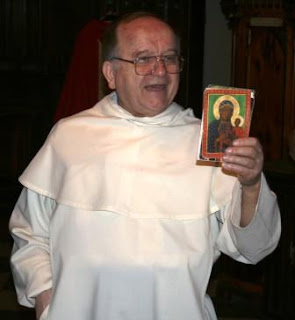 In the cloister of the monastery there are altars set up for Mass. They are in the open although sheltered from rain by the cloister, and people tend to just walk past. Nonetheless, it was edifying to see priests saying their Masses.

When we arrived, the image of Our Lady was still covered. The daily unveiling took place at 1.30pm, just before the Mass. Our pilgrims said they found the unveiling, with the trumpet fanfare, an incredibly moving experience, as the face of Our Lady and the Child were gradually revealed. Our Lady's face has a rather haunting appearance.
Here's a photo of the covered image before Mass.


In the following picture you can see the sash that Pope John Paul II was wearing when he was shot on 13th May 1981:

Father Simon, one of the Pauline priests, gave us a brief guided tour. He is a charming man, named after the apostle Simon.


Thursday, May 13, 2010
Our Lady of Fatima

Pope Benedict is in Fatima right now. When he arrived in Portugal on Tuesday, he said:
I come as a pilgrim to Our Lady of Fatima invested from on high with the mission of confirming my brothers and sisters as they advance on their own pilgrimage towards heaven.In an interview with the Press on his flight to Portugal, referring to the current scandals afflicting the Church the Pope said the greatest threat to the Church comes not from without but from within. He also identified himself as a suffering Pope.
The Virgin Mary came from heaven to remind us of the truths of the Gospel which for humankind - lacking in love and without hope of salvation - represent a source of hope... The relationship with God is a constituent part of man who was created and ordained for God, who seeks for truth within his own cognitive structures, who tends towards good in the sphere of volition, and who is attracted by beauty in the aesthetic dimension.
A conscience may be described as Christian in the measure to which it is open to the fullness of the life and wisdom we have in Jesus Christ. The aim of this visit, which I am now beginning under the sign of hope, is to be a proposal of wisdom and of mission.
Apart from the great vision of the Pope's suffering, which we can primarily ascribe to Pope John Paul II", said Pope Benedict, the apparitions "indicate events of the future of the Church, which develop and are revealed little by little. Thus it is true that, apart from the moment indicated by the vision, we see the need for a passion of the Church, a passion naturally reflected in the person of the Pope, but the Pope stands for the Church and thus it is the sufferings of the Church that are being announced.The Vatican is updating its coverage of the Pope's visit here.
As for the novelties we can discover in this message today, we may see that attacks against the Pope and the Church do not only come from outside; rather, the sufferings of the Church come from inside the Church, from the sin that exists in the Church. This was always common knowledge, but today we see it in truly terrifying form: the greatest persecution of the Church does not come from external enemies, but is born of sin within the Church. Thus the Church has a profound need to relearn penance, to accept purification, to learn forgiveness but also the need for justice. Forgiveness does not replace justice.
Wednesday, April 14, 2010
Medjugorje Commission will carry out its work 'with the utmost reserve'

"The International Investigative Commission on Medjugorje met for its first session on 26 March 2010."This will be a very important step in clarifying the supernatural or otherwise phenomena that are taking place at Medjugorje. I have been there once on a free trip for clergy courtesy of Medjugorje Peace Tours. The people in the group I joined were fine upstanding Catholics, very loyal to the Church. I also had the privilege of making my confession to the late Father Slavko. I was also impressed by the testimonies of the "visionaries" Ivan Dragicevic and Vicka Ivankovic-Mijatovic.
"The Commission, presided over by Cardinal Camillo Ruini, His Holiness' vicar general emeritus for the diocese of Rome, is composed of the following members: Cardinal Jozef Tomko, prefect emeritus of the Congregation for the Evangelisation of Peoples; Cardinal Vinko Puljic, Archbishop of Vrhbosna, president of the Bishops' Conference of Bosnia-Herzegovina; Cardinal Josip Bozanic, Archbishop of Zagreb and vice-president of the Council of European Bishops' Conference; Cardinal Julian Herranz, president emeritus of the Pontifical Council for Legislative Texts; Archbishop Angelo Amato, S.D.B., prefect of the Congregation for the Causes of Saints; Msgr. Tony Anatrella, psychoanalyst and specialist in Social Psychiatry; Msgr. Pierangelo Sequeri, professor of Fundamental Theology at the Theological Faculty of Northern Italy; Fr. David Maria Jaeger, O.F.M., consultant to the Pontifical Council for Legislative Texts; Fr. Zdzislaw Jozef Kijas, O.F.M. Conv., relator of the Congregation for the Causes of Saints; Fr. Salvatore M. Perrella, O.S.M., teacher of Mariology at the Pontifical Marianum Faculty of Theology; and Fr. Achim Schutz, professor of Theological Anthropology at the Pontifical Lateran University as secretary. Msgr. Krzysztof Nykiel, an officer of the Congregation for the Doctrine of the Faith serves as additional secretary."
"Other experts have also participated in the commission's work: Fr. Franjo Topic, professor of Fundamental Theology in Sarajevo; Fr. Mijo Nikic, S.J., professor of Psychology and Psychology of Religion at the Philosophical and Theological Institute of the Society of Jesus in Zagreb, Fr. Mihaly Szentmartoni, S.J., professor of Spirituality at the Pontifical Gregorian University, and Sr. Veronica Nela Gaspar, professor of Theology at Rijeka."
"As announced previously, the work of the Commission will be carried out with the utmost reserve. Its conclusions will be submitted to the Congregation of the Doctrine of the Faith for study."
The work of the Cenacolo community in helping drug addicts to recover was most impressive. So a lot of good has come to the Church through Medjugorje. Nevertheless it is important that the various doubts that exist be clarified, not least for the sake of unity. The long-running dispute between the Franciscans at the parish and the diocesan bishop needs to be resolved.
Sunday, April 11, 2010
Day with Mary - Easter Saturday
Yesterday the Day with Mary was held at our parish church. Many visitors from London and elsewhere came, and I was pleased that a number of our parishioners attended too. It was a wonderful day of prayer and devotion in honour of the Virgin Mary.
Father Selvam Sahaya, a Salesian priest from Madras, was present for the day and gave a sermon in the afternoon, helped with confessions, and led the Blessed Sacrament Procession.
At the request of the organisers, Mass was celebrated in the Extaordinary Form of the Roman Rite with the Franciscan Sisters of the Immaculate performing the chant. Two Friars of the Immaculate, Brothers Leonard and Peter Damian (Eymard), were also present and helped in the liturgies. I was very pleased that a number of our young servers volunteered to serve at the Mass.
Many visitors commented on the beauty of our church and the celebration of the liturgy.
Here's a slide show of the some of the day.
Father Selvam Sahaya, a Salesian priest from Madras, was present for the day and gave a sermon in the afternoon, helped with confessions, and led the Blessed Sacrament Procession.
At the request of the organisers, Mass was celebrated in the Extaordinary Form of the Roman Rite with the Franciscan Sisters of the Immaculate performing the chant. Two Friars of the Immaculate, Brothers Leonard and Peter Damian (Eymard), were also present and helped in the liturgies. I was very pleased that a number of our young servers volunteered to serve at the Mass.
Many visitors commented on the beauty of our church and the celebration of the liturgy.
Here's a slide show of the some of the day.
Saturday, March 27, 2010
Our Lady of Sorrows in Malta

Monday, September 21, 2009
Rosary Crusade of Reparation, 10th October

The 25th Annual National Rosary Crusade of Reparation takes place on Saturday 10th October. This year it will be led by Mgr Emmanuel-Marie de St Jean, Abbot of Sainte-Marie de Lagrasse, France.
Assemble by 1.45pm outside Westminster Cathedral. Procession to Brompton Oratory. Ends about 5.00pm. (There is an anticipated Mass of Sunday at Brompton Oratory at 6.00pm.)
See some great postings on previous years' Crusades at Fr Timothy Finigan's blog.
Mgr Lagrasse's visit has been organised by a newly-founded English Charity, The Friends of the Canonical Abbey of Lagrasse.

I have been reminded by John Eidinow, chairman of the Trustees of the Friends, that I posted some photos on flickr of Father Abbot's Solemn Pontifical Mass at Merton in 2008.
The Abbot will be accompanied by the Sub-prior, Père Augustin-Marie de la Trinité, and his programme is as follows:
Saturday, 10th October, 2009
- 11.45am: Celebrates Mass in the usus antiquior in the Crypt Chapel of Westminster Cathedral, by kind permission of the Canon Administrator.
- 1.45pm: Leads the Rosary Crusade of Reparation through the streets of London from Westminster Cathedral to the London Oratory, by kind invitation of the organisers. At the London Oratory he will give Pontifical Benediction of the Blessed Sacrament.
Sunday, 11th October, 2009,
- 9.00am: Celebrates the regular usus antiquior Mass at the London Oratory, by kind invitation of the Fathers, and hopes to be able to meet members of the congregation after Mass.
Subscribe to:
Posts (Atom)
LinkWithin
