Oremus pro Antistite nostro Alexandro. Stet et pascat in fortitudine tua, Domine, in sublimitate nominis tui. (Let us pray for our Bishop Alexander. May he stand firm and shepherd his flock by Your strength, O Lord, in the majesty of Your name.)
Showing posts with label Latin Mass. Show all posts
Saturday, July 21, 2012
Bishop Sample ordains deacons and subdeacons
Bishop Sample (the Bishop of Marquette where I am currently serving) recently ordained deacons and subdeacons for the Institute of Christ the King Sovereign Priest in Florence. Many wonderful photographs can be seen the the Institute's website.
Bishop Sample has a facebook page where you can keep up with his teachings and activities. On that page he also draws our attention to this CNS video on The Call of Beauty, an interview with Cardinal Burke in which he speaks of the strong sense of the transcendent in the Extraordinary Form of the Mass.
Labels:
Bishop Alexander Sample,
Holy Orders,
Latin Mass,
Liturgy,
Tradition,
Vocations
Thursday, May 17, 2012
The Paschal Candle is extinguished
Even the Low Mass of Ascension that we celebrated here this evening had its little bit of drama as the paschal candle was extinguished immediately after the Gospel. It seems eminently logical to do so and I cannot quite understand why this was changed.
As with many things that used to take place during the Liturgy (e.g. the unveiling of the statues and images during the Easter Vigil), the paschal candle is now extinguised after the Mass on Pentecost Sunday. As it was lit with great solemnity at the Easter Vigil, should a certain solemnity not surround its extinguishing?
Jesus, the Light, has gone. Yes, I know that, as an early father wrote, as He came to earth without leaving heaven, so He returns to heaven without leaving earth. Yet, symbolically, the extinguishing of the paschal candle during the Mass somehow helps us visualise and be present at the Lord's ascent into the clouds. We experience "sacramentally" the departure of the Lord as the apostles themselves did.
As one fire - which began in the form of a huge fire outside our churches in the night of Easter - is extinguished, so we await the coming of a new Fire as the apostles and the whole Church are baptised in the Spirit at Pentecost.
The time between Ascension and Pentecost is a time of waiting.
Come, Holy Spirit...
As with many things that used to take place during the Liturgy (e.g. the unveiling of the statues and images during the Easter Vigil), the paschal candle is now extinguised after the Mass on Pentecost Sunday. As it was lit with great solemnity at the Easter Vigil, should a certain solemnity not surround its extinguishing?
Jesus, the Light, has gone. Yes, I know that, as an early father wrote, as He came to earth without leaving heaven, so He returns to heaven without leaving earth. Yet, symbolically, the extinguishing of the paschal candle during the Mass somehow helps us visualise and be present at the Lord's ascent into the clouds. We experience "sacramentally" the departure of the Lord as the apostles themselves did.
As one fire - which began in the form of a huge fire outside our churches in the night of Easter - is extinguished, so we await the coming of a new Fire as the apostles and the whole Church are baptised in the Spirit at Pentecost.
The time between Ascension and Pentecost is a time of waiting.
Come, Holy Spirit...
Friday, February 17, 2012
Baptism of Logan Michael Tregembo
Congratulations to Sarah and Dan Tregembo on the baptism last Sunday of their little son Logan Michael. The baptism was celebrated according to the Extaordinary Form of the Roman Rite.
Monday, February 6, 2012
Bishop of Miami celebrates Candlemas in the Extraordinary Form
Archbishop Thomas Wenski, the Archbishop of Miami, celebrated Candlemas (The Purification of Our Lady or Presentation of the Lord) on February 2nd in the Extraordinary Form of the Roman Rite. I feel that this is the only form of the feast's celebration that really brings to light (no pun intended) the splendour and significance of this feast as the Virgin Mary bears her divine Son, the Light of the World, into the temple forty days after His birth. Nearly 75 priests and seminarians took part in the liturgy, as well as the assembled congregation. The Archbishop's homily is here and the diocese's report on the Mass is here.
Thursday, February 2, 2012
Candlemas Extaordinary Form Mass at St Anthony, Gwinn
We had a good attendance. Thanks to Matthew, a regular attendee at EF Masses, who did the chanting solo. Thanks to servers who did a good job. The weather permitted a brief excursion out of the church for the procession. And thanks to one of our parishioners for the photos.
Thursday, December 1, 2011
Extraordinary Form of the Mass at Gwinn - and a request
![]() |
| Bishop Sample celebrating Mass in the Extraordinary Form at St Peter Cathedral |
My intention is to celebrate this form of the Mass on the evenings of my day off, Thursday, and maybe on other occasions if the faithful request it.
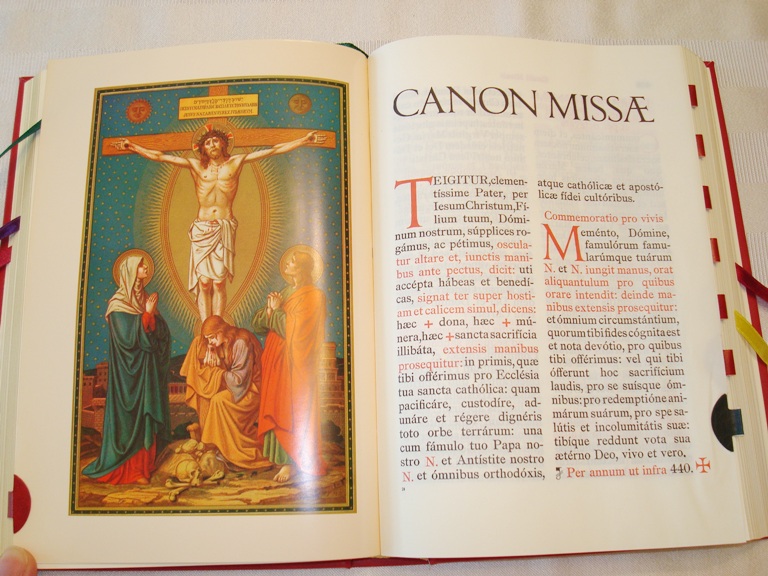
This evening I celebrated with my small travel edition of the Missale Romanum which I brought with me from England and which you can find reviewed by Fr Z.
Whilst I don't mind celebrating with this Missal privately - it is a very worthy publication - for a public Mass it has its drawbacks. I did not notice any damage to the tabs as Fr Z did but the glue binding the tabs to the page also binds pages to pages, so that one has to use two hands to carefully separate the pages during the celebration of Mass. This evening I slightly tore one of the pages of the Canon. Also, I now notice my age: my sight is not as good as it was and I found myself struggling with the smaller print.
So, I need to buy a new Missal.
I could get the 1962 Missal published with the approval of the late Cardinal O'Connor. The lowest price I have found it available for is $110.00 (s/h included) from Roman Catholic Books or $99.99 plus $12.25 s/h from Fraternity Publications i.e. the Priestly Fraternity of St Peter (FSSP). This is the Missal I bought for (and donated to) my previous parish in South Ashford, England. My verdict on this Missal is that is quite adequate - it does the job and would be fine.However, there is a much nicer one: a 2008 reprint of the well-known and beautiful Benziger Brothers Missal approved by the late Cardinal Spelman, with ad libitum prefaces that were approved in July 1962, including a restored Advent preface, and Masses approved for use in the dioceses of the USA.
Fr Z reviews it here.
The lowest price I have found it available for is $320.00 plus $17.00 s/h from Preserving Christian Publications. The website of Biretta Books gives further details, including examples of the beautful type setting and artwork (far superior to the O'Connor Missal above) shown below:
My question: would anyone like to help me get either of these Missals for the parish? See About Me if you would like to email me.
Monday, October 24, 2011
Bishop Alexander Sample on the Orientation of the Sacred Liturgy
Bishop Sample preached this homily during the celebration of the Extraordinary Form Mass at St Peter Cathedral Marquette on September 4th.
Labels:
Bishop Alexander Sample,
Latin Mass,
Liturgy,
Mass,
Tradition
Monday, October 3, 2011
New Personal Parish for the Traditional Mass and Sacraments
From Rorate Caeli:
America is fast becoming the nation of Personal Parishes for the Traditional Roman Mass and Sacraments. This Sunday, the creation a new Personal Parish, to be established by the Ordinary of Fort Wayne-South Bend, was announced - a decision of Bishop Kevin Rhoades, as foreseen by Summorum Pontificum, art. 10. As reported by D. Werling, the existing Sacred Heart parish will cease being a territorial parish and is to become a personal parish for those attached to the "Extraordinary Form of the Roman Rite" in Fort Wayne, Indiana (with its former territory attached to that of another territorial parish).The parish will be administered by the Priestly Fraternity of St Peter (FSSP).
Sunday, August 28, 2011
Excellent series on Tradition and the Missals of Pius V and Paul VI
John Hunwicke (Fr Hunwicke's Liturgical Notes), a former anglican clergyman now hoping for ordination as a priest in the Ordinariate of Our Lady of Walsingham and a liturgical scholar has written a great series of posts on "Ratzinger and Liturgical Law." He explainst that the Pope is the servant of Tradition, that a form of Liturgy that has had centuries of usage simply cannot be abrogated by the Pope, and so he explains how Pope Benedict XVI was able to say that the Missal of Pius V (as modified by Pope John XXIII in 1962) was not abrogated by Pope Paul VI.
Even if you are not a liturgical scholar yourself, I urge you to read carefully these excellent articles (and don't worry about the Latin):
Ratzinger on Liturgical Law (1)
Ratzinger on Liturgical Law (2)
Ratzinger on Liturgical Law (3)
Ratzinger on Liturgical Law (4)
Ratzinger on Liturgical Law (5)
And do keep John in your prayers.
Even if you are not a liturgical scholar yourself, I urge you to read carefully these excellent articles (and don't worry about the Latin):
Ratzinger on Liturgical Law (1)
Ratzinger on Liturgical Law (2)
Ratzinger on Liturgical Law (3)
Ratzinger on Liturgical Law (4)
Ratzinger on Liturgical Law (5)
And do keep John in your prayers.
Monday, August 8, 2011
Mutual Enrichment of the Ordinary Form at Father Charles Briggs' Silver Jubilee
From the Southwark Archdiocese website (reproduced here in full since it is not possible to link to individual posts):
Father Charles Briggs, Parish Priest of Saint Mary's, Chislehurst, and the diocesan Archivist, celebrated twenty-five years as a priest on Tuesday, 2nd August 2011, with a High Mass of Thanksgiving at St Mary's.
Father Charles with Archbishop Kevin, clergy and servers after his
Jubilee Mass
Father Charles was assisted by Father Timothy Finigan as deacon and Deacon John Harrison as subdeacon. Archbishop Kevn, who gave the homily, was among the large number of clergy from the diocese and beyond who were present. Eight servers competently served the High Mass, which was in the Extraordinary Form of the Roman Rite. At the end of Mass a Solemn Te Deum was sung in thanksgiving.
Note: Ordinary Form Mass with deacons and concelebrating priest, deacons raising the chasuble as the celebrant elevates the Host. Mass ad orientem. (My comment.)
And from the Archivist's personal archive:
Father Charles offered a further Mass on Saturday, 6th August, when he was joined, among others, by Provost Joseph Collins and Father Philip Glandfield
Father Charles is ordained by Bishop John Jukes in August 1986
Labels:
Latin Mass,
Liturgy,
Mass,
Priesthood,
Priests,
Tradition
Sunday, June 5, 2011
Priests' Training Course in Extraordinary Form USA 12-16 September
From Fr Z, I have found this information about a forthcoming training course offered by the Priestly Fraternity of St Peter (FSSP) 12th - 16th September at Our Lady of Guadalupe Shrine, Denton, Nebraska. This appears to be a Low Mass training seminar.
Details here.
I would heartily recommend any priest remotely interested in learning the Extraordinary Form to attend such a training seminar. I attended one organised by the Latin Mass Society in Oxford, England a number of years ago. The fraternity alone was well worth it and, although I am now fairly proficient at Low Mass and Missa Cantata, it is this - and the interest in visiting the Our Lady of Guadalupe Seminary - that would tempt me to attend this one...
Saturday, May 28, 2011
In praise of England
Who could fully tell the joy that has sprung up in the hearts of all the faithful because the race of the Angles, through the grace of Almight God and the labours of your brotherhood, has had the light of holy faith poured out on it and the darkness of error driven away? Now in purity of mind they trampmle down those idols which previously they served in insane fear. They worship Almighty God with pure hearts, and by the rules that they have learnt from the holy preaching they are restrained from falling into evil deeds. With their souls they serve the divine commandments and in their minds they are raised up by them. They bow down to the ground continually in prayers, that their minds may not lie prostrate on the earth. Whose work is this, if not the work of him who says: 'May father is working even now, and I am working'?
(From the letters of Pope St Gregory the Great, the Apostle of the English, presumably written to St Augustine of Canterbury, Liturgy of the Hours, Office of Readings 27th May)
Perhaps we need to pray that this may once again be the case.
Today I celebrated Mass in the Extraordinary Form. In that calendar today is the feast of St Augustine of Canterbury. I found the prayers of the Extroardinary Form very moving - reference to Augustine's preaching and miracles, prayers for those who have gone astray that they may be brought back to unity of faith, for sheep who have been lost that they may return to the true fold, all very appropriate for post-Reformation and post-Christian England - and thought how before the reform of the liturgy, these prayers were offered by the Universal Church as a 3rd class feast rather than the Optional Memorial that it now is. The whole Catholic Church was praying for England.
The Collect:
Deus, qui Anglorum gentes praedicatione et miraculis beati Augustini Confessoris tui atque Pontificis, verae fidei luce illustrare dignatus es: concede; ut, ipso interveniente, errantium corda ad veritatis tuae redeant unitatem, et nos in tua simus voluntate concordes. Per Dominum.
O God, who by the preaching and miracles of blessed Augustine, Thy confessor and bishop, dist vouchsage to enlighten the English nation with the light of the true faith; moved by his prayers, vouchsage that the hearts of those who have gone astray may return to the unity of Thy truth, and that we may ever be of one mind in doing Thy will. Through our Lord.
(Translation from the St Andrew Daily Missal)
The Secret:
Sacrificium tibi offerimus, Domine, in solemnitate beati Augustini Pontificis et Confessoris tui, humiliter deprecantes: ut oves, quae perierunt, ad unum ovile reversae, hoc salutari pabulo nutriantur. Per Dominum.
Very humbly, O Lord, on this fesival-day of blessed Augustine, Thy bishop and confessor, we offer up our sacrifice to Thee: beseeching that those sheep which have been lost, may once more be gathered into the one fold, and fed with this food of salvation. Through our Lord.
The Postcommunion:
Hostia salutari refecti: te, Domine, supplices exoramus; ut eadem, beati Augustini interveniente suffagio, in omni loco nomini tuo jugiter immoletur. Per Dominum.
We who are strengthened by this Victim of salvation, humbly beseech Thee, O Lord, that by the prayers of blessed Augustine, this sacrifice may be offered in every place to the glory of Thy name. Through...
The texts from the English Missal (Ordinary Form) read:
Opening Prayer:
Father, you sent Saint Augustine to be the first apostle to the people of England. May the work he began be renewed in his land and continue to prosper.
Prayer over the Gifts
Lord, accept the gifts we present to you in honour of Saint Augustine, whose life of innocence and simplicity converted many people to you.
Prayer after Communion
Lord, strengthen us by the sacrament we have received. Just as Saint Augustine perservered to the end in the fulfilment of his mission, so may we not falter in our work for Christian unity.
PRAYER FOR ENGLAND
O Blessed Virgin Mary, Mother of God and our most gentle Queen and Mother look down in mercy upon England, thy dowry, and upon us who greatly hope and trust in thee.
By thee it was that Jesus, our Saviour and our hope was given unto the world; and He has given thee to us that we might hope still more.
Plead for us thy children, whom thou didst receive and accept at the foot of the cross, O Sorrowful Mother, Intercede for our separated brethren, that with us in the one true fold, they may be united to the Chief Shepherd, the Vicar of thy Son.
Pray for us all, dear Mother, that by faith, fruitful in good works we may all deserve to see and praise God, together with thee in our heavenly home.
Sunday, May 15, 2011
Usus Antiquior celebrated in St Peter's Basilica
The Extraordinary Form of the Roman Rite was celebrated at the Altar of the Chair today at St Peter's Basilica. It just happened to conclude a conference on Summorum Pontificum, which just happened to coincide with the publication of the Instruction Universae Ecclesiae.
You will find lots of pictures at Orbis Catholicus together with this youtube video:
In the mind of "modernisers" this probably just should not be happening. And yet future generations eventually find that which is truly theirs. See the many young relgious clerics in the procession!
The Church has a bright future ahead of it and this celebration shows in action what Universae Ecclesiae stated: the ordinary and extraordinary forms of the Roman Rite "are two usages of the one Roman Rite, one alongside the other." (no. 6)
On a related matter, Fr Z is conducting a survey of seminarians as to which form they would prefer to be ordained in, ordinary or extraordinary. At the current time there is a clear majority in favour of ordination in the extraordinary form, which possibility is not permitted under Universae Ecclesiae. But this too could change.
What is wrong with these young people???
Saturday, May 14, 2011
Off on vacation tomorrow!
Will be taking my post-Easter break tomorrow afternoon, heading to Green Bay, WI, to spend a couple of nights with a priest friend and visiting the shrine of Our Lady of Good Help and then to Chicago for a couple of nights. So I was mighty pleased to find Fr Ray Blake's post about St John Cantius parish in Chicago. Fr Ray in turn links to Fr Simon Henry who writes the Offerimus Tibi Domine blog.
Here's a video about the restoration of the Church:
Fr Henry describes the transformation that has occurred since the Fathers and Brothers of the Canons Regular took over:
Fr Frank Phillips took over a failing church and parish in downtown Chicago in 1988 when there were only 40 families attending Mass and has transformed the parish into an active and thriving community with a Mass attendance of 2,500 and in 1998 formed a community following the rule of St Augustine of 26 priests and brothers.Fr Blake posits this as a model for the "new evangelism".
Mass is offered in both forms with the Novus Ordo in both Latin and English. Fr Phillips believes that a concern with celebrating the liturgy beautifully and in full conformity with the rubrics of the Church is important and his conviction certainly seems to have borne much fruit. The community pray the Divine Office in full and certainly the community members I met were very impressive, dedicated, young and serious about the Religious Life - but not stuffy or lacking a sense of humour.
Friday, May 13, 2011
One priest's reason to be grateful for Universae Ecclesiae
Catholic News Agency writes today about Glasgow priest Father Stephen Dunn's experience and his reasons for being grateful that the 1962 Mass is fully part of the life of the Church:Father Stephen Dunn had a very personal reason for wanting to learn the Tridentine Mass.And that public celebration in St Peter's will be very significant. Will the Pope do so one day? It would be a very powerful message to send to the whole Church. Given sufficient notice, I shouldn't be surprised if it might need to be celebrated outside!
“My father, who attends the Tridentine Mass every Sunday, has stipulated in his will that he is to be buried to the Tridentine Mass and no other Mass. So as his only son who’s a priest I hated to think I couldn’t bury my father through incompetence and lack of knowledge of the traditional Mass of the Church.”
So when Pope Benedict XVI called for a more generous provision of the Tridentine Mass in his 2007 document “Summorum Pontificum” Fr. Dunn thought the time had finally come to learn the traditional liturgy. Hence the priest from Glasgow, Scotland, quickly signed up for a course in Oxford, England, organized by the Latin Mass Society.
Crucially “Summorum Pontificum” lifted the requirement upon priests to receive episcopal approval before saying the old Mass. However, Fr. Dunn explained, soon all the priests in Glasgow received a four page advisory document drafted by the chancellor of the archdiocese, Monsignor Peter Smith.
Fr. Dunn said the advisory note seemed to interpret the Pope’s instructions in a way that effectively turned many of them on their head. In fact, the renowned blogger Fr. John Zuhlsdorf described the advisory document’s interpretation of “Summorum Pontificum” as the “coldest, most hostile I have read so far.”
“There were three Glasgow priests signed up to the course in Oxford. After that note came round, two dropped out. They felt really intimidated. My own response, though, was to stick it out and attend.
“Archbishop Vincent Nichols of Westminster said the first Mass. [Comment: he did so in the novus ordo] When I told him I was from the Archdiocese of Glasgow he said, ‘My goodness, you’re a brave boy’.”
That’s why Fr. Dunn welcomes today’s official clarification from the Vatican as to how “Summorum Pontificum” should be authentically interpreted and applied. So much so that he’s traveled to Rome for its publication and to attend the first traditional liturgy celebrated at the high altar of St Peters Basilica since 1969.
The Mass will take place this weekend.
“It’s really great. The fact that Rome is being so clear and precise about what the document really means. There now has to be obedience on all sides. It gives me great cause for hope and I pray by the grace of the Holy Spirit and through the intercession of Our Lady that Pope Benedict and his advisors are firm in applying this to bishops around the world and don’t accept any wavering.”
There are now only two parishes in Glasgow offering the Tridentine Mass but Fr. Dunn says that five other priests are now learning how to say the traditional liturgy.
Meanwhile, the Mass at St. Peter’s Basilica will be offered this Sunday morning by Cardinal Antonio Canizares Llovera, the prefect of the Congregation for Divine Worship.
"The Missal of Blessed John XXIII is our secure foundation, our doctrinal certainty, our beacon of light and faith in the dark night of Holy Mother Church."
This is the claim made by Leo Darroch, Executive President of Una Voce, in a talk given in Poland on 9th April. His talk, which can be found here, is all the more worth reading in the light of today's promulgation of the Instruction Universae Ecclesiae by the Pontifical Commission Ecclesia Dei.
Darroch suggests that the root cause of the crisis in the liturgical reform was the appointment of a Consilium to interpret the mind of the Fathers of Vatican II, removing this responsibility from the Congregation for Rites, the dicastery of the curia responsible for the regulation of the Sacred Liturgy. Darroch claims:
Despite the fact that the Consilium was merely an advisory body, it is now clear that the leading members had their own agenda and were given the freedom to impose their own ideas of the faith on to an unsuspecting Church at the time.Whereas the Council voted for a moderate revision of the liturgical books, what resulted were
such spectacular changes that the public worship, in the new form of Mass, was unrecognisable to that which it replaced.The problems were spotted very early on. Already in 1964 the Latin Mass Society had been formed in England and Wales in response to the concerns felt by members of the laity.
Darroch writes that, on 3rd September 1969, five months after the promulgation of the Apostolic Constitution Missale Romanum which introduced the new form of Mass, Cardinal Ottaviani, fromer pro-Prefect of the Congregation for the Doctrine of the Faith, and Cardinal Bacci, a leading Latin expert, took it upon themselves to warn Pope Paul VI:
To abandon a liturgical tradition which for four centuries was sign and pledge of unity of worship and to replace it with another which can only stand for division, given the endless licence it implicitly authorises and which teems with oblique attacks and downright errors against the integrity of the Catholic faith, can only be described – in the most restrained terms – as a mistake likely to have incalculable consequences.In a talk given by Cardinal Ratzinger in October 1988, His Eminence said:
Were one to shun these essential rules and put to one side the normae generales which one finds in numbers 34 – 36 of the Constitution De Sacra Liturgia (SL), in that case one would indeed be guilty of disobedience to the Council.Did he think such disobedience had been committed? Here are those numbers of Sacrosanctum Concilium:
Wherefore, in the revision of the liturgy, the following general norms should be observed:Were these norms to have been observed, I don't think there would have been the dramatic change in the liturgy that in fact resulted.
34. The rites should be distinguished by a noble simplicity; they should be short, clear, and unencumbered by useless repetitions; they should be within the people's powers of comprehension, and normally should not require much explanation.
35. That the intimate connection between words and rites may be apparent in the liturgy:
1) In sacred celebrations there is to be more reading from holy scripture, and it is to be more varied and suitable.
2) Because the sermon is part of the liturgical service, the best place for it is to be indicated even in the rubrics, as far as the nature of the rite will allow; the ministry of preaching is to be fulfilled with exactitude and fidelity. The sermon, moreover, should draw its content mainly from scriptural and liturgical sources, and its character should be that of a proclamation of God's wonderful works in the history of salvation, the mystery of Christ, ever made present and active within us, especially in the celebration of the liturgy.
3) Instruction which is more explicitly liturgical should also be given in a variety of ways; if necessary, short directives to be spoken by the priest or proper minister should be provided within the rites themselves. But they should occur only at the more suitable moments, and be in prescribed or similar words.
4) Bible services should be encouraged, especially on the vigils of the more solemn feasts, on some weekdays in Advent and Lent, and on Sundays and feast days. They are particularly to be commended in places where no priest is available; when this is so, a deacon or some other person authorized by the bishop should preside over the celebration.
36. 1. Particular law remaining in force, the use of the Latin language is to be preserved in the Latin rites.
2. But since the use of the mother tongue, whether in the Mass, the administration of the sacraments, or other parts of the liturgy, frequently may be of great advantage to the people, the limits of its employment may be extended. This will apply in the first place to the readings and directives, and to some of the prayers and chants, according to the regulations on this matter to be laid down separately in subsequent chapters.
3. These norms being observed, it is for the competent territorial ecclesiastical authority mentioned in Art. 22, 2, to decide whether, and to what extent, the vernacular language is to be used; their decrees are to be approved, that is, confirmed, by the Apostolic See. And, whenever it seems to be called for, this authority is to consult with bishops of neighboring regions which have the same language.
4. Translations from the Latin text into the mother tongue intended for use in the liturgy must be approved by the competent territorial ecclesiastical authority mentioned above.
One of the Consilium members who was unhappy with what was going on in the revision of the Mass was Father (later Cardinal) Ferdinando Antonelli. He kept a journal and, in 1967, wrote about the lack of concern for true piety amongst the Consilium members:
No one has any longer an awareness of the sacred and binding character of liturgical law. The work of desacralization, which is now called secularization, continues on a grand scale. It is clear from this that the liturgical question is part of a far bigger set of problems, which are fundamentally doctrinal, so the big crisis is the crisis of traditional doctrine and the magisterium.Fr Antonelli also wrote:
[they] have no love, no veneration for what has been transmitted to us. [My emphasis.] Right from the start they despise everything which exists at present. This is an unjust and poisonous negative mentality. Unfortunately, even Pope Paul VI has something of this attitude. They all have the best of intentions, but, given this mentality, they are bound to demolish, not to restore.Later in his paper, Darroch speaks about Una Voce's work in securing the retention by the older form of the liturgy of its full right of citizenship in the Church, two forms of the Roman Rite on an equal footing. This goal has clearly been secured by the promulgation today of Universae Ecclesiae.
Back in 1970, the first president of Una Voce, Dr Eric de Saventhem foresaw a renaissance that is now occurring with the flowering of new movements, congregations, fraternities, orders of young people giving themselves to a radical dedication to the Lord inspired by the treasure of a truly sacred liturgy.
The desire of the members of the International Federation Una Voce are summed up toward the end of the paper as follows:
For the International Federation Una Voce, the Missal of 1962, of Blessed John XXIII, is our secure foundation, our doctrinal certainty, our beacon of light and faith in the dark night of Holy Mother Church. The members of the Federation all over the world wish to attend Mass according to this venerable and ancient usage; untouched, and without modification or adaptation unless authorised by the Supreme Legislator. [Comment: and the Supreme Legislator will be authorising modifications and adaptations such as new Prefaces, the inclusion of new Saints, etc. See Universae Ecclesiae 25. He already authorised a change in the Good Friday prayer for the Jewish people.] Our concern is for the Catholic faith, for the supremacy of Peter, and to ensure that the faith of our forebears is handed down in its fullness to our children and grandchildren. The pearl of great price is one that we wish to hand on to our successors in the way that it has been handed down to us. It is this Missal that will undoubtedly be the remedy for the crisis in the Church.This is an excellent paper. I hope that what I have quoted above will lead you to want to read it for yourself.
Vatican Instruction Universae Ecclesiae
This instruction, published today (feast of Our Lady of Fatima) by the Pontifical Commission Ecclesia Dei and dated on the memorial of Pope Saint Pius V (the Pope of the implementation of the Council of Trent), will already have been commented on elsewhere and I haven’t yet read those comments. Here is what I am picking up as I read through it.
The full text of the Instruction can be found here.
1. The Apostolic Letter Summorum Pontificum of the Sovereign Pontiff Benedict XVI given Motu Proprio on 7 July 2007, which came into effect on 14 September 2007, has made the richness of the Roman Liturgy more accessible to the Universal Church.The re-introduction of the usus antiquior is therefore good for the WHOLE Church. There is a richness in the Roman Liturgy which is not accessible in the Mass of Paul VI alone.
3. The Holy Father, having recalled the concern of the Sovereign Pontiffs in caring for the Sacred Liturgy and in their recognition of liturgical books, reaffirms the traditional principle, recognised from time immemorial and necessary to be maintained into the future, that "each particular Church must be in accord with the universal Church not only regarding the doctrine of the faith and sacramental signs, but also as to the usages universally handed down by apostolic and unbroken tradition. These are to be maintained not only so that errors may be avoided, but also so that the faith may be passed on in its integrity, since the Church's rule of prayer (lex orandi) corresponds to her rule of belief (lex credendi)."Liturgy is a vessel for the handing on of the faith from one generation to the next. We mess with it at our peril. According to St Vincent of Lerins (+445) the test of revealed and apostolic doctrine is “quod semper, quod ubique, quod ab omnibus” (that which has been held always, everywhere and by all).
6. The Roman Missal promulgated by Pope Paul VI and the last edition prepared under Pope John XXIII, are two forms of the Roman Liturgy, defined respectively as ordinaria and extraordinaria: they are two usages of the one Roman Rite, one alongside the other. Both are the expression of the same lex orandi of the Church. On account of its venerable and ancient use, the forma extraordinaria is to be maintained with appropriate honor.The two forms of the Roman Rite are intimately connected with one another. Perhaps as beasts of burden yoked together both must pull in the same direction: towards God. But the more ancient use must be held in honour. No Catholic should therefore despise the older form. As the Instruction reminds us (n.7):
Among the statements of the Holy Father was the following: "There is no contradiction between the two editions of the Roman Missal. In the history of the Liturgy growth and progress are found, but not a rupture. What was sacred for prior generations, remains sacred and great for us as well, and cannot be suddenly prohibited altogether or even judged harmful."And a reminder of the reasons Pope Benedict had for promulgating Summorum Pontificum (n.8):
a.) offering to all the faithful the Roman Liturgy in the Usus Antiquior, considered as a precious treasure to be preserved;The Instruction contains “Specific Norms”. The first of these (n.13) reminds the Bishops of their responsibility to implement Summorum Pontificum in accordance with the mens legislatoris (the “mind” of the Holy Father) as clearly expressed in the Motu Proprio. In other words, in the case of any doubt, a Bishop must ask himself: what does the Holy Father desire?
b.) effectively guaranteeing and ensuring the use of the forma extraordinaria for all who ask for it, given that the use of the 1962 Roman Liturgy is a faculty generously granted for the good of the faithful and therefore is to be interpreted in a sense favourable to the faithful who are its principal addressees;
c.) promoting reconciliation at the heart of the Church.
Bishops must also promote respect for the Extraordinary Form.
14. It is the task of the Diocesan Bishop to undertake all necessary measures to ensure respect for the forma extraordinaria of the Roman Rite, according to the Motu Proprio Summorum Pontificum.He could consider:
- celebrating it himself
- arranging for it to be celebrated in his cathedral
- if he is unable or unwilling to celebrate it himself, he could demonstrate the honour and respect due to the older usage by his gracious presence at its celebration.
15. A coetus fidelium ("group of the faithful") can be said to be stabiliter existens ("existing in a stable manner"), according to the sense of art. 5 § 1 of the Motu Proprio Summorum Pontificum, when it is constituted by some people of an individual parish who, even after the publication of the Motu Proprio, come together by reason of their veneration for the Liturgy in the Usus Antiquior, and who ask that it might be celebrated in the parish church or in an oratory or chapel; such a coetus ("group") can also be composed of persons coming from different parishes or dioceses, who gather together in a specific parish church or in an oratory or chapel for this purpose.Nos. 16-18 make it clear that priests and faithful who arrive at a church or oratory requesting the possibility of celebrating Mass in the extraordinary form should be received in a spirit of pastoral zeal and of generous welcome by the pastor or rector of the church who must always permit the requested celebration with due respect to the already established schedule of liturgical celebrations.
16. In the case of a priest who presents himself occasionally in a parish church or an oratory with some faithful, and wishes to celebrate in the forma extraordinaria, as foreseen by articles 2 and 4 of the Motu Proprio Summorum Pontificum, the pastor or rector of the church, or the priest responsible, is to permit such a celebration, while respecting the schedule of liturgical celebrations in that same church.And who is “a qualified priest”?
17. § 1. In deciding individual cases, the pastor or the rector, or the priest responsible for a church, is to be guided by his own prudence, motivated by pastoral zeal and a spirit of generous welcome.
§ 2. In cases of groups which are quite small, they may approach the Ordinary of the place to identify a church in which these faithful may be able to come together for such celebrations, in order to ensure easier participation and a more worthy celebration of the Holy Mass.
18. Even in sanctuaries and places of pilgrimage the possibility to celebrate in the forma extraordinaria is to be offered to groups of pilgrims who request it (cf. Motu Proprio Summorum Pontificum, art. 5 § 3), if there is a qualified priest.
20 a.) Every Catholic priest who is not impeded by Canon Law is to be considered idoneus ("qualified") for the celebration of the Holy Mass in the forma extraordinaria.Hurrah! At last it has been said!
Must he be fluent in Latin?
b.) Regarding the use of the Latin language, a basic knowledge is necessary, allowing the priest to pronounce the words correctly and understand their meaning.No! The ability to pronounce and understand is all that is necessary. The prayers and readings of the older usage have a style that one quickly gets used to. I find that if I carefully read over the texts in Latin and English before the Mass, I am then able to understand what I am praying during the Mass. And surely a priest should do this anyway: to prayerfully meditate on the texts of the Mass before celebrating it is bound to increase his own reverence and attention, and possibly make up for any lack of attention or distraction that may befall him during the Mass.
Training in the celebration of the extraordinary form:
21. Ordinaries are asked to offer their clergy the possibility of acquiring adequate preparation for celebrations in the forma extraordinaria. This applies also to Seminaries, where future priests should be given proper formation, including study of Latin and, where pastoral needs suggest it, the opportunity to learn the forma extraordinaria of the Roman Rite.
Archbishop Nichols of Westminster is reported by the Catholic Herald as saying:
“Personally I don’t think it needs to be added to an already crowded seminary programme because it’s a skill that can be learned later in a priest’s life.”
Dumbing Universae Ecclesiae down a bit? The Catholic Herald has opened a debate: Should England's seminaries teach the Extraordinary Form?
No qualified priest in the diocese?
22. In Dioceses without qualified priests, Diocesan Bishops can request assistance from priests of the Institutes erected by the Pontifical Commission Ecclesia Dei, either to the celebrate the forma extraordinaria or to teach others how to celebrate it.Institutes such as the Priestly Fraternity St Peter (FSSP) or the Instutite of Christ the King Sovereign Priest can be called upon to celebrate the Mass or to assist in training priests of the diocese to do so.
Although the Liturgical Books of the extraordinary form are to be followed without modification, new saints and prefaces are going to be included:
25. New saints and certain of the new prefaces can and ought to be inserted into the 1962 Missal, according to provisions which will be indicated subsequently.We must await these provisions. This was already indicated in Summorum Pontificum. and in the letter of Pope Benedict to the Bishops of the world concerning the re-introduction of the older usage.
The Scripture readings may be proclaimed in the vernacular in the following way:
- at Low Mass: either solely in Latin, solely in the vernacular, or in Latin followed by the vernacular;
- at “higher” forms of celebration: either solely in Latin, or in Latin followed by the vernacular. It would not be illicit to proclaim the readings solely in the vernacular at the more solemn celebrations.
26. As foreseen by article 6 of the Motu Proprio Summorum Pontificum, the readings of the Holy Mass of the Missal of 1962 can be proclaimed either solely in the Latin language, or in Latin followed by the vernacular or, in Low Masses, solely in the vernacular.Which Liturgical laws apply? The Code of Canon Law 1983 is to be observed. But all liturgical law promulgated since 1962 which is incompatible with the rubrics of the liturgical books in effect in 1962 is derogated:
27. With regard to the disciplinary norms connected to celebration, the ecclesiastical discipline contained in the Code of Canon Law of 1983 applies.So the Eucharistic fast is one hour; one may receive Holy Communion a second time in the same day; one fulfils the Sunday obligation by attending Mass in the evening of the Vigil, etc. etc. But Holy Communion is not to be given under both kinds; Holy Communion is to be received on the tongue; girls are not permitted to serve Mass.
28. Furthermore, by virtue of its character of special law, within its own area, the Motu Proprio Summorum Pontificum derogates from those provisions of law, connected with the sacred Rites, promulgated from 1962 onwards and incompatible with the rubrics of the liturgical books in effect in 1962.
Confirmation
29. Permission to use the older formula for the rite of Confirmation was confirmed by the Motu Proprio Summorum Pontificum (cf. art. 9 § 2). Therefore, in the forma extraordinaria, it is not necessary to use the newer formula of Pope Paul VI as found in the Ordo Confirmationis.The faculty to confirm is very easily given to priests these days. I wonder if this is the intention in this Instruction or should Confirmation still be reserved to the bishop except for the most extreme cases? I remember an occasion in my previous parish when a couple of older people would have liked to have been confirmed in the extraordinary form. I had duly received faculties but, burdened by scruple, I took the opportunity to consult an official of Ecclesia Dei who informed me that this was not the mind of the Church and that the people concerned should be asked to accept Confirmation in the ordinary form, which they graciously did.
Holy Orders
The use of the extraordinary form is restricted:
31. Only in Institutes of Consecrated Life and Societies of Apostolic Life which are under the Pontifical Commission Ecclesia Dei, and in those which use the liturgical books of the forma extraordinaria, is the use of the Pontificale Romanum of 1962 for the conferral of minor and major orders permitted.So no seminarian not belonging to one of these communities may request ordination in the extraordinary form.
These are some of the things I have considered worth noting.
Father Z comments here, and is keeping an uptodate list of other comments here.
CNS reports here.
New Liturgical Movement here.
National Catholic Register.
Labels:
Benedict XVI,
Canon Law,
Latin Mass,
Liturgy,
Mass,
Pope,
Tradition
Wednesday, May 11, 2011
Vatican to publish Instruction on Extraordinary Form of the Mass
The Vatican Information Services has today announced that on Wednesday May 13th there will be published the Instruction Universae Ecclesiae of the Pontifical Commission Ecclesia Dei on the application of the Apostolic Letter given Motu Proprio Summorum Pontificum of His Holiness Benedict XVI. The Instruction will be published in the afternoon edition of Osservatore Romano and dated 14th May.
The Instruction will also be accompanied by an accompanying Note
On Monday May 16th the Congregation for the Doctrine of the Faith's Circular Letter to assist the Episcopal Conferences in preparing cases that deal with the sexual abuse of minors by clerics. It will also be accompanied by an accompanying Note.
As a Canonist friend of mine has said: it promises to be an interesting few days for media relations.
The Instruction will also be accompanied by an accompanying Note
On Monday May 16th the Congregation for the Doctrine of the Faith's Circular Letter to assist the Episcopal Conferences in preparing cases that deal with the sexual abuse of minors by clerics. It will also be accompanied by an accompanying Note.
As a Canonist friend of mine has said: it promises to be an interesting few days for media relations.
Wednesday, April 20, 2011
Historic celebration at York Minster
The Catholic Herald reports that
Over 700 Catholics converged on York Minster on Saturday March 26 to attend the first celebration of a Catholic Mass according to the Extraordinary Form in the Minster.
Read more here.
For readers here in the USA, there are two provinces of the Church of England: Canterbury and York. York Minster is the Cathedral of the Archbishop of York.
Tuesday, March 29, 2011
Catholic Heritage Association in Ireland
Am very happy to provide a link to St Conleth's Catholic Heritage Association whose aims are:
- 1: To work as a lay Catholic movement for an organic restoration of the Liturgy in conformity with its nature and with the Latin tradition.
- 2: To ensure that the traditional Roman Catholic Mass as codified in the Missale Romanum edited by Pope John XXIII in 1962 is maintained both in practice and in law as one of the forms of Eucharistic celebration, which are recognized and honoured, in universal liturgical life.
- 3: To obtain freedom of use for all other Roman liturgical books enshrining previous liturgical disciplinary forms of the Latin tradition.
- 4: To safeguard and promote the use of Latin, Gregorian chant and sacred polyphony in the Holy Roman Catholic Church.
- 5: To encourage the establishment of non-territorial parishes and or chaplainces in which only the liturgical books used in 1962 are employed.
- 6: To serve the Church by helping the members of the movement and through their apostolate all the Christifideles better to understand and more fully participate in the Catholic liturgy as a sacred action.
Subscribe to:
Posts (Atom)