Showing posts with label St Joseph. Show all posts

Tuesday, May 24, 2011

National Shrine of St Joseph, De Pere, Wisconsin


On a recent post-Easter vacation which took in Green Bay and Chicago, I visited the National Shrine of St Joseph which is at St Norbert's Abbey in De Pere, Wisconsin, not far from Green Bay. The abbey is set in beautiful grounds. The National Shrine is beneath the abbey church and is quite small. The shrine was recognised as the National Shrine by Pope Leo XIII in 1892.


I was struck by the beauty of the crowned statue. If Jesus is truly God, then Joseph bore - and bears - God in his holy arms. If Christ is the Head of the Church, Joseph is truly the Protector of the Church for he bears our Head in the safety of his arms. If the Church is the Mystical Body of Christ, and the Head and members are one, then Joseph also bears the Church - the Body of Christ - in his arms.

And as the Holy Joseph of Israel was in charge of the grain and Pharoah directed the hungry people to "go to Joseph", so too must we "go to Joseph" to obtain the Bread of Life whom he bears for us.

In this image, St Joseph is also shown as king.

My friend Father John Doerfler and I were the only ones in the crypt shrine. The quiet atmosphere and the beauty of this sculpture led easily to contemplation and simple theological thoughts.

Memorare of St Joseph

Remember, O most illustrious Patriarch Saint Joseph,
never has it been heard that anyone who asked for your protection
or sought your intercession was left unaided.
In this confidence, I come before you,
my loving protector, chaste Spouse of Mary;
foster father of the Saviour and dispenser of the treasures of His Sacred Heart.
Despise not my earnest prayer but graciously hear and obtain my petition...

O God Who by Your providence
chose Blessed Joseph for the spouse of Your Most Holy Mother,
grant, I ask, that he whom we venerate as our protector on earth
may be our intercessor in Heaven. Amen.

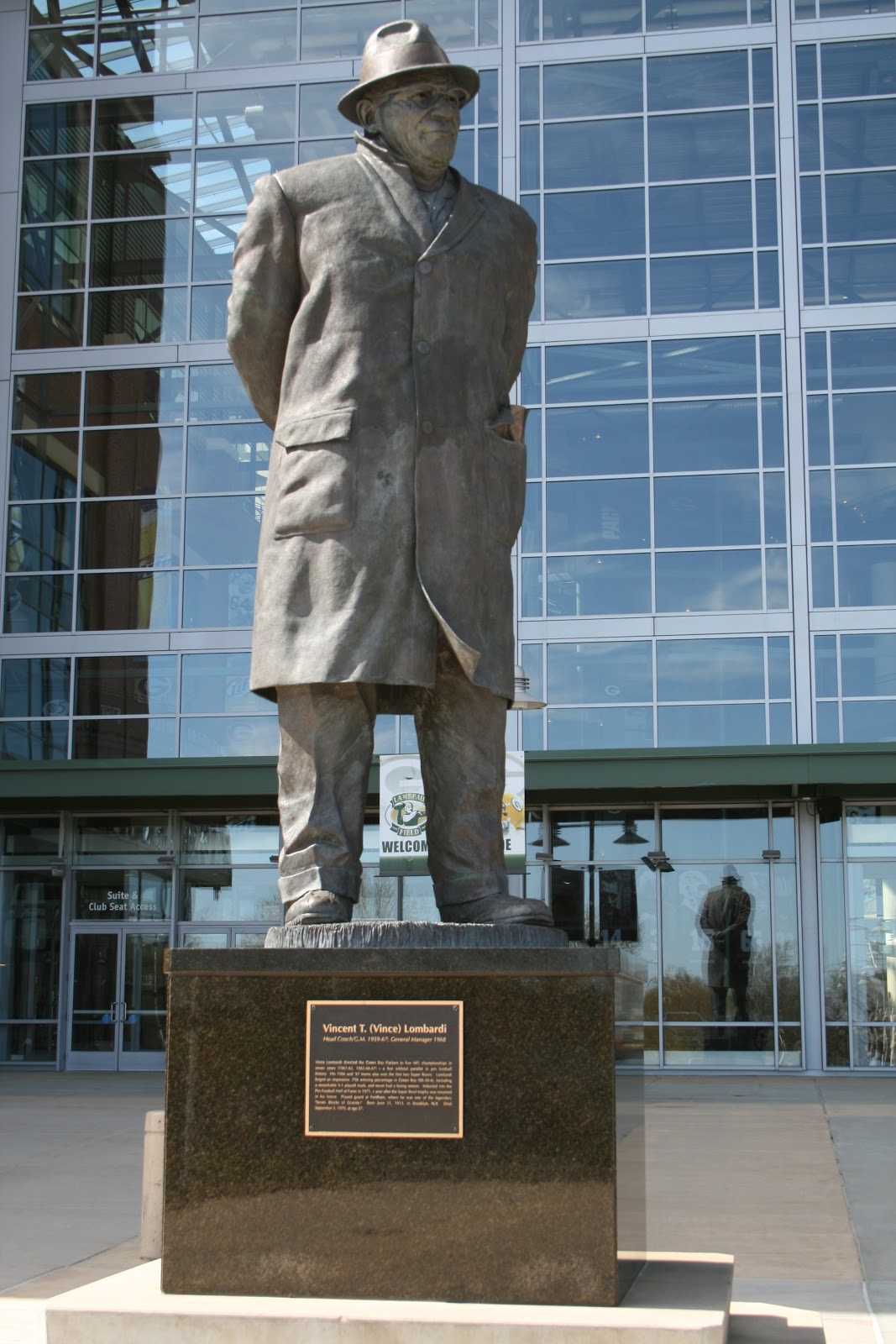
I should say that this was not the first "shrine" we visited. This was:


Vince Lombardi was the legendary 1960's coach
of the Packers. Under his watch they won
the first two Super Bowls in 1966 and 1967. He was
also a practising Catholic and attended Mass at
the Cathedral Church of St Francis Xavier.

Earl Louis (Curly) Lambeau (1898 - 1965) was
founder, player, and first coach of the Packers.

Wednesday, May 4, 2011

Easter Triduum Polish style

My friend Father Piotr Kaczmarek sent me some pictures from St Joseph's parish in Ursus, Warsaw.

After the Holy Thursday Mass, the Blessed Sacrament is taken to a special place (there is normally a tabernacle also - we would refer to it as an Altar of Repose):

After the Good Friday liturgy the Blessed Sacrament is taken to the Sepulchre and set alongside the image of the dead Christ with special decorations


Adoration continues until midnight:


Confessions are heard until the last person has made his/her confession (this year until 11:35 p.m.) Adoration continues all day Saturday.

I was quite surprised when I heard about this custom but Fr Piotr assures me that the exposition/adoration of the Blessed Sacrament in this way is not forbidden in Poland. On the contrary it is a very well-known and widespread custom. People are praying waiting for the Resurection and contemplating the Passion of Our Lord.

On Saturday at 20:00 the Easter Vigil commences:

On Easter Sunday morning there was a special Resurrexit procession. The Cardinal Archbishop of Warsaw participated.

After the Triduum they replaced the sepulchre with a replica of Pope John Paul's coffin in anticipation of his forthcoming beatification.


It's always fascinating to appreciate different traditions.

Before the Protestant Reformation in England there used always to be an Easter Sepulchre built into the side of the churches and a Sacred Host was buried there after the Good Friday liturgy until the Easter Vigil. Here's a typical example from St Owswald's Church in Ashbourne, Derbyshire:

Sunday, March 27, 2011

Spiritual adoption of the unborn and Sisters of Mary Mother of the Eucharist


Today the parish launced its Spirital Adoption of the Unborn to coincide with the period of Our Lord's gestation in the womb of His Virgin Mother. Parishioners were invited to adopt an unborn baby - naming it if they wished (I have named mine James, the name my mother gave to a child she miscarried) - and to pray Archbishop Fulton Sheen's the prayer of spiritual adoption each day.


The prayer runs as follows:
Jesus, Mary and Joseph. I love you very much. I beg you to spare the life of the unborn child whom I have spiritually adopted and who is in danger of an abortion.
Here are some of our young parishioners pictured with postulants of the Dominican Sisters of Mary Mother of the Eucharist who were visiting Marquette this weekend.


The sisters with pastor Msgr Michael Steber and our own Sisters of Saint Paul of Chartes:


And...

No caption needed!

Saturday, March 19, 2011

40 days for life on St Joseph's feast

A great response this morning, with three of the above having travelled from Escanaba!

[UPDATE]: Jennifer Heikkila (she's in the picture above) writes up her experiences: What it's like to take a stand.

There was also a small group this afternoon.

Vigils will resume Monday.

Update to previous post: some of the above people thought they heard something metallic thrown from the passing car. Today they found a metal coat hanger shaped into an aborting device. What was the message: "we kill babies"? Or  "do you want to go back to back-street abortions"? I don't know. Either way it was pretty distasteful.

St Joseph can teach us men how to be more in awe of the mystery that each woman holds within her body.

Tuesday, January 4, 2011

Couple of jokes - home schoolers and sex ed


The following via a friend from Catholic-pages.com.

Sts Dominic, Francis and Ignatius of Loyola are transported back in time and place to the Birth of Our Lord. St Dominic, seeing the Incarnation of the Word, is sent into ecstasy. St Francis, seeing God become a helpless child, is overcome with humility. St Ignatius of Loyola takes St Joseph and Our Lady aside and asks "Have you given any thought to His education?"

And this, longer, and funny but serious too....
School Sex Ed

I was holding a notice from my 13-year-old son's school announcing a meeting to preview the new course in sexuality. Parents could examine the curriculum and take part in an actual lesson presented exactly as it would be given to the students.

When I arrived at the school, I was surprised to discover only about a dozen parents there. As we waited for the presentation, I thumbed through page after page of instructions in the prevention of pregnancy or disease. I found abstinence mentioned only in passing. When the teacher arrived with the school nurse, she asked if there were any questions. I asked why abstinence did not play a noticeable part in the material.

What happened next was shocking.

There was a great deal of laughter, and someone suggested that if I thought abstinence had any merit, I should go back to burying my head in the sand. The teacher and the nurse said nothing as I drowned in a sea of embarrassment. My mind had gone blank, and I could think of nothing to say. The teacher explained to me that the job of the school was to teach "facts," and the home was responsible for moral training. I sat in silence for the next 20 minutes as the course was explained. The other parents seemed to give their unqualified support to the materials.

"Donuts, at the back," announced the teacher during the break. "I'd like you to put on the name tags we have prepared-they're right by the donuts-and mingle with the other parents."

Everyone moved to the back of the room.

As I watched them affixing their name tags and shaking hands, I sat deep in thought. I was ashamed that I had not been able to convince them to include a serious discussion of abstinence in the materials. I uttered a silent prayer for guidance.

My thoughts were interrupted by the teacher's hand on my shoulder. "Won't you join the others, Mrs. Layton?" The nurse smiled sweetly at me. "The donuts are good." "Thank you, no," I replied.

"Well, then, how about a name tag? I'm sure the others would like to meet you." "Somehow I doubt that," I replied.

"Won't you please join them?" she coaxed. "I'll just wait here," I said.

When the class was called back to order, the teacher looked around the long table and thanked everyone for putting on name tags. She ignored me.

Then she said, "Now we're going to give you the same lesson we'll be giving your children. Everyone please peel off your name tags." I watched in silence as the tags came off. "Now, then, on the back of one of the tags, I drew a tiny flower. Who has it, please?"

The gentleman across from me held it up. "Here it is!" "All right," she said.

"The flower represents disease. Do you recall with whom you shook hands?" He pointed to a couple of people. "Very good," she replied. "The handshake in this case represents intimacy. So the two people you had contact with now have the disease." There was laughter and joking among the parents.

The teacher continued, "And whom did the two of you shake hands with?"

The point was well taken, and she explained how this lesson would show students how quickly disease is spread. "Since we all shook hands, we all have the disease."

"Speak now, I thought, "but be humble."

I noted wryly the latter admonition, then rose from my chair. I apologized for any upset I might have caused earlier, congratulated the teacher on an excellent lesson that would impress the youth, and concluded by saying I had only one small point I wished to make.

"Not all of us were infected," I said. "One of us ... abstained."

Tuesday, December 28, 2010

St Joseph: just man, model for the men of today.


A number of people said they found my homily on St Joseph on the Fourth Sunday of Advent helpful. I did not have it properly written out but preached from notes. Here is an attempted reconstruction.
_______________________________________________
The Church's Advent liturgy prepares us by stages for the feast of Christmas. The First Sunday of Advent presents us with the second coming of Christ. We are to be watchful and prayerful and prepared for when the Lord comes again, awaiting him in joyful hope. On the Second and Third Sundays, we hear about John the Baptist and his cry to prepare a way for the Lord.

On the Fourth Sunday the Church directs our thoughts to Our Lady. The prayers of the Mass refer to her and the Gospel Acclamation and Communion Antiphons both refer to the prophecy that a maiden is with child whom she will call Emmanuel. In Years B and C the Gospel is taken from Luke who dwells on the Annunication (Year B) and the Visitation (Year C). In Year A, however, the Gospel comes from Matthew who directs our attention much more to the 'dilemma' that Joseph faced.

The Entrance Antiphon of today's Mass says: "Let the clouds rain down the just one, and the earth bring forth a Saviour." (Is45:8)

Naturally this prophecy refers to the Just One who is Christ the Saviour. And yet other just ones are sent by Providence to lead and inspire us. Joseph was such a just man and Matthew describes him precisely as a just man. What is it to be a just man? The Catechism of the Catholic Church defines justice as

A cardinal moral virtue that consists in the constant and firm will to give their due to God and neighbour.

The Catechism continues:

The just man, often mentioned in Sacred Scripture, is distinguished by habitual right thinking and the uprightness of his conduct toward his neighbour.


So we can expect that all these strengths, these virtues, would be found in St Joseph.

The Fathers discuss Joseph's dilemma, many of them facing up to the fact that he might have considered the possibility that Mary had somehow been unfaithful and that therefore he must separate from her. Others conclude that Joseph was well aware of the holiness of his bride and that he considered himself unworthy of being involved in such a wonderful event as the incarnation. And that this was why he decided to separate from Mary.

Let us examine the question of 'shame' that Matthew refers to: that Joseph did not wish to expose his betrothed to shame.

To have divorced Mary formally would have put her to shame. She would have been publicly accused of infidelity. Because of his delicate love and esteem for his bride and his "habitual right thinking and the uprightness of his conduct toward his neighbour" (Cathechism) Joseph could not contemplate such an action.

However, by putting Mary away informally, without going through proper courts, no apparent ground for his separation from Mary would have been proven. Society might consider that he had abandoned his wife and he would incur the shame of being thought of as unmanly, disloyal. Joseph chose to risk taking the shame upon himself rather than allow his bride to be exposed to such a risk.

Joseph knew about Mary's promise of virginity. But a young girl could not live alone. On a human level, Mary's parents would have been concerned to find for their daughter a husband who would be the custodian of her chastity. In this readiness of Joseph to accept this role, we see a manly Joseph in whom the parents of Mary had full confidence, who would protect his young bride, who was able to love his wife with the utmost purity.

Joseph was also a man who was attentive to the voice of God in discerning how to behave in challenging circumstances. Seeing the workings of God in Mary, Joseph was bound to wonder and even worry. This often happens when one sees God working in others. Sometimes it arouses jealousy or confusion. In Evelyn Waugh's Brideshead Revisited, Charles Ryder, the atheist agnostic, never fails to ridicule Lady Julia Flyte's Catholic beliefs that never leave her in spite of the fact that she has not managed to live fully in accord with them. In the end Julia calls for Charles to stop his unceasing mockery and she decides that they cannot remain together and marry as both have been previously married. The story ends with Charles embracing the Catholic faith.

Similarly, in Rome Sweet Home, Scott and Kimberley Hahn describe their conversion to Catholicism. At one point, Kimberley becomes jealous as Scott, still a protestant, disappears from the house to say his rosary. The love of this other woman Mary provokes a kind of envy in Kimberley. It is however Kimberley who becomes a Catholic first and Scott follows.

In his dream, Joseph learns that the child Mary is carrying is of the Holy Spirit and that the natural desire for fatherhood that he had renounced would be fulfilled by a real - albeit adoptive - fatherhood. He must name the child. And finally that he should have no fear in taking Mary to himself.

We men have much to learn from St Joseph. We need to be more like him, just men: giving what is due to God and neighbour; distinguished by habitual right thinking and uprightness of conduct towards our neighbour.

We are blessed here in the parish by the wonderful example of so many married men who are strong for their wives and children: chaste - treating their wives in accordance with their dignity; protective and nurturing; who give a great example of living faith to their children.

But some women have not been fortunate to meet a man like St Joseph: wives have been abandoned by their husbands; some women have placed their trust in a man only to find he was not truly a man, leaving them hurt and betrayed, sometimes even leaving them with a child, or perhaps planning for the deliberate killing of the child that is his too.

And some of these women might still be looking for a just man like St Joseph.

In my pastoral experience, there has been more than one single woman in a parish who perhaps has gone with a man and it has all come to tears and the woman is left with a child. And by her own admission she either will never trust a man again, or considers herself a fallen woman whom no self-respecting man will come near. I have often prayed: if only a good man in the parish would accept her and her child. It could make a man out of him! He could be a true Joseph to that woman and child.

We have much to learn from this wonderful man, St Joseph. Not one of his words is recorded in the Gospel. He is known simply as "the husband of Mary - of whom was born Jesus who is called Christ" and he was set over the Holy Family.

St Joseph is also set over the Church and over each one of our parish families. May he help us in our preparations to be one with Mary and with the child she bears in her womb.

Friday, December 24, 2010

Like a young man marrying a virgin, so will the one who built you wed you

The Christmas Crib in the gather area of St Peter Cathedral, Marquette

GK Chesterton was a prolific English writer and a famous convert from Anglicanism to the Catholic faith whose life spanned the 19th and 20th centuries. In his book “The Everlasting Man” he presents a whole view of world history as informed by the Incarnation. Beginning with the origin of man and the various religious attitudes throughout history, Chesterton shows how the fulfillment of all of man’s desires takes place in the person of Jesus Christ and in Christ’s Church.

Christianity, he says, is no myth, nor can it be compared with any other religion for, unlike other religions, it unites the world of the spiritual with the material, without confusing the two. It unites Creator and creature. Creator and creature are no longer separated but made one.

He speaks of the first men who, it is supposed, lived in caves. These cavemen painted images of creatures and scenes of nature on the walls of their caves. And at the dawn of the re-creation of humanity, the New Man dwelt in a cave at Bethlehem. Much is made of the stable and the manger, but tradition tells us that the nativity of Christ took place in one of the many hillside caves near Bethlehem where shepherds used to shelter. You can visit these caves today. The one where Jesus was born has a huge Church built over it and you must descend below ground, to the crypt, to visit it.

Chesterton describes how a homeless couple crept underground among animals to find a place to shelter. It was in the cellar, on the very floor of the world, where the Savior Christ was to be born. Christ was born not only on the level of the world but below the level of the world, on a dark and sunken stage rather than on a stage visible to the world.

So God becomes a caveman. But the pictures he drew of mankind made in God’s image and likeness came to life again, unlike the images painted by the original cavemen that remained lifeless on the walls on which they were painted.

In this cave we contemplate a baby, whose unknown strength sustains the stars. We contemplate the paradox of the omnipotence of God united with the impotence of a baby. We marvel at the unity of the timeless and eternal divinity with the infancy that is destined to grow and mature and to die in time. Bethlehem, says Chesterton, is a place where extremes meet.

But in that place of extremes, in a cave below the level of the earth, a few shepherds discover what they had been searching for, the fulfillment of all their hopes and desires. In the Child, the shepherds find their Shepherd.

And now the cribs or crèches or nativity scenes, or the nativity plays performed in our schools and in fields and theatres around the world present the shepherds not in the costumes of those shepherds of Bethlehem 2,000 years ago but in the diverse costumes of all the different nations of the world, with the actors speaking in their own diverse accents, manifesting the truly Catholic and universal scope of this momentous birth.

According to Dom Hugh Gilbert, Abbot of Pluscarden Abbey in Scotland, the love of God in the incarnation is “over-whelming, mind-blowing, heart-ravishing”. The prophet Isaiah says: “Like a young man marrying a virgin, so will the one who built you wed you. As the bridegroom rejoices in his bride, so will your God rejoice in you.” (Is 62:5) So much does God want to be one with you and with all mankind. Abbot Gilbert continues:
This is love than which no greater can be conceived. There is a being, God, who is completely, infinitely, eternally, unassailably happy, blessed, joyful, in his own Trinitarian life. This Being decides, out of love, to create other, finite beings outside itself, centrally man, in order to share its happiness with them. And when it does this, it does it to the maximum conceivable, even though or even because, the human creature has refused the love. One of the Trinity in order to connect to each and every man takes to himself an individual human nature in a marriage than which there is no closer nor more intimate. Humanity is part of the Trinity: indissolubly and forever. By taking a human nature to himself, the Son of God has united himself in a certain way to every human being. Christ is part of every human’s humanity, more me than I am. Really, a clatter of genuflections at the Et incarnatus est hardly rises to the occasion! I only mention what most immediately astonishes me: this act of Incarnation, God marrying humanity. But then there’s the child, the teacher, the suffering One, the risen One, the One who gives the Spirit, the One who breaks the bread of his Body. They all speak the same love, and they are all, in the unity of his Person, one and the same, and present already at Christmas.

The only possible knock-on effect – though heaven knows how many Christmases it takes to come to it – is (an) enlarged heart. The heart of the Trinity is large enough for all humanity… What is it, after all, that the Lord wants (of us)? ... a wider heart, a heart widened by the Christmas love. (Unfolding the Mystery, pp. 42-43)
Our celebration of Christmas must have consequences. We must know that this Child will grow up to challenge us. We are not disciples of His unless we take up our cross and follow Him. We do not love Him if we do not keep His commandments, if we do not honor him every day of our lives and keep the Sunday holy by attending Mass. Salvation will not be possible for us unless we “give up everything that does not lead to God, and all our worldly ambitions,” seeking to be “self-restrained and live good and religious lives here in this present world, while we wait in hope for the … appearing of” the glory of our Savior Jesus Christ at the end of time. (Titus 2:11-14)

By becoming a man, the Son of God has made us children, sons of God. Contemplating the Child in the cave should move us to truly desire to be children before God, obeying His will as Jesus Christ obeyed the will of the Father in coming to earth.

However, as Chesterton writes: we cannot visit the Child without visiting the Mother. We cannot have access to the Child without going through the Mother. The holiness of the two mingle and cannot be separated. May the Virgin Mother and Holy Joseph assist us in being similarly holy and one with Christ.

I wish you all a very Happy and a very Holy Christmas.


Share |

Wednesday, December 22, 2010

Bishop Olmsted of Pheonix Az withdraws Catholic status from Hospital


As Lifesite News reports:
Bishop Thomas Olmsted of Phoenix, Az. announced in a news conference Tuesday morning that St. Joseph’s Hospital was no longer Catholic after it refused to comply with the bishop’s terms, which included renouncing the direct killing of an unborn baby of a woman suffering from pulmonary hypertension, at 11 weeks gestation.

Read more here.

Tuesday, November 2, 2010

Is this Marquette Diocese's 'Hidden Gem'


A couple of weeks ago my friend Father Ron Browne took me out to Linden Lake to visit Father Francis Dobrzenski, Pastor of St Joseph Church which is at 701 Calumet Street, MI 49945-1004. It was originally built for a Canadian French community which has long since ceased to exist.

My breath was taken away by the splendour of the church, which Fr Dobrzenski continues to enhance.

Friday, September 24, 2010

Brother St Andre Besette - God's Doorman

A quick post about an upcoming movie on this wonderful saint, devoted to St Joseph.


He is especially venerated at the shrine of St Joseph in Montreal.

LinkWithin

Related Posts Plugin for WordPress, Blogger...