Showing posts with label Mass. Show all posts

Wednesday, October 10, 2012

What conscience dreads and what prayer does not dare to ask


The priest is given much freedom in selecting the prayers for the weekday Masses. He can repeat the prayers from the previous Sunday or choose prayers from any of the Sundays in Ordinary Time, or even celebrate a Votive Mass.

I tend to repeat the prayers of the preceding Sunday. In this way, the Sunday Mass is somehow extended throughout the week, and the prayers sink deeper into the heart as they are repeated.

This week's Collect might seem a bit of a mouthful but what it expresses is truly profound:
Almighty ever-living God,
who in the abundance of your kindness
surpass the merits and the desires of those who entreat you,
pour out your mercy upon us
to pardon what conscience dreads
and to give what prayer does not dare to ask.
This prayer is one of true release. There are probably dark areas in all our consciences that we would rather not open up. Yet in prayer, before God, we need have no fear. We may dread to face up to things - sometimes great things, more often the small embarrassing things - but we may be confident in the Lord as he pours forth his mercy upon us.

What might we not dare ask for in prayer? All sorts of things. But perhaps, also, for the grace to truly respond to God's call to discipleship, to abandon whatever holds us back, to say "Yes" even though we may doubt our ability. Or perhaps we fear to embrace the Lord's will fully. With the Lord's mercy, all things are possible.

The Prayer after Communion is similarly beautiful:
Grant us, almighty God,
that we may be refreshed and nourished
by the Sacrament which we have received,
so as to be transformed into what we consume.
It is this "divinization" that is made possible by the Incarnation. The Divine Food that we eat at Communion is not changed into us. We are changed into It. We truly are invited to become what we eat.

Friday, September 28, 2012

Who and what are we offering at Mass?


When ... the bread and the wine are placed on the altar we are symbolically hidden in them, united to Jesus Christ and offered with him. (Blessed Columba Marmion, Christ: the Ideal of the Priest, Ignatius Press, p.217)
So when the priest says the following prayer at the Offertory:
Suscipe, sancte Pater, omnipotens ætérne Deus, hanc immaculátam hóstiam, quam ego indígnus fámulus tuus óffero tibi Deo meo vivo et vero, pro innumerabílibus peccátis, et offensiónibus, et neglegéntiis meis, et pro ómnibus circumstántibus, sed et pro ómnibus fidélibus christiánis vivis atque defúnctis: ut mihi, et illis profíciat ad salútem in vitam ætérnam. Amen.

Receive, O holy Father, almighty and eternal God, this spotless host, which I, Thy unworthy servant, offer unto Thee, my living and true God, for mine own countless sins, offenses and negligences, and for all here present; as also for all faithful Christians living and dead, that it may avail both for my own and their salvation unto life eternal. Amen.
what is the "immaculate (or spotless) host"? Is it the bread that lies on the altar? Maybe. But surely it is also the Church, all of us. The Church is spotless, we no doubt are sinners, and yet we are all that the Son has to offer to the Father. The priest, standing in persona Christi, professes the fact that he is servant and unworthy, that he has countless sins that require the Father's mercy. In some senses, he is Christ taking upon Himself all the sins of the Church so that the Church can be offered pure and spotless.

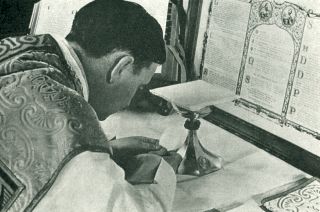
I am reminded of the first time I celebrated Mass in the Extraordinary Form. Even though I had read and rehearsed the prayers, it was only when standing at the altar that the force of the following words said in preparation for Holy Communion after the Lord's Prayer became apparent to me:
Domine Jesu Christe, qui dixisti Apostolis tuis: Pacem relinquo vobis, pacem meam do vobis: ne respicias peccata mea, sed fidem Ecclesia tua; eamque secundum voluntatem tuam pacificare et coadunare digneris: Qui vivis et regnas Deus per omnia saecula saculorum. Amen.

O Lord Jesus Christ, who saidst to Thy Apostles, Peace I leave with you, My peace I give unto you; look not upon my sins, but upon the faith of Thy Church; and vouchsafe to grant her peace and unity according to Thy will: O God who livest and reignest world without end. Amen.
The faith of the Church is pleasing to God, even if the priest is sinful and unworthy. Even though the Mass is effective even if the participation of the faithful is lacking, think dear Catholic faithful of how the priest asks the Father to look upon your faith and upon you as members of the immaculate Bride of Christ, a spotless victim offered to the Father in union with His Son.

Pray for me as I go now to offer the Holy Sacrifice. I'll make a special memento for all my readers.

Thursday, September 27, 2012

We proclaim the death of the Lord...


Why? Shouldn't it be His Resurrection? My reading from Christ the Ideal of the Priest has provided a neat insight.

We must realize that, at the consecration, the whole drama of Calvary, with all the consequence of sufferings and humiliations which it involved for Jesus, is present before God. It may be said in all truth truth that we are displaying before the eyes of the Eternal One all this divine past; that is why the Apostle says so aptly that at every Mass "we announce to the Father the death of His Son."
...

Every time that a priest celebrates Mass, he is presenting (to the Father) the Son Himself under the sacred species making, for love, a true immolation, though in sacramental form.

Let us dwell a little on this thought. What does the Father see on the altar stone on which the holy sacrifice is offered? He sees the body and blood of the Son of His love: Filius dilectionis suae (Col. 1:13). And what is that the Son is doing on the altar? Anuntiat mortem: He is placing before the eyes of the Father His love, His obedience, His suffering, the oblation of His life. And the Father casts on us a look of mercy.
We really do need to try to acquire a "God's eye view" of the Mass.

Monday, September 3, 2012

On washing of hands, pots, kettles, beds...


Commenting on yesterday's Gospel (Mk 7), St Bede the Venerable:
For taking the spiritual words of the prophets in a carnal sense, they observed, by washing the body alone, commandments which concerned the chastening of the heart and deeds, saying: "Wash yourselves, make yourselves clean" (Is 1:16) and again, "Purify yourselves, you who bear the vessels of the Lord."

It is therefore a superstitious human tradition, that men who are clean already, should wash oftener because they eat bread, and that they should not eat on returning from the market without washing.

But is is necessary for those who desire to partake of the bread which comes down from heaven, often to cleanse their evil deeds by alms, by tears, and the other fruits of righteousness.

It is also necessary for a man to wash thoroughly away the pollutions which he has contracted from the cares of temporal business, by being afterwards intent on good thoughts and works.


Friday, June 8, 2012

Corpus Christi and the Restoration of the Sacred


It is wonderful to see the resurgence of processions of the Blessed Sacrament on Corpus Christi. God-willing there will be one here in Gwinn this coming Sunday and it appears that it is the first in living memory.

Pope Benedict led the traditional procession in Rome Thursday, the Solemnity of Corpus Christi according to the Universal Calendar.

His homily during the Mass made some powerful observations about the times we now live in. The Holy Father chose to dwell on two interconnected aspects of the eucharistic Mystery: the cult (or worship) of the Eucharist and its sacrality. He said how it is important to consider these two aspects in order to protect oneself from an incomplete vision of this Mystery, as has been the case in recent times.

A unilateral interpretation of Vatican Council II had penalized the dimension of adoration, in practice restricting the Eucharist to the moment of its celebration (i.e. the Mass). Of course, it is very important to recognize the centrality of the Eucharistic celebration (Mass) in which the Lord calls his people, unites it around the dual table of the Word and of the Bread of life, nourishes it and unites it to Himself in the offering of the Sacrifice. But an appropriate equilibrium is required. It has often happened that underlining one aspect results in sacrificing the other. What has happened is that the just emphasis on the celebration of the Eucharist has been made to the detriment of Eucharistic adoration as an act of faith and of prayer directed to the Lord Jesus, really present in the Sacrament of the Altar. Confining one's relationship with the Eucharistic Jesus solely to the Mass risks removing any sense of his presence from the rest of time and space. And so one perceives less the sense of Jesus' constant presence among us and with us, a concrete presence, one which is near, among our homes, as the "pulsating Heart" of the city, the country, the territory with its varied expressions and actvities.

It's a mistake to counterpose the celebration of the Mass and adoration of the Eucharist. On the contrary, the cult of the Most Holy Sacrament constitutes the spiritual "environment" in which the community can celebrate the Eucharist well and in truth.

So the Holy Father is putting adoration and Mass together. Each is necessary for a fuller appreciation of the other. Surely a symptom of the mistaken contra-positioning of adoration and celebration is the removal of the Tabernacle from its central location in our parish churches. Thankfully we are seeing a return of the Tabernacle to its rightful place at the heart of our churches.

The Holy Father also speaks about his experience of adoration as uniting the common priesthood of the faithful and the ministerial priesthood as both find themselves called as one in the eucharistic cult. He refers to his experiences of the youth vigils in Cologne, Hyde Park (London), Madrid and elsewhere, when all - priest and faithful - were united, and how these times of adoration prepared the hearts of all for a more fruitful encounter with the Lord in the Holy Mass.
For everyone to be in prolonged silence before the Lord present in his Sacrament, is one of the most authentic experiences of our being Church, which accompanies itself in a complementary manner with that of celebrating the Eucharist, listening to the Word of God, singing, drawing close together to the table of the Bread of life. Communion and contemplation cannot be separated, they go together.
Pope Benedict also considered the aspect of sacrality. He refers to a secularistic mentality of the sixties and seventies of last century which as influenced the cult of the Eucharist. It is important that the sacred nature of the Eucharist be manifest by appropriate signs.
If, for example, in the name of a secularized faith which has no longer any need of sacred signs, this city procession of Corpus Domini were to be abolished, the spiritual profile of Rome would be rendered flattened, and our personal and communitarian conscience would become weakened. Or let us consider a mother and a father who, in the name of a desacralized faith, would deprive their children of all religious ritual: in reality they would end up by leaving an open field to so many surrogates present in our consumer society, to other rites and other signs, which could more easily become idols. God, our Father, has not made humanity in this way: he sent his Son into the world not to abolish but to bring to fulfilment the sacred.
There are many, many people who no longer participate in the Mass and I have no doubt that this is due in large part to the desacralisation that has occurred over recent decades. It is my prayer and hope that a re-sacralization will result in recapturing the field of people's spiritual lives which have been overcome by consumerism or, lacking any real purpose in life, by despair, bitterness...

Our Blessed Sacrament procession on Sunday will be a public manifestation of our faith in the abiding presence of the Eucharistic Jesus who lives in the town, who wants to be close to the people of this town, who wants to walk by and bless the homes and businesses of this town and all who dwell or work in them.

Monday, June 4, 2012

Communion at St John's Espicopalian Church Detroit


I was searching for a video of the Rendez a Dieu hymn music since it is the tune to the hymn set for Vespers of Corpus Christi at ebreviary.com and I came across this one. See how in this video communicants all receive kneeling, and they have an interesting solution to the distribution of Communion under both kinds - a number of ministers of the chalice who come to the communion rail after the priest has distributed under the form of bread, and things run smoothly and reverently. Of course the eucharist is celebrated in an eastward facing direction.

You can watch the Canon here.  All familiar with the Extraordinary Form of the Roman Rite will notice unmistakeable similarities: the repeated signings of the Cross over the offerings, and the signs of the Cross made with the consecrated bread at the "Through him, with him..." If this is an example of Anglican Patrimony that may now be considered part of the treasury of the Catholic Church as a result of Pope Benedict's creation of Personal Ordinariates for former anglicans, how enriched the Church will be.


Our Catholic parishes could take note...

Thursday, May 17, 2012

The Paschal Candle is extinguished

Even the Low Mass of Ascension that we celebrated here this evening had its little bit of drama as the paschal candle was extinguished immediately after the Gospel. It seems eminently logical to do so and I cannot quite understand why this was changed.

As with many things that used to take place during the Liturgy (e.g. the unveiling of the statues and images during the Easter Vigil), the paschal candle is now extinguised after the Mass on Pentecost Sunday. As it was lit with great solemnity at the Easter Vigil, should a certain solemnity not surround its extinguishing?

Jesus, the Light, has gone. Yes, I know that, as an early father wrote, as He came to earth without leaving heaven, so He returns to heaven without leaving earth. Yet, symbolically, the extinguishing of the paschal candle during the Mass somehow helps us visualise and be present at the Lord's ascent into the clouds. We experience "sacramentally" the departure of the Lord as the apostles themselves did.

As one fire - which began in the form of a huge fire outside our churches in the night of Easter - is extinguished, so we await the coming of a new Fire as the apostles and the whole Church are baptised in the Spirit at Pentecost.

The time between Ascension and Pentecost is a time of waiting.

Come, Holy Spirit...

Saturday, April 28, 2012

Pope moves to avert split among German bishops over "for all"/"for many"

The Pope never stops writing, it seems. During his Easter week in Castelgandolfo, he wrote a letter to the German bishops in advance of the publication of a new translation of the German Missal. He refers to the lack of consensus among bishops of the German language area (Germany, Switzerland, Austria...) concerning the correct translation of the words "pro multis" and writes:
I promised you (when the German bishops visited Rome on March) to express myself in writing about this serious issue in order to forestall such a split in the innermost room of our prayer.
Pretty high stakes!

In his letter the Pope also refers to the lack of unity throughout the world in the liturgy. He speaks from the vantage point of one who often prays the liturgical texts in different languages:
Since I often have to pray the liturgical prayers in different languages, I notice that among the various translations it is sometimes hard to find common ground and that the underlying common text often only remains visible from a distance.
This Pope is a Pope of Unity! There must be unity in the prayer of the Church.

The Pope pretty much dismisses as crumbling the former exegetial thesis that these words could be properly translated as "for all". With his impressive skills of biblical interpretation, he demonstrates the biblical roots of the phrase "for many". He gives a programme of catechesis to help the bishops explain to the priests and then to the people why the words "for many" are to be used instead of "for all".

You can read the letter in German here, or in Google translate English here.

You can also read an editorial by Father Federico Lombardi.

Monday, February 6, 2012

Bishop of Miami celebrates Candlemas in the Extraordinary Form


Archbishop Thomas Wenski, the Archbishop of Miami, celebrated Candlemas (The Purification of Our Lady or Presentation of the Lord) on February 2nd in the Extraordinary Form of the Roman Rite. I feel that this is the only form of the feast's celebration that really brings to light (no pun intended) the splendour and significance of this feast as the Virgin Mary bears her divine Son, the Light of the World, into the temple forty days after His birth.
Nearly 75 priests and seminarians took part in the liturgy, as well as the assembled congregation. The Archbishop's homily is here and the diocese's report on the Mass is here.

Saturday, February 4, 2012

The Gay Mass Scandal in London


Like my friend Father Ray Blake, I was sent a link to this video and hesitated before publishing it. I do not want to unnecessarily scandalise my readers. I think particularly of some of my younger readers. But Father Blake and Father Finigan, who has also published it, are priests whose judgement I respect highly and trust implicitly. They have published it, and so do I.

"God", not "Lord", and prayers that the Church may change teachings she cannot change. References to the "season of Pride" as if a liturgical season rather than a one-day secular rally. This is a clear politicization of the Mass and must come to an end.

A correspondent has also sent me a link to the following video which he made, interviewing one of the prominent parishioners, who openly advocates homosexual relationships.


The interviewee is in fact Martin Pendergast, who entered into a civil partnership with Julian Filochowski, former head of the English and Welsh Bishops major overseas aid charity CAFOD (Catholic Fund for Overseas Development, mentioned elsewhere in this blog here). Father Finigan refers to the Pendergast/Filochowski union at his blog. Pendergast wrote in The Guardian on April 28, 2009:
Marriage is a variable and culturally conditioned social institution with no inherent religious inspiration, but subsequently clothed with meaning by various faiths. In many cultures it was rooted more in property contracts or ways of social engineering through annexing others into extended family networks.
which tells you all you need to know about his understanding of Christian marriage and how it is totally at odds with the Church's understanding.

A worrying claim by Mr Pendergast is that the Vatican is aware of these Masses and seems to think fit not to intervene. The teaching of the Catholic Church on homosexuality and chastity is contained in the Catechism of the Catholic Church ##2357-2359:
Chastity and homosexuality

2357 Homosexuality refers to relations between men or between women who experience an exclusive or predominant sexual attraction toward persons of the same sex. It has taken a great variety of forms through the centuries and in different cultures. Its psychological genesis remains largely unexplained. Basing itself on Sacred Scripture, which presents homosexual acts as acts of grave depravity, tradition has always declared that "homosexual acts are intrinsically disordered." They are contrary to the natural law. They close the sexual act to the gift of life. They do not proceed from a genuine affective and sexual complementarity. Under no circumstances can they be approved.

2358 The number of men and women who have deep-seated homosexual tendencies is not negligible. This inclination, which is objectively disordered, constitutes for most of them a trial. They must be accepted with respect, compassion, and sensitivity. Every sign of unjust discrimination in their regard should be avoided. These persons are called to fulfill God's will in their lives and, if they are Christians, to unite to the sacrifice of the Lord's Cross the difficulties they may encounter from their condition.

2359 Homosexual persons are called to chastity. By the virtues of self-mastery that teach them inner freedom, at times by the support of disinterested friendship, by prayer and sacramental grace, they can and should gradually and resolutely approach Christian perfection.
Pendergast clearly equates homosexual unions with marriage. He says that those who enter into such unions are prayed for at these Masses and on their anniversaries. He distinguishes between celibacy and chastity in the homosexual, as if one in a homosexual union is not called to live in the celibate state. This is contrary to Church teaching. One thing is clear: if you are a "liberal" in the terms described by the interviewee, you do not hold the Catholic faith.

Thursday, February 2, 2012

Candlemas Extaordinary Form Mass at St Anthony, Gwinn

We had a good attendance. Thanks to Matthew, a regular attendee at EF Masses, who did the chanting solo. Thanks to servers who did a good job. The weather permitted a brief excursion out of the church for the procession. And thanks to one of our parishioners for the photos.

Friday, January 20, 2012

Pope Benedict on the Neo Catechumate's Liturgy - call to unity with the parish community

In an audience with members of the Neocatechumenal Way this morning Pope Benedict said the following concerning the celebration of the Eucharist:

Ciò vale in modo specialissimo per la celebrazione dell’Eucaristia, che, essendo il culmine della vita cristiana, è anche il cardine della sua riscoperta, alla quale il neocatecumenato tende. Come recitano i vostri Statuti, "L’Eucaristia è essenziale al Neocatecumenato, in quanto catecumenato post-battesimale, vissuto in piccola comunità" (art. 13 §1). Proprio al fine di favorire il riavvicinamento alla ricchezza della vita sacramentale da parte di persone che si sono allontanate dalla Chiesa, o non hanno ricevuto una formazione adeguata, i neocatecumenali possono celebrare l’Eucaristia domenicale nella piccola comunità, dopo i primi Vespri della domenica, secondo le disposizioni del Vescovo diocesano (cfr Statuti, art. 13 §2). Ma ogni celebrazione eucaristica è un’azione dell’unico Cristo insieme con la sua unica Chiesa e perciò essenzialmente aperta a tutti coloro che appartengono a questa sua Chiesa. Questo carattere pubblico della Santa Eucaristia si esprime nel fatto che ogni celebrazione della Santa Messa è ultimamente diretta dal Vescovo come membro del Collegio Episcopale, responsabile per una determinata Chiesa locale (cfr Conc. Ecum. Vat. II, Cost. dogm. Lumen gentium, 26). La celebrazione nelle piccole comunità, regolata dai Libri liturgici, che vanno seguiti fedelmente, e con le particolarità approvate negli Statuti del Cammino, ha il compito di aiutare quanti percorrono l’itinerario neocatecumenale a percepire la grazia dell’essere inseriti nel mistero salvifico di Cristo, che rende possibile una testimonianza cristiana capace di assumere anche i tratti della radicalità. Al tempo stesso, la progressiva maturazione nella fede del singolo e della piccola comunità deve favorire il loro inserimento nella vita della grande comunità ecclesiale, che trova nella celebrazione liturgica della parrocchia, nella quale e per la quale si attua il Neocatecumenato (cfr Statuti, art. 6), la sua forma ordinaria. Ma anche durante il cammino è importante non separarsi dalla comunità parrocchiale, proprio nella celebrazione dell’Eucaristia che è il vero luogo dell’unità di tutti, dove il Signore ci abbraccia nei diversi stati della nostra maturità spirituale e ci unisce nell’unico pane che ci rende un unico corpo (cfr 1 Cor 10, 16s).

Basically:

... for the celebration of the Eucharist which, being the summit of the christian life and also the hinge of its rediscovery, to which the neocatechumenate tends. As you Statutes say: "The Eucharist is essential in the Neocatechumenate, as in so far as it is a post-baptismal catechumenate, lived out in small communities." Precisely to favour the coming close once again to the richness of the sacramental life on the part of persons who are far from the Church, or who have not received an adequate formation, the neocatechumens can celebrate the Sunday eucharist in small communities, after the first Vespers of Sunday according to the disposition of the diocesan bishop. But every eucharistic celebration is an action of the one Christ together with his one Church and therefore essentially open to all those who belong to this his Church. This public characteristic of the Holy Eucharist es expressed in the fact that every celebration of the Holy Mass is ultimately directed by the Bishop as member of the Episcopal College, responsible for a determined local Church. The celebration in small communities, regulated by the liturgical Books, which must be followed faithfully, and with the particularities approved in the Statutes of the Way, has the purpose of helping all who follow the necatechumenal itinerary to perceive the grace of being inserted into the salvific mission of Christ, who makes possible a christian testimony capable of assuming a certain radicality. At the same time, the progressive maturation in the faith of each of the small communities must favour their insertion into the life of the great ecclesial community, which is found in the liturgical celebrations of the parish, in which and for which the Neocatechumenate acts, and which is its ordinary (normal) form. But also during the way it is important not to separate oneself from the parish community, particularly in the celebration of the Eucharist which is truly the place of the unity of everyone, where the Lord embraces us in the diverse states of our spiritual maturity and unites us in the one bread which renders us one body.


Saturday, January 14, 2012

Vatican approval coming for Neo Cat liturgy?


Other blogs are carrying the comments of Sandro Magister who reports that the Holy Father is due to hold an audience with thousands of members of the Neocatechumenal Way on January 20th and that this could be the occasion for the approval of the rather strange liturgical practices observed during the Mass.

If Magister's analysis is correct, I think any approval of the manner in which "The Way" celebrates the Mass would be a serious set back for the work of liturgical reform. We would, in effect, have three approved forms of the Roman Rite: the Ordinary Form, the Extraordinary Form and the Neocatechumenal Form. I can't see why The Way shouldn't conform to the universal norms of the Church.

Magister describes some of the peculiarities of the Mass celebrated by "The Way" ("Placet" or "Non placet"? The wager of Carmen and Kiko):
1. They are celebrated in small groups, corresponding to the different stages of advancement on the catechetical journey. If in a parish, for example, there are twelve Neocatechumenal communities, each at a different stage, there will be twelve Masses, celebrated in separate places more or less at the same time, preferably on Saturday evening.

2. The surroundings and furnishings trace out the image of a banquet: a table with the participants seated around it. Even when the Neocatechumenals celebrate the Mass not in a parish hall but in a church, they often ignore the altar. They put a table in the middle and sit around it in a circle.

3. Each of the biblical readings of the Mass is preceded by an extensive "monition" on the part of one or the other of the community and is followed, especially after the Gospel, by "resonances," or personal reflections by a substantial number of those present. The priest's homily is added to the "resonances" without being distinguished from them.

4. Communion also takes place in banquet form. The consecrated bread – a large unleavened loaf, two thirds white flour and one third whole wheat flour, prepared and baked according to detailed rules established by Kiko – is broken and distributed to those present, who remain in their places. After the distribution, it is eaten at the same time by all, including the priest. After this, the priest goes from one person to the next with the chalice of consecrated wine, which everyone drinks.

There are also other peculiarities, but these four are enough to understand how different in form and substance the Masses of the Neocatechumenals are from those celebrated according to the general liturgical rules. A difference that is certainly more pronounced than that between the Masses in the ancient Roman rite and in the modern rite.

The Vatican authorities have repeatedly sought to bring the Neocatechumenals back to greater fidelity to the "lex orandi" in effect in the Catholic Church. But with a weak pulse and almost no results.

The strongest reminder came with the promulgation of the definitive statutes of the Way, approved in 2008.

In them, at article 13, the Vatican authorities established that the Masses of the communities must be "open also to other faithful"; that communion must be received "standing"; that for the biblical readings, only "brief monitions" of introduction are permitted, apart from the homily.

There is no trace of the "resonances" (permitted in the previous, provisional statutes of 2002) in this same article 13 dedicated to the celebration of the Mass. It is mentioned only in article 11, which, however, concerns the weekday celebrations of the Word, which each community holds with its own catechists.

The fact is that there has been very little change between the way in which the Neocatechumenals celebrate the Mass today and the way in which they celebrated it until a few years ago, when, moreover, the cups of consecrated wine were passed festively from hand to hand.

It is only in theory that their group Masses have been opened to other faithful as well.

Standing or seated, their convivial way of distributing communion is still the same.

The personal "resonances" of those present continue to invade and overwhelm the first part of the Mass.
Anyway, read Magister ("Placet" or "Non placet"? The wager of Carmen and Kiko) for yourself and decide.

See also:
Catholic Culture: Vatican acceptance coming for Neocatechuman liturgy?
New Liturgical Movement: Magister on the Neocatechumenal Way Liturgy
Pertinacious Papist: Bugnini's Dream:  Will Pope approve Neocatechuman liturgy?
Rorate Coeli: Reform of the reform...

Tuesday, January 3, 2012

The man who learns to believe learns also to kneel


This will be my "Desktop" item for this coming weekend's parish bulletin for the Solemnity of the Epiphany.
“Going into the house they saw the child with Mary his mother, and they fell down and worshiped him.” (Mt 2:11 - RSV)

This is a very striking phrase from Matthew’s Gospel. These wise men fell to the ground when they encountered “the child”.

Many would consider kneeling, or prostration, beneath man’s dignity. We should not be humbled before anyone, not even our God. We should not demean ourselves by falling down. We should stand face to face before our God. This is folly! The Magi - pagans! - of today’s feast teach us true wisdom.

Bishop Sample gave all the priests of the diocese a Christmas present: a book by the then Joseph Cardinal Ratzinger, now Pope Benedict XVI, entitled The Spirit of the Liturgy. Our bishop clearly desires that we priests study the Pope’s book and apply it to our liturgy today. I first read this book soon after it came out in 2000 and consider it a charter for renewal of our Catholic worship.

Pope Benedict writes about the gesture of prostration or kneeling. He says that kneeling, of its very nature, “does not come from any culture.” In other words, those who protest that kneeling does not belong to their culture do not understand that kneeling “comes from the Bible and from knowledge of God.” “We now kneel before that humility” of Christ “which went as far as the Cross”. “The kneeling of Christians is not a form of inculturation into existing customs. It is quite the opposite, an expression of Christian culture, which transforms the existing culture through a new and deeper knowledge and experience of God.”

Pope Benedict stresses the importance of the unity of our spiritual dispositions and our bodily postures. “The bodily gesture itself is the bearer of the spiritual meaning, which is precisely that of worship. Without the worship, the bodily gesture would be meaningless, while the spiritual act must of its very nature … express itself in the bodily gesture… When kneeling becomes merely external, a merely physical act, it becomes meaningless. On the other hand, when someone tries to take worship back into the purely spiritual realm and refuses to give it embodied form, the act of worship evaporates, for what is purely spiritual is inappropriate to the nature of man. Worship is one of those fundamental acts that affect the whole man. That is why bending the knee before the presence of the living God is something we cannot abandon.
Pope Benedict  gives Holy Communion to  communicants
kneeling and on the tongue.
“The man who learns to believe
learns also to kneel, and a faith or a liturgy no longer familiar
with kneeling would be sick to the core. Where it has been lost,
kneeling must be rediscovered…”
(Pope Benedict, Spirit of the Liturgy)
Sadly, this gesture of bending the knee has been abandoned by many who either simply ignore the presence of the Lord in the Tabernacle, or who bow rather than genuflect. Obviously one understands those whose knees are weakened by ill health or old age and for whom kneeling/genuflecting would be painful. But for the rest, Pope Benedict says that “the Hebrews regarded the knees as a symbol of strength; to bend the knee is, therefore, to bend our strength before the living God.” He relates a story that comes from the Desert Fathers according to which the devil showed himself to a certain Abba Apollo. “He looked black and ugly, with frighteningly thin limbs, but, most strikingly, he had no knees. The inability to kneel is seen as the very essence of the diabolical.”

Pope Benedict concludes his consideration of kneeling as follows:
“The man who learns to believe learns also to kneel, and a faith or a liturgy no longer familiar with kneeling would be sick to the core. Where it has been lost, kneeling must be rediscovered, so that, in our prayer, we remain in fellowship with the apostles and martyrs, in fellowship with the whole cosmos, indeed in union with Jesus Christ himself.”

O come, let us adore him!

Wednesday, December 7, 2011

Bishop Sample's Christmas Message to His Priests

Yep, that's it. With his Christmas card to priests, the Bishop enclosed this gift. I think it tells all the clergy very clearly where he wants to lead us and where he wants us to lead our parisioners: right behind our Holy Father, Pope Benedict.

Wednesday, November 30, 2011

No holding hands during the "Our Father" - Bishop decrees.


I am grateful to a correspondent who has drawn my attention to The Deacon's Bench blog reporting the letter and decree of the Bishop of Covington, the Most Reverend Roger J Foys, issued on the occasion of the implementation of the new English translation of the Roman Missal.

In his letter the Bishop points out that
The rituals of the Roman Church, of which we are a part, call for specific words to be used as well as particular actions and gestures, both on the part of the priest and the faithful who join their hearts with his in their worship of God.

He reminds his people:
As we continually give ourselves to the Lord, to His Word and to His Church, as your bishop I ask for your cooperation with the implementation process and to take to heart the teachings of the Second Vatican Council, in the decree Sacrosanctum Concilium (The Constitution on the Sacred Liturgy), that no one on their own authority, for any reason, may add to, remove or change anything in the Sacred Liturgy (emphasis added).

In a recent memo to priests in his diocese, Bishop Alexander K Sample of Marquette also reminded us of this very point. Bishop Sample is currently preparing a pastoral letter on the liturgy.

Amongst some of the points in Bishop Foys' decree that I was glad to read:

The music used in the Sacred Liturgy be theologically sound and properly composed in accord with the teaching of the Church on Sacred Music.
Would this seem to imply that not all hymns in our hymnals fulfill this condition? I have already given my parish music director a list of hymns from our hymnal that I do not consider appropriate.
Music for the Ordinary Parts of the Mass (also known as Service Music – e.g. Kyrie, Gloria, Sanctus, Agnus Dei) must have the approval from the Diocesan Office of Worship and Liturgy.
i. From November 27, 2011, until June 30, 2012, only the following three English settings are permitted for use:
1. The Chant Mass of the 3rd Edition of the Roman Missal (mandatory)
a. This one setting is mandatory so as to foster a unified participation of the faithful at Mass throughout the Diocese.
2. The Heritage Mass (optional)
3. The Mass of Renewal (optional)
ii. Other Mass Settings will be approved for use on July 1, 2012.
iii. Please note: Hymns that are theologically sound and properly composed are not restricted.
Note that the bishop is only speaking about the English settings. All the Latin Gregorian Chant settings are permitted, nay encouraged, by the universal law of the Church and have been repeatedly proposed for use by the Supreme Pontiffs before and after Vatican II.

In Marquette, Bishop Sample has asked all parishes to learn the Mass of Resurrection, in addition to the chant settings.

Bishop Foys reminds the faithful that
“Songs or hymns may not be used in place of the responsorial Psalm.”(GIRM 61)
(How often has one heard hymns in stead of the psalm, or paraphrasing of the psalms - Because the Lord is my shepherd...)

He reminds people that the people should kneel from the end of the Sanctus through to the end of the Eucharistic Prayer, that deacons are to kneel from the epiclesis through to the showing of the Chalice, that priests (presumably concelebrants - for it is normally the case that priests and other clergy attending in choir kneel when the people kneel) should remain standing, and that the people should kneel after the Agnus Dei.

Concerning the Our Father, the bishop writes:
Special note should also be made concerning the gesture for the Our Father. Only the priest is given the instruction to “extend” his hands. Neither the deacon nor the lay faithful are instructed to do this. No gesture is prescribed for the lay faithful in the Roman Missal; nor the General Instruction of the Roman Missal, therefore the extending or holding of hands by the faithful should not be performed.

The bishop makes these important observations about silence:

The General Instruction of the Roman Missal reminds us: “Sacred silence also, as part of the celebration, is to be observed at the designated times…. Even before the celebration itself, it is commendable that silence is observed in the church, in the sacristy, in the vesting room, and in adjacent areas, so that all may dispose themselves to carry out the sacred action in a devout and fitting manner.” (GIRM 45) Silence following the Mass is also encouraged for those who might want to remain in the church to pray.

I am very pleased to say that in this parish there is always a reverent silence before Mass. However, since I have arrived a number of people have brought my attention to the rather noisy atmosphere afterwards, hoping that I will "do something about it". A group of parishioners has organized coffee in an adjacent room to encourage visiting there rather than in the church. I haven't yet preached on this matter but the time is coming soon when I shall do so. The fact that a bishop has mentioned this point obviously adds some strength to my position.

Other things I have drawn attention to here in this parish are:

  • the striking of the breast during the I confess
  • the bowing during the words referring to the incarnation in the Creed
  • the sign of peace to be made in a sober fashion and only with persons next to you, the words "The peace of the Lord be with you always" being permitted with the reply "Amen"
  • that communicants receive on the tongue or, in those places where it is permitted, on the hand, and how communion on the hand is to be received.
It is most encouraging to hear news from so many places that the liturgy is being restored to what was really intended by the Second Vatican Council.

Sunday, November 27, 2011

How did the new English Mass go today?

The Regal Edition of the Roman Missal available from Midwest Theological Forum.
Here, there were a few stumbles - but by and large it went well. For me as a priest, it was like learning the Mass once again. The Missal - we have the MTF Regal Edition pictured above - is beautifully bound and illustrated. It will take a little while to become familiar with both the layout and the new words, and to discover the richness of what is on offer. Check the appendices for music for the presidential prayers and dialogues, sample prayers of the faithful, etc.

The language is uplifting and - as sacred language should - veils the mystery that we must penetrate with the eyes of faith through prayer and contemplation.

For me, the Mass will never be the same again.


Today we veiled the Tabernacle with a new purple veil made by our parishioner Bonnie Hurkmans. Bonnie is also going to make veils in the other liturgical colours: white, green and red. We are blest to have people like her - and many others in the parish - who put their talents at the service of the Lord. Rosie King has made linen cloths to go under the top altar cloth and on the credence table, and she is working on one for the shelf on which the tabernacle rests. As I mentioned in my homily this morning, the veil over the Tabernacle indicates that there is Mystery beyond the veil that we are called to meditate upon, a Mystery that the Lord will reveal to those who keep silence before it in reverence and awe.

It is a beautiful Tabernacle in itself, as you can see from this previous photograph:


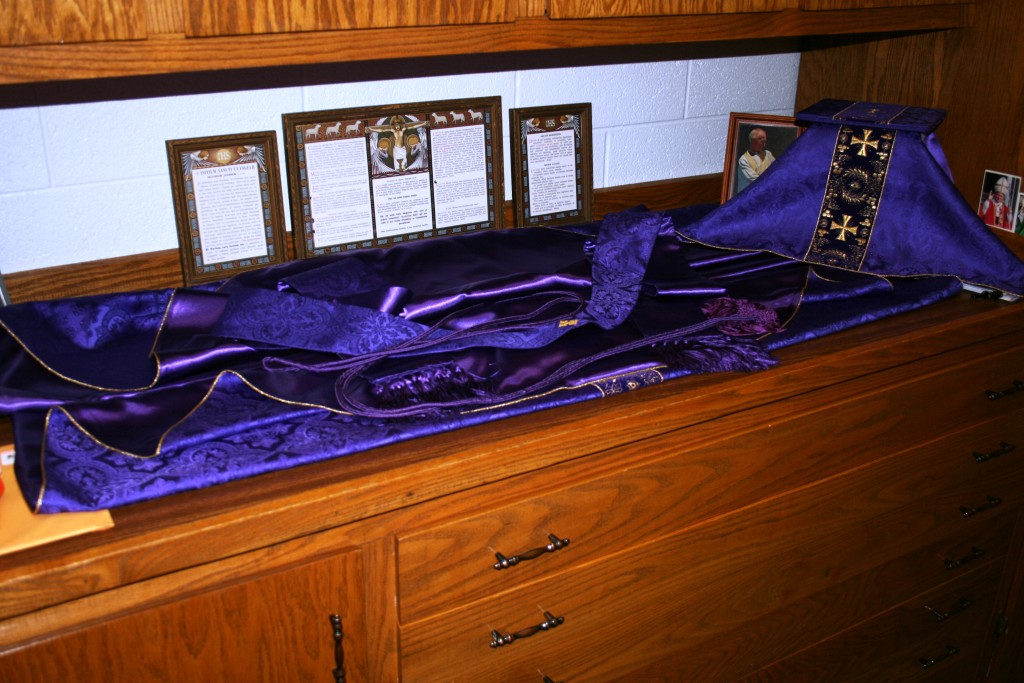
The new purple vestments got their first proper outing today.

Although they look a bit blue in this picture, this is the effect of night lighting
and flash. See the tabernacle above for a better idea of the colour.

The tabernacle veil is made from the same material. The vestments were purchased from House of Hansen with money donated by parishioners and include all the five parts: chasuble, stole, maniple, chalice veil and burse (these last three are not included in the price shown at the House of Hansen website). I shall use them in the Extraordinary Form for the first time this coming Thursday evening at 7pm. Parishioners have generously funded the purchase of new rose vestments which have been purchased from Luzar Vestments and red vestments which are now on order from House of Hansen. We have also received donations towards a new white set and these are now also on order from House of Hansen. Thank you to all our generous parishioners.

During this time of Advent, we consider the Mystery concealed within Mary and await - in silent conemplation - Its revelation.

I was struck by - and preached on - the orations (Collect, Prayer of the Offerings, Prayer after Communion) of today's Mass.

Prayer after Communion:
May these mysteries, O Lord,
in which we have participated,
profit us, we pray,
for even now, as we walk amid passing things,
you teach us by them to love the things of heaven
and hold fast to what endures.
Through Christ our Lord.
By what does the Lord teach us "to love the things of heaven"? By "these mysteries" or by our "walk amid passing things"? Probably the former, but the passing things of this world are also created by God and should lead us beyond them to the appreciation of the beauty of their Creator and Lord.

Indeed, the sacraments, too, are "passing things". A time will come when there is no time and no sacraments. We will no longer see Christ veiled in the Eucharistic "vestments" of the appearances of bread and wine but we shall see Him "immediately", without the mediation of sense, sign or symbol. As ecstatic as our union with the Lord in Holy Communion can be, it is a mere foretaste of the heavenly union.

The new, more sacral language, also veils a mystery. If we now find some words of the Mass a little more difficult to "get" at first, this might indicate that perhaps the previous translation was not up to the mark in showing forth the mysterious nature of the Mass. If, now, we must exert ourselves in thinking and - preferably - contemplating in prayer, this is a grace given us by the Lord. As we prayed in the Collect today:
Grant your faithful, we pray, almighty God,
the resolve to run forth to meet your Christ
with righteous deeds at his coming...
 We are called to "run forth" out of our comfort zone, out of our worldly way of seeing things, into the realm of mystery through prayer and contemplation. There are many "righteous deeds" that we can accumulate in readiness for the coming of the Father's Christ, but perhaps prayer and contemplation are the more important.

Wishing everyone a blessed Advent.

Monday, October 24, 2011

Bishop Alexander Sample on the Orientation of the Sacred Liturgy


Bishop Sample preached this homily during the celebration of the Extraordinary Form Mass at St Peter Cathedral Marquette on September 4th.

Monday, September 26, 2011

Biblical Walk through the Mass Bible Study


Last week we held our first sessions of this five-session study programme published by Ascension Press. The desire in the parish to know more about the Mass and to understand it better is amazing. The advent of the new English translation has surely been a wonderfully providential occasion to provoke renewed interest in the Mass.


Between 50 and 60 people have signed up for the programme which takes place in two groups: Tuesday evening with a repeat on Wednesday morning.


Highly to be recommended, thoroughly orthodox, deeply theological and biblical. The significance of the changes with the new translation is also explained.

Our parish wishes to record its thanks to the Marquette Diocese Legacy of Faith for funding the purchase of the presentation materials.

LinkWithin

Related Posts Plugin for WordPress, Blogger...