Showing posts with label Eucharist. Show all posts

Wednesday, October 31, 2012

Dr Edward Peters on when to exclude people from Holy Communion


In an article in First Things entitled Fencing the Altar, Dr Peters writes:
Participation in Holy Communion is achieved by two related but distinct acts: the action of a member of the faithful in seeking Communion (reception) and the action of the minister in giving Communion (administration). These two actions are not only performed by different persons, they are governed by different canon laws. Virtually all confusion over Communion can be traced to the failure to keep these two actions distinct.
It is worth reading as it helps minsters guard against over-zealous denial of the Holy Communion on the one hand as well as giving clear guidance on how to apply the law of the Church in this matter. There are public figures whom Peters has no doubt should be excluded by their bishops from Holy Communion.

I am much consoled by his line:
Difficult cases of law and fact will arise, and mistakes will inevitably be made in deciding them.
for we do inevitably find ourselves in tight spots during the celebration of Mass and do not always get it right.

Monday, September 3, 2012

On washing of hands, pots, kettles, beds...


Commenting on yesterday's Gospel (Mk 7), St Bede the Venerable:
For taking the spiritual words of the prophets in a carnal sense, they observed, by washing the body alone, commandments which concerned the chastening of the heart and deeds, saying: "Wash yourselves, make yourselves clean" (Is 1:16) and again, "Purify yourselves, you who bear the vessels of the Lord."

It is therefore a superstitious human tradition, that men who are clean already, should wash oftener because they eat bread, and that they should not eat on returning from the market without washing.

But is is necessary for those who desire to partake of the bread which comes down from heaven, often to cleanse their evil deeds by alms, by tears, and the other fruits of righteousness.

It is also necessary for a man to wash thoroughly away the pollutions which he has contracted from the cares of temporal business, by being afterwards intent on good thoughts and works.


Monday, June 11, 2012

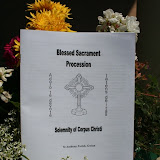
Corpus Christi Procession, Gwinn


I hope you enjoy this slideshow of our parish Corpus Christi Procession yesterday. It kicked off a week of celebration of the centennial of the first Mass celebrated in the basement of the still uncompleted church and was followed by Benediction in the Peter Nordeen Park and luncheon.

There seems to be a problem with creating a slideshow on picasa currently. Click on the image below to view the photographs.

Saturday, June 9, 2012

Pray for Ireland


The International Eucharistic Congress begins tomorrow, Solemnity of Corpus Christi. Let us pray that Ireland will be renewed in its faith, that the Church in Ireland may once again be the beacon of light it once was. It was St Patrick's mission to bring the pagan Irish of his day to the Light of Christ. May Ireland spread that Light well beyond its borders.

Friday, June 8, 2012

Corpus Christi and the Restoration of the Sacred


It is wonderful to see the resurgence of processions of the Blessed Sacrament on Corpus Christi. God-willing there will be one here in Gwinn this coming Sunday and it appears that it is the first in living memory.

Pope Benedict led the traditional procession in Rome Thursday, the Solemnity of Corpus Christi according to the Universal Calendar.

His homily during the Mass made some powerful observations about the times we now live in. The Holy Father chose to dwell on two interconnected aspects of the eucharistic Mystery: the cult (or worship) of the Eucharist and its sacrality. He said how it is important to consider these two aspects in order to protect oneself from an incomplete vision of this Mystery, as has been the case in recent times.

A unilateral interpretation of Vatican Council II had penalized the dimension of adoration, in practice restricting the Eucharist to the moment of its celebration (i.e. the Mass). Of course, it is very important to recognize the centrality of the Eucharistic celebration (Mass) in which the Lord calls his people, unites it around the dual table of the Word and of the Bread of life, nourishes it and unites it to Himself in the offering of the Sacrifice. But an appropriate equilibrium is required. It has often happened that underlining one aspect results in sacrificing the other. What has happened is that the just emphasis on the celebration of the Eucharist has been made to the detriment of Eucharistic adoration as an act of faith and of prayer directed to the Lord Jesus, really present in the Sacrament of the Altar. Confining one's relationship with the Eucharistic Jesus solely to the Mass risks removing any sense of his presence from the rest of time and space. And so one perceives less the sense of Jesus' constant presence among us and with us, a concrete presence, one which is near, among our homes, as the "pulsating Heart" of the city, the country, the territory with its varied expressions and actvities.

It's a mistake to counterpose the celebration of the Mass and adoration of the Eucharist. On the contrary, the cult of the Most Holy Sacrament constitutes the spiritual "environment" in which the community can celebrate the Eucharist well and in truth.

So the Holy Father is putting adoration and Mass together. Each is necessary for a fuller appreciation of the other. Surely a symptom of the mistaken contra-positioning of adoration and celebration is the removal of the Tabernacle from its central location in our parish churches. Thankfully we are seeing a return of the Tabernacle to its rightful place at the heart of our churches.

The Holy Father also speaks about his experience of adoration as uniting the common priesthood of the faithful and the ministerial priesthood as both find themselves called as one in the eucharistic cult. He refers to his experiences of the youth vigils in Cologne, Hyde Park (London), Madrid and elsewhere, when all - priest and faithful - were united, and how these times of adoration prepared the hearts of all for a more fruitful encounter with the Lord in the Holy Mass.
For everyone to be in prolonged silence before the Lord present in his Sacrament, is one of the most authentic experiences of our being Church, which accompanies itself in a complementary manner with that of celebrating the Eucharist, listening to the Word of God, singing, drawing close together to the table of the Bread of life. Communion and contemplation cannot be separated, they go together.
Pope Benedict also considered the aspect of sacrality. He refers to a secularistic mentality of the sixties and seventies of last century which as influenced the cult of the Eucharist. It is important that the sacred nature of the Eucharist be manifest by appropriate signs.
If, for example, in the name of a secularized faith which has no longer any need of sacred signs, this city procession of Corpus Domini were to be abolished, the spiritual profile of Rome would be rendered flattened, and our personal and communitarian conscience would become weakened. Or let us consider a mother and a father who, in the name of a desacralized faith, would deprive their children of all religious ritual: in reality they would end up by leaving an open field to so many surrogates present in our consumer society, to other rites and other signs, which could more easily become idols. God, our Father, has not made humanity in this way: he sent his Son into the world not to abolish but to bring to fulfilment the sacred.
There are many, many people who no longer participate in the Mass and I have no doubt that this is due in large part to the desacralisation that has occurred over recent decades. It is my prayer and hope that a re-sacralization will result in recapturing the field of people's spiritual lives which have been overcome by consumerism or, lacking any real purpose in life, by despair, bitterness...

Our Blessed Sacrament procession on Sunday will be a public manifestation of our faith in the abiding presence of the Eucharistic Jesus who lives in the town, who wants to be close to the people of this town, who wants to walk by and bless the homes and businesses of this town and all who dwell or work in them.

Monday, June 4, 2012

Communion at St John's Espicopalian Church Detroit


I was searching for a video of the Rendez a Dieu hymn music since it is the tune to the hymn set for Vespers of Corpus Christi at ebreviary.com and I came across this one. See how in this video communicants all receive kneeling, and they have an interesting solution to the distribution of Communion under both kinds - a number of ministers of the chalice who come to the communion rail after the priest has distributed under the form of bread, and things run smoothly and reverently. Of course the eucharist is celebrated in an eastward facing direction.

You can watch the Canon here.  All familiar with the Extraordinary Form of the Roman Rite will notice unmistakeable similarities: the repeated signings of the Cross over the offerings, and the signs of the Cross made with the consecrated bread at the "Through him, with him..." If this is an example of Anglican Patrimony that may now be considered part of the treasury of the Catholic Church as a result of Pope Benedict's creation of Personal Ordinariates for former anglicans, how enriched the Church will be.


Our Catholic parishes could take note...

Friday, May 18, 2012

De La Salle College (Belfast) Prayer Club's anticipation of Irelands Eucharistic Congress

Year 9 check my blog every week, which is kind of them. The College Prayer Club has a website which is well worth checking out. As you will see, it is promoting vocations to the priesthood and the religious life.

Their teacher Miss Jo Kelly keeps me informed of things and so I pray for them - never having met them in person! I should like to put that right at some point.

Enjoy their International Eucharistic Congress video below, but do visit their website. They also have a blog, and so are being educated for evangelisation in this world of modern communications.

Go and encourage them by liking their video and putting an encouraging comment on the blog. This kind of news inspires hope for the Church in Ireland.

Tuesday, January 3, 2012

The man who learns to believe learns also to kneel


This will be my "Desktop" item for this coming weekend's parish bulletin for the Solemnity of the Epiphany.
“Going into the house they saw the child with Mary his mother, and they fell down and worshiped him.” (Mt 2:11 - RSV)

This is a very striking phrase from Matthew’s Gospel. These wise men fell to the ground when they encountered “the child”.

Many would consider kneeling, or prostration, beneath man’s dignity. We should not be humbled before anyone, not even our God. We should not demean ourselves by falling down. We should stand face to face before our God. This is folly! The Magi - pagans! - of today’s feast teach us true wisdom.

Bishop Sample gave all the priests of the diocese a Christmas present: a book by the then Joseph Cardinal Ratzinger, now Pope Benedict XVI, entitled The Spirit of the Liturgy. Our bishop clearly desires that we priests study the Pope’s book and apply it to our liturgy today. I first read this book soon after it came out in 2000 and consider it a charter for renewal of our Catholic worship.

Pope Benedict writes about the gesture of prostration or kneeling. He says that kneeling, of its very nature, “does not come from any culture.” In other words, those who protest that kneeling does not belong to their culture do not understand that kneeling “comes from the Bible and from knowledge of God.” “We now kneel before that humility” of Christ “which went as far as the Cross”. “The kneeling of Christians is not a form of inculturation into existing customs. It is quite the opposite, an expression of Christian culture, which transforms the existing culture through a new and deeper knowledge and experience of God.”

Pope Benedict stresses the importance of the unity of our spiritual dispositions and our bodily postures. “The bodily gesture itself is the bearer of the spiritual meaning, which is precisely that of worship. Without the worship, the bodily gesture would be meaningless, while the spiritual act must of its very nature … express itself in the bodily gesture… When kneeling becomes merely external, a merely physical act, it becomes meaningless. On the other hand, when someone tries to take worship back into the purely spiritual realm and refuses to give it embodied form, the act of worship evaporates, for what is purely spiritual is inappropriate to the nature of man. Worship is one of those fundamental acts that affect the whole man. That is why bending the knee before the presence of the living God is something we cannot abandon.”
Pope Benedict  gives Holy Communion to  communicants
kneeling and on the tongue.
“The man who learns to believe
learns also to kneel, and a faith or a liturgy no longer familiar
with kneeling would be sick to the core. Where it has been lost,
kneeling must be rediscovered…”
(Pope Benedict, Spirit of the Liturgy)
Sadly, this gesture of bending the knee has been abandoned by many who either simply ignore the presence of the Lord in the Tabernacle, or who bow rather than genuflect. Obviously one understands those whose knees are weakened by ill health or old age and for whom kneeling/genuflecting would be painful. But for the rest, Pope Benedict says that “the Hebrews regarded the knees as a symbol of strength; to bend the knee is, therefore, to bend our strength before the living God.” He relates a story that comes from the Desert Fathers according to which the devil showed himself to a certain Abba Apollo. “He looked black and ugly, with frighteningly thin limbs, but, most strikingly, he had no knees. The inability to kneel is seen as the very essence of the diabolical.”

Pope Benedict concludes his consideration of kneeling as follows:
“The man who learns to believe learns also to kneel, and a faith or a liturgy no longer familiar with kneeling would be sick to the core. Where it has been lost, kneeling must be rediscovered, so that, in our prayer, we remain in fellowship with the apostles and martyrs, in fellowship with the whole cosmos, indeed in union with Jesus Christ himself.”

O come, let us adore him!

Monday, December 19, 2011

Bishop Mark Davies to restore central position of Tabernacle?

I have heard from a good priest friend of mine from another continent (not Europe) that he was watching Bishop Davies' recent Advent reflection on EWTN during which he announced that the tabernacle at Shrewsbury Cathedral would be placed in a central position.

Has this been announced anywhere else?

It would certainly be in keeping with what Pope Benedict wrote in his post synodal apostolic exhortation Sacramentum Caritatis:
"The correct positioning of the tabernacle contributes to the recognition of Christ's real presence in the Blessed Sacrament. Therefore, the place where the eucharistic species are reserved, marked by a sanctuary lamp, should be readily visible to everyone entering the church. It is therefore necessary to take into account the builiding's architecture: in churches which do not have a Blessed Sacrament chapel, and where the high altar with its tabernacle is still in place, it is appropriate to continue to use this structure for the reservation and adoration of the Eucharist, taking care not to place the celebrant's chair in front of it."
In some cathedrals, there is a very prominent Blessed Sacrament Chapel, but if a Cathedral is no bigger than a large church, it would seem to me far more preferable to have the Tabernacle in a central position. (For liturgical rigour, the Blessed Sacrament could, of course, be removed when the Bishop celebrates. Liturgists would have to advise as to whether this is a possibility, a recommendation, something advisable or something required. I don't have the law on this matter readily available.)

If you visit the Cathedral's website, you will notice that the good Bishop will make himself available for confessions from 11pm to 11:30pm Christmas Eve, prior to the Midnight Mass.

UPDATE: This reflection will be repeated Friday December 23rd on EWTN UK at 09:30 and 19:00 hours GMT and on EWTN in the US on Wednesday December 21st at 11pm PT/Thursday 22nd 2am ET.

Monday, December 12, 2011

"Two people talking stop forty people praying"

Thanks to berenike for drawing my attention to Bishop Hugh Gilbert's pastoral letter for yesterday.

Silence in church is vital. There is the Great Silent One in the Tabernacle who cannot be heard if we talk in church.

After complaints from people about levels of noise in the church, instead of the recessional hymn I asked everybody after the 11am Mass to kneel for some moments in silent recollection and thanksgiving. After priest and servers had observed their silence on their knees, the people were invited to depart in silence and, if they wanted to socialise/visit with others, to do so either in the narthex or in the room where coffee was provided. The atmosphere was transformed.

Bishop Gilbert's letter will be a very helpful text for my homily next Sunday!

See Prayer - Divine Silence and homesickness for the tabernacle and altar...

Wednesday, December 7, 2011

Bishop Sample's Christmas Message to His Priests

Yep, that's it. With his Christmas card to priests, the Bishop enclosed this gift. I think it tells all the clergy very clearly where he wants to lead us and where he wants us to lead our parisioners: right behind our Holy Father, Pope Benedict.

Sunday, November 27, 2011

How did the new English Mass go today?

The Regal Edition of the Roman Missal available from Midwest Theological Forum.
Here, there were a few stumbles - but by and large it went well. For me as a priest, it was like learning the Mass once again. The Missal - we have the MTF Regal Edition pictured above - is beautifully bound and illustrated. It will take a little while to become familiar with both the layout and the new words, and to discover the richness of what is on offer. Check the appendices for music for the presidential prayers and dialogues, sample prayers of the faithful, etc.

The language is uplifting and - as sacred language should - veils the mystery that we must penetrate with the eyes of faith through prayer and contemplation.

For me, the Mass will never be the same again.


Today we veiled the Tabernacle with a new purple veil made by our parishioner Bonnie Hurkmans. Bonnie is also going to make veils in the other liturgical colours: white, green and red. We are blest to have people like her - and many others in the parish - who put their talents at the service of the Lord. Rosie King has made linen cloths to go under the top altar cloth and on the credence table, and she is working on one for the shelf on which the tabernacle rests. As I mentioned in my homily this morning, the veil over the Tabernacle indicates that there is Mystery beyond the veil that we are called to meditate upon, a Mystery that the Lord will reveal to those who keep silence before it in reverence and awe.

It is a beautiful Tabernacle in itself, as you can see from this previous photograph:


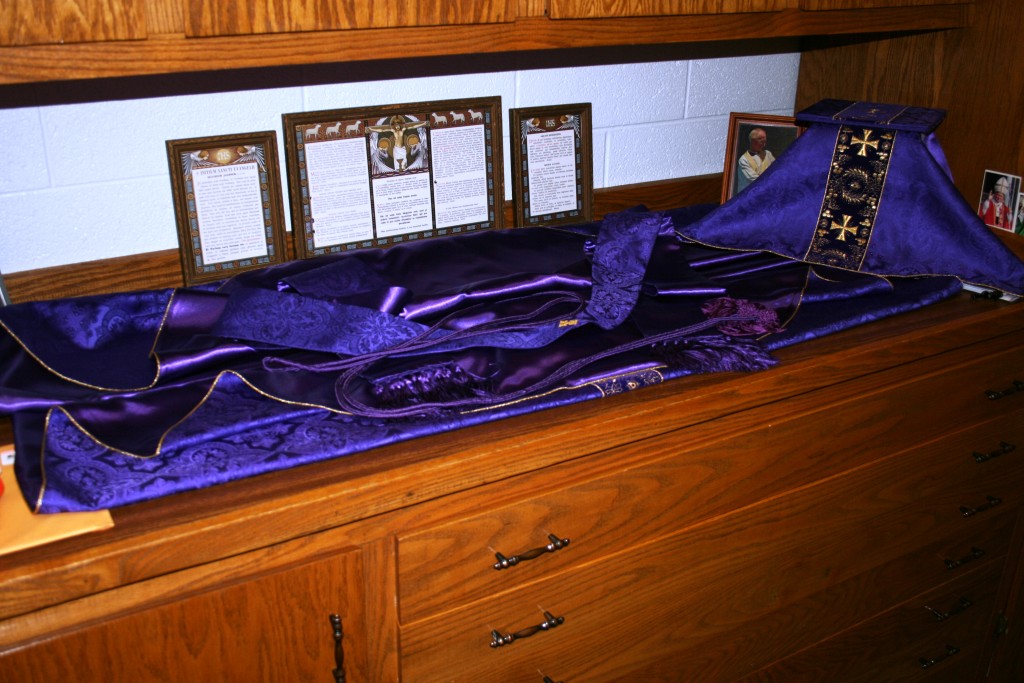
The new purple vestments got their first proper outing today.

Although they look a bit blue in this picture, this is the effect of night lighting
and flash. See the tabernacle above for a better idea of the colour.

The tabernacle veil is made from the same material. The vestments were purchased from House of Hansen with money donated by parishioners and include all the five parts: chasuble, stole, maniple, chalice veil and burse (these last three are not included in the price shown at the House of Hansen website). I shall use them in the Extraordinary Form for the first time this coming Thursday evening at 7pm. Parishioners have generously funded the purchase of new rose vestments which have been purchased from Luzar Vestments and red vestments which are now on order from House of Hansen. We have also received donations towards a new white set and these are now also on order from House of Hansen. Thank you to all our generous parishioners.

During this time of Advent, we consider the Mystery concealed within Mary and await - in silent conemplation - Its revelation.

I was struck by - and preached on - the orations (Collect, Prayer of the Offerings, Prayer after Communion) of today's Mass.

Prayer after Communion:
May these mysteries, O Lord,
in which we have participated,
profit us, we pray,
for even now, as we walk amid passing things,
you teach us by them to love the things of heaven
and hold fast to what endures.
Through Christ our Lord.
By what does the Lord teach us "to love the things of heaven"? By "these mysteries" or by our "walk amid passing things"? Probably the former, but the passing things of this world are also created by God and should lead us beyond them to the appreciation of the beauty of their Creator and Lord.

Indeed, the sacraments, too, are "passing things". A time will come when there is no time and no sacraments. We will no longer see Christ veiled in the Eucharistic "vestments" of the appearances of bread and wine but we shall see Him "immediately", without the mediation of sense, sign or symbol. As ecstatic as our union with the Lord in Holy Communion can be, it is a mere foretaste of the heavenly union.

The new, more sacral language, also veils a mystery. If we now find some words of the Mass a little more difficult to "get" at first, this might indicate that perhaps the previous translation was not up to the mark in showing forth the mysterious nature of the Mass. If, now, we must exert ourselves in thinking and - preferably - contemplating in prayer, this is a grace given us by the Lord. As we prayed in the Collect today:
Grant your faithful, we pray, almighty God,
the resolve to run forth to meet your Christ
with righteous deeds at his coming...
 We are called to "run forth" out of our comfort zone, out of our worldly way of seeing things, into the realm of mystery through prayer and contemplation. There are many "righteous deeds" that we can accumulate in readiness for the coming of the Father's Christ, but perhaps prayer and contemplation are the more important.

Wishing everyone a blessed Advent.

Sunday, October 2, 2011

Prayer - Divine Silence and homesickness for the tabernacle and altar...


"What makes the soul really suffer is when one is obliged to lend one's attention to some banal, worldly conversation. The soul then feels ill at ease, estranged by all the insignificant things she hears, and to which she must make some reply. She compares these empty words to the divine silence of the church and the tabernacle, and the heart is homesick for the altar." Spiritual Journal of Lucie Christine as edited by Father Poulain and quoted in Common Mystic Prayer by Gabriel Diefenbach, O.F.M. Cap.

I'll be addressing the topic of silence in Church soon... So many words that should not be uttered in this temple of "divine silence".

Witness of Christ's Presence in London

Photo: londonse1 community website
My home archdiocese's website carries news of a wonderful procession of the Blessed Sacrament from Westminster Cathedral to St George's Cathedral Southwark to commemorate the first anniversary of Pope Benedict's visit to the UK and the beatification of Blessed John Henry Newman. Here is the post in full (quoted in full since it is not possible to provide a link to the post itself).
On Saturday, 1st October 2011, nearly a thousand people, following the processional cross, accompanied the Blessed Sacrament in procession from Westminster Cathedral to St George's Cathedral, Southwark. The Blessed Sacrament Procession marked the first anniversary of the beatification of Blessed John Henry Newman and the Holy Father's visit to Britain. It was a walk to witness to the reality of the presence of Christ in London.

Biishop Alan Hopes, Auxiliary Bishop in Westminster, carried the Blessed Sacrament and gave Benediction at St George's Cathedral.


During the procession pilgrims sang hymns and prayed the Rosary

It took nearly fifteen minutes for the procession to enter the Cathedral


These two cathedrals are thought to be the closest Catholic cathedrals in the world. They are just 1.31 miles apart as the crow flies. And, strangely, although the Southwark diocese is south of the Thames and the Westminster diocese is north of the Thames, St George's Cathedral is further north than Westminster Cathedral due to a bend in the river.

More photos on the RCSouthwark Flickr page

Saturday, September 10, 2011

New Missal Translation "can help us, even more than before, lift up our hearts and minds to God"


Another excellent pastoral letter, this time from the newly consecrated Bishop of Aberdeen, the Right Reverend Hugh Gilbert OSB.

Father Tim Finigan highlighted the following excerpt from the letter:
‘The Word became flesh and dwelt among us.’ In Christ, the Son of God takes on everything human, except sin, and transforms it. And in the Liturgy this mystery of the Incarnation – the Word becoming flesh – lives on among us. Everything speaks of it. When we gather to worship we come together in a building – not usually in any building, though, but in a church, a building dedicated for worship. The ministers who lead our prayer don’t wear just ordinary clothes, but vestments. We stand, sit or kneel, but each of these postures now has a special meaning. We come together to listen to readings – not any readings though, but words inspired by the Holy Spirit, words that are now the word of God. We gather round a table – but not any table, rather a holy table, an altar. We eat and drink – but not any food or drink, rather bread and wine which have become that holiest of things, the Body and Blood of the Lord, his very Self. In the Liturgy, ordinary things are taken up by Christ and the Church and become vehicles of something greater than themselves. And so it is too with the words, the language, we use in prayer. Christianity has always, to some extent, created its own language. It took the words of ancient Israel or the Greco-Roman world and filled them with a new meaning. And so, in the Liturgy, we use words that carry the resonances of a long tradition, words that express our faith, and are rich with many centuries of experience of the God who has spoken to us in Christ. The new translation of the Missal is very aware of this and tries to be loyal to it. And, once again, when these words are sung, they can lift our hearts even more.
The rest can be read at the diocesan website.

Pastoral Letter from Bishop Mark Davies of Shrewsbury


Bishop Davies has written a splendid pastoral letter to be read in all churches and chapels of the Shrewsbury diocese on the 24th Sunday of Ordinary Time. His themes: Friday Abstinence, the anniversary of Pope Benedict's visit to the UK, renewal of the celebration of the Eucharist.
On the Anniversary of Pope Benedict’s Apostolic Journey
to the United Kingdom

To be read in all churches and chapels of the Diocese
on
the 24th Sunday in Ordinary Time
11th September 2011

My dear brothers and sisters,

The extraordinary scenes as they unfolded on the streets of London and Birmingham would disturb public opinion, shock media commentators and prompt a statement from the Prime Minister. I write to you today not of the rioting which brought violence to so many cities this summer but of the visit of our Holy Father, Pope Benedict, twelve months ago. In cities where mobs momentarily brought fear, much greater crowds gave witness to their faith and joy with Pope Benedict. Today I wish to mark this happy anniversary of the Pope’s visit to our country and to draw inspiration from those days last September. Just as so many Catholics from many different backgrounds stood together in public witness with the Holy Father so this September in two small ways we are being called to stand together in that same witness of faith and unity.

From Friday this week, the Bishops of England and Wales have restored the practice of abstinence from meat every Friday. We are familiar with this act of penance on Ash Wednesday and Good Friday but now it is extended to every Friday other than Feast Days like Christmas Day.

For a number of years we have been asked to choose our own act of self-denial on Fridays to mark the day on which Our Lord gave His life for us. But we know this obligation has in practice been often forgotten. So abstinence from meat each Friday (and for those who do not eat meat, abstinence from some other food) will become a weekly reminder that we are a people called to penance and to conversion of life together. It will become a small but significant weekly witness to our Catholic life and identity. And so I wish us to embrace this in a positive way despite the practical difficulties we may encounter. The very fact this will be an act of penance shared by all Catholics will be a witness to our faith in the midst our working and family lives.

I am also conscious we have just begun to use the new translation of The Roman Missal which unites us in worship. At the heart of Pope Benedict’s visit to our country was always the Holy Eucharist celebrated with great dignity and adored with love and reverence. The Holy Father asked that the introduction of this revised English translation would be something more than simply a change of wording: “I encourage you now to seize the opportunity that the new translation offers,” he asked, “for in-depth catechesis on the Eucharist and renewed devotion in the manner of its celebration.” As we become more familiar with this fresh translation, I hope it will enrich our prayer and understanding, help us to recognise more clearly in the Liturgy the words and images of Scripture and, by the beauty and richness of its language, express our wonder at the mystery and reality of the Mass. I hope we will always go beyond the translated words to the reality they express at the heart of the Mass: Jesus Christ, His Sacrifice and His Real Presence with us as we come together with all the Church.

We recall a year ago those extraordinary moments in London’s Hyde Park when more than 80,000 people knelt with the Pope in silent adoration of Christ, God and man who, “makes himself wholly and entirely present,” in the most blessed sacrament of the Eucharist (CCC 1374). “Together,” Pope Benedict invited us, “in the silence of common adoration let us open our minds and hearts to his presence, his love, and the convincing power of his truth.” May the newly translated prayers of the Mass be such an invitation for us; and may the renewed practice of Friday penance become a weekly reminder of the people we are called by daily conversion to be. In all our homes, working lives and communities, by coming together each Sunday in the Mass, may we always give witness to the unity and joy of our faith seen so wonderfully during Pope Benedict’s visit to our country twelve months ago.

+ Mark

Bishop of Shrewsbury

Tuesday, July 5, 2011

Every Knee Shall Bow - Flash Mob in Preston UK


This is quite a moving display of witness to the Real Presence of the Lord in the Eucharist. It is somewhat unconventional and, if you go to the National Catholic Register website, after many very positive comments some reservations are expressed about the apparent lack of reverence shown in carrying the Blessed Sacrament in a mere hold-all or duffle bag and that the Bishop's permission was not sought.

I sympathise wholeheartedly with such comments. It would have been much better if the friar had carried the Blessed Sacrament on his person, concealed beneath his habit, and then donned stole and humeral veil and placed the Blessed Sacrament in the monstrance, and even have arranged for a canopy or at least an ombrelino to be held over the monstrance, and some people holding candles either side of him.

Nevertheless I think the event is typical of the lack of convention that the mendicant orders have often shown in the past and, overall, is to be commended. The fact that people did kneel in public before the Lord was a powerful testimony to faith. Also, the fact that the friar paid did not delay to speak with the young woman who touched his shoulder was clear sign that he did not want to engage in any conversation while carrying the Blessed Sacrament. It has certainly made me think ahead to next year's Corpus Christi. I hope we can have a procession through the streets of Gwinn.

Check the NCR page for a transcription of the titles given to Our Blessed Lord by the narrating friar.

Monday, March 7, 2011

International Conference on Eucharistic Adoration

“In order to evangelize the world, we need experts in celebration, adoration and contemplation of the Holy Eucharist” (John Paul II)

The Bishop of Fréjus-Toulon, France, Bishop Dominique Rey (see Fr Tim Finigan's blog for some facts about Bishop Rey) has announced a major International Conference on Eucharistic Adoration to take place in Rome from June 20-24, 2011.

Organised by the Missionaries of the Most Holy Eucharist, a new community founded by Bishop Rey in 2007, the conference brings together a wide range of international speakers, including six prominent Cardinals. “The first condition for the new evangelisation is adoration”, Bishop Rey said. “We must regain the ability to adore Christ in the Most Holy Eucharist if we are to bring the men and women of the twenty-first century to faith in Jesus Christ. This is one of the key themes of the pontificate of Pope Benedict XVI”, he emphasised, “which is why we are taking this initiative.”

Adoratio 2011 will be held in Rome, June 20th - 24th. Speakers will include Cardinal Francis Arinze, Emeritus Prefect of the Congregation of Divine Worship; Cardinal Raymond Burke, Prefect of the Supreme Tribunal of the Apostolic Signatura; Cardinal Antonio Cañizares Llovera, Prefect for the Congregation of Divine Worship; Cardinal Malcolm Ranjith, Archbishop of Colombo, Sri Lanka, former Secretary of the Congregation for Divine Worship.

The Conference aim: to promote the desire of the Magisterium of the Catholic Church to see Perpetual Adoration spread to Parishes and Dioceses around the world.

Wednesday, January 19, 2011

New Missal - English & Welsh Bishops ahead of the game

The new translation of the Missal is due to be published in time for Advent this year. But it will begin to be used in parishes in England and Wales from September onwards. This is so that there can be a period of "in-depth catechesis on the Eucharist and renewed devotion in the manner of its celebration."


See:
Zenit
Catholic Communications Network Press Release
Liturgy Office webpage on the Roman Missal.
Bishops' Press Release about Become One Body One Spirit in Christ - interactive DVD

Saturday, September 25, 2010

Men's Ministry Apologetics Course


Apologetics - the art of defending the faith and giving a reasoned explanation for the faith. That's what the men who have joined the Saturday morning Apologetics Course at St Peter's Cathedral seek to acquire.


Coffee and donuts are available before the meeting which starts at 8.45am and lasts about an hour and a quarter.

The course follows a series published by San Juan Catholic Seminars.

Today's first session gave practical points concerning Bible reading and how to engage with others - Protestants - who may wish to discuss the Catholic faith. Charity was a key word.

Interestingly, the course says that one must always insist right at the beginning on dicussing the Eucharist in the light of Jn 6, Lk 22:17-20, 1 Cor. 10:14-17, Mk 14:22-24, Lk 24:30-35, 1 Cor. 11:23-29, Mt 26:26-28. We also looked at the writings of some of the early ecclesiastical writers and their description of the celebration of the Mass and their faith in the Real Presence of Christ in the Eucharist. These writings were given even before the Canon of Scripture was set by the Church. With these references to Scripture and the Fathers, one has an immediate opportunity to engage with one's Protestant interlocutor on the Church's scripturally based belief in the Eucharist. It is difficult if not impossible to deny that the faith of the early Church was clearly that Jesus is really and substantially present in the Eucharist, i.e. that the Lord is present by transubstantiion, and that Protestant theories such as trans-signification are not in keeping with Christ's teaching.

It was refreshing to note the men's obvious desire to learn their faith for their own sakes and to be able to pass it on to others. An interesting discussion took place concerning current developments in the liturgy in the Church, from reverence for the Eucharist to the hymns we use. But that shall remain within the group for the time being!

May God bless abundantly this latest initiative at forming men as lay apostles for the New Evangelisation.

LinkWithin

Related Posts Plugin for WordPress, Blogger...