
Wednesday, December 7, 2011
Bishop Sample's Christmas Message to His Priests


Thursday, December 1, 2011
Society of St Pius X rejects a "Preamble"
 |
| Pope Benedict with SSPX leader Bishop Bernard Fellay |
I have to say that they probably have a point about "the sterility of 50 years of openness to the modern world." I am glad the Church is looking in on itself now, concentrating on getting the liturgy right, restoring right teaching, etc.
ROME, NOV. 30, 2011 (Zenit.org).- The superior-general of the Society of St. Pius X, Bishop Bernard Fellay, has declared that his group is not in full agreement with the content of a "Doctrinal Preamble" offered to them by the Vatican.
The preamble is the first part of a document designed to bring the Society of St. Pius X back into communion with Rome. It was sent to the group in September, by Cardinal William Levada, prefect of the Congregation for the Doctrine of the Faith.
Bishop Fellay made his opinion known in a Monday interview posted on the organization's Web site. He said that a note accompanying the preamble explained that the text was not definitive, so that is why they are proposing some changes.
He claimed the preamble needed "many modifications" but added that for the moment he was not going to make public the text itself or what changes the group is requesting. He did say that once talks with the Vatican have taken place following the society's proposed amendments, the text of the preamble will be made public.
The interview made clear that the path to reconciliation between the Vatican and the Society of St. Pius X will not be easy. Bishop Fellay spoke openly of his dissatisfaction with some of the documents of the Second Vatican Council and of "the sterility of 50 years of openness to the modern world."
The preamble sent to the society by the Vatican continues a series of conversations begun in 2009. The rupture was formalized when the society's founder and then leader, Archbishop Marcel Lefebvre, illicitly ordained four bishops in 1988 without the authorization of the Roman Pontiff.
Irish Dominicans Interactive

Worth checking out.
Extraordinary Form of the Mass at Gwinn - and a request
 |
| Bishop Sample celebrating Mass in the Extraordinary Form at St Peter Cathedral |
My intention is to celebrate this form of the Mass on the evenings of my day off, Thursday, and maybe on other occasions if the faithful request it.
This evening I celebrated with my small travel edition of the Missale Romanum which I brought with me from England and which you can find reviewed by Fr Z.
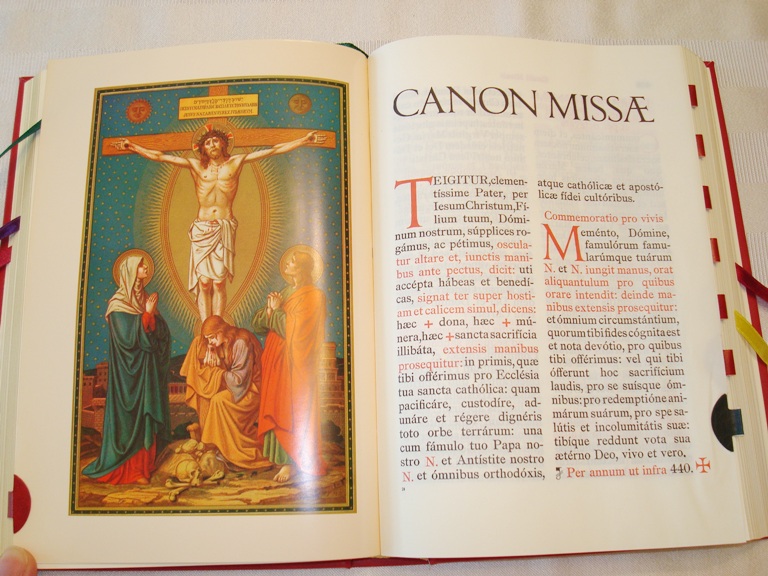
Whilst I don't mind celebrating with this Missal privately - it is a very worthy publication - for a public Mass it has its drawbacks. I did not notice any damage to the tabs as Fr Z did but the glue binding the tabs to the page also binds pages to pages, so that one has to use two hands to carefully separate the pages during the celebration of Mass. This evening I slightly tore one of the pages of the Canon. Also, I now notice my age: my sight is not as good as it was and I found myself struggling with the smaller print.
So, I need to buy a new Missal.
 I could get the 1962 Missal published with the approval of the late Cardinal O'Connor. The lowest price I have found it available for is $110.00 (s/h included) from Roman Catholic Books or $99.99 plus $12.25 s/h from Fraternity Publications i.e. the Priestly Fraternity of St Peter (FSSP). This is the Missal I bought for (and donated to) my previous parish in South Ashford, England. My verdict on this Missal is that is quite adequate - it does the job and would be fine.
However, there is a much nicer one: a 2008 reprint of the well-known and beautiful Benziger Brothers Missal approved by the late Cardinal Spelman, with ad libitum prefaces that were approved in July 1962, including a restored Advent preface, and Masses approved for use in the dioceses of the USA.

The lowest price I have found it available for is $320.00 plus $17.00 s/h from Preserving Christian Publications. The website of Biretta Books gives further details, including examples of the beautful type setting and artwork (far superior to the O'Connor Missal above) shown below:


Keys of the Kingdom on Fox UP Premieres Sunday Dec. 11th 11:30am
KinGdomLOWERHarbor from Gchild Productionz on Vimeo.
The above is a trailer. Kevin Branson is founder of "Claves Regni Ministries" and Father Ryan Ford is Associate Pastor at St Peter Cathedral, Marquette.Wednesday, November 30, 2011
St Andrew's Day pro-marriage rally in Edinburgh

The cardinal said: "As an institution, marriage long predates the existence of any state or government.
"It was not created by government and should not be changed by them. Instead, recognising the innumerable benefits which marriage brings to society, they should act to protect and uphold it, not attack or dismantle it."
Archbishop of Westminster backs civil partnerships

“We would want to emphasise that civil partnerships actually provide a structure in which people of the same sex who want a lifelong relationship [and] a lifelong partnership can find their place and protection and legal provision,” Archbishop Vincent Nichols said at a press conference after the Bishops’ Conference of England and Wales’ meeting last week.and
“As a Church we are very committed to the notion of equality so that people are treated the same across all the activities of life … The Church holds great store by the value of commitment in relationships and undertakings that people give. Stability in society depends upon the reliability of commitments that people give. That might be in offering to do a job but especially in their relationships with one another. Equality and commitment are both very important and we fully support them.”As quoted in The Tablet, London, UK.
He's wrong. Civil partnerships are deeply discriminatory. A brother may not enter into a civil partnership with a brother, or a sister with a sister. Or a man may not enter into one with a woman. The impediments of consanguinity to entering into a partnership are analogous to, if not exactly the same as, those of marriage.
Let us keep the question of chastity out of it for a moment. Let us not even enquire into the nature of the relationship between the parties to a (potential) civil partnership. Why do these need the protection of the law? One can be in a committed and stable relationship of friendship which, it could be argued, is good for society. But these neither need nor merit any legal recognition.
As the Congregation for the Doctrine of the Faith pointed out in its 2003 document Considerations regarding Proposals to give Legal Recognition to Unions between Homosexual Persons:
By putting homosexual unions on a legal plane analogous to that of marriage and the family, the State acts arbitrarily and in contradiction with its duties. The principles of respect and non-discrimination cannot be invoked to support legal recognition of homosexual unions. Differentiating between persons or refusing social recognition or benefits is unacceptable only when it is contrary to justice. The denial of the social and legal status of marriage to forms of cohabitation that are not and cannot be marital is not opposed to justice; on the contrary, justice requires it. (No. 8)
If it is true that all Catholics are obliged to oppose the legal recognition of homosexual unions, Catholic politicians are obliged to do so in a particular way, in keeping with their responsibility as politicians. Faced with legislative proposals in favour of homosexual unions, Catholic politicians are to take account of the following ethical indications.
When legislation in favour of the recognition of homosexual unions is proposed for the first time in a legislative assembly, the Catholic law-maker has a moral duty to express his opposition clearly and publicly and to vote against it. To vote in favour of a law so harmful to the common good is gravely immoral.
When legislation in favour of the recognition of homosexual unions is already in force, the Catholic politician must oppose it in the ways that are possible for him and make his opposition known; it is his duty to witness to the truth. If it is not possible to repeal such a law completely, the Catholic politician, recalling the indications contained in the Encyclical Letter Evangelium vitae, “could licitly support proposals aimed at limiting the harm done by such a law and at lessening its negative consequences at the level of general opinion and public morality”, on condition that his “absolute personal opposition” to such laws was clear and well known and that the danger of scandal was avoided.(18) This does not mean that a more restrictive law in this area could be considered just or even acceptable; rather, it is a question of the legitimate and dutiful attempt to obtain at least the partial repeal of an unjust law when its total abrogation is not possible at the moment. (No. 10)
See comment by William Oddie of the Catholic Herald, and Father Ray Blake, and His Grace's interventions in the following interview:
Subscribe to:
Posts (Atom)
LinkWithin
