Friday, September 10, 2010

8th Grade retreat day

The school term has begun and my first involvement with the Father Marquette Schools was with a retreat for 8th-graders (pictured above with their class teachers Heather Anderson and Mary Friggins) held yesterday at St Michael's Church. For my British readers, 8th graders are normally aged 13/14. It's their last year at Catholic school as there is no Catholic High School in Marquette. So it's an important year for them. Father Ben Hasse, the Associate Pastor of St Michael's, and I took it in turns to give presentations and lead discussion.

The morning included a time of adoration before the Blessed Sacrament - we were totally taken aback at the number of youngsters who wanted to go to Confession during that time. The plan was for me to lead some guided meditation before the Blessed Sacrament while Father Ben made himself available for those who might want to go to Confession. I soon realised why there were so few joining in the prayers I was leading - most of the youngsters had gone to the confession area. So I helped as well but we didn't have time to provide for everyone. It was very encouraging - and a lesson for us in planning for future events like this.

The day ended with a simple said Mass in which all participated with respect and reverence. It was the memorial of St Peter Claver, the Jesuit who left Spain in 1610 to travel to Cartagena, Colombia, to minister to the African slaves.
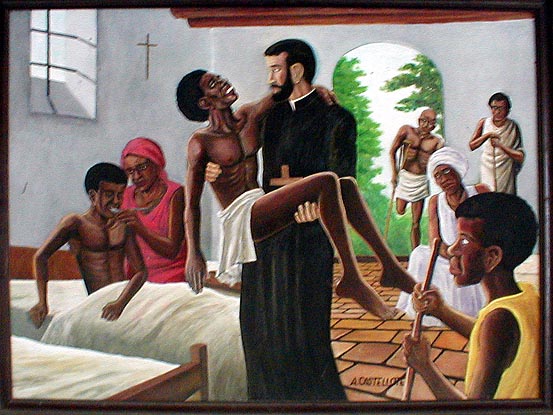
He was known for his care for the slaves, not only when they arrived, but also when they were in their places of work, providing things that they might need and also things that might provide some pleasure and relief, including tobacco and brandy. Apparently he coverted 300,000 to the Christian faith.

You can read more at Catholic Online and American Catholic which gives the following quote:

Peter Claver understood that concrete service like the distributing of medicine, food or brandy to his black brothers and sisters could be as effective a communication of the word of God as mere verbal preaching. As Peter Claver often said, "We must speak to them with our hands before we try to speak to them with our lips."

Tuesday, September 7, 2010

Tony Blair and the Causes he supports

Since arriving in the US I have been asked by quite a few about Tony Blair and his 'conversion' to the Catholic Church. I always reply that Blair never converted, although he was received into the Church.

Here is a post from Uzima on how Blair has not contributed anything to the Papal Visit but supports LGBT causes etc.

Monday, September 6, 2010

How to take Clandestine Cathedral Pictures

I was thoroughly amused by this post at new blog I came across: Catholic Life.

I might use these tips myself sometime! (Although I don't suppose I should be encouraging these techniques at St Peter's Cathedral in Marquette!)


Ever wondered how to take better pictures inside churches? Wonder no more! I found the answer while browsing Flickr. A non-Catholic photographer is kind enough to share the secrets.
My method for getting tripods into cathedrals and shooting is this:
1) Go in the exit and act like you are lost if someone asks
2) Wear a long matrix-coat and stuff your tripod up inside like a shotgun. Try not to walk with a limp.
3) Stride confidently through the crowds like you are in a hurry on a photo assignment.
4) Work your way into the pews and have a seat. You can even pretend to be Catholic and say a few Latin words as you sit down. I suggest “Pater Noster (My Father) or Quid Pro Quo (Rub Beads and go to Heaven)”
5) Slide out the tripod and assemble along the ground, When other parishioners look at you suspiciously, give them the sign of the cross.
6) Watch for old people in the main aisle, because they have trouble getting around tripods. Jump out, take your long exposures at 100 ISO, then sit back down.
7) If securty comes to get you, blame Stuck In Customs and that will confuse them long enough so you can make a getaway.
8 ) Don’t worry about getting caught. The church is much more leniant than they were during the Inquisition. Most big cathedrals do have crypts, but they are full of dead saints and they have never put a photographer in there.
9) If you see a tourist with a tiny camera taking a picture with the flash on, please tell them to stop. The flash does nothing in that situation. It’s just embarassing for them, really.
10. See #9. It’s your duty to stop tourists from using flashes… next thing you know, they’ll have their flash on when shooting the Eiffel Tower at night.
Do you have any tips for taking good pictures inside of churches?

Sunday, September 5, 2010

Father Rutler on Newman


The Church of Our Saviour whose pastor is Father George Rutler offers a subscription service by which you can receive a weekly email with the Pastor's Corner reflection. In the weeks leading up to Cardinal Newman's beatification, Father Rutler has been publishing excerpts of Newman's writings to promote a greater understanding of his teachings.

This week's is entitled 'The Faith of Catholics' and contains a text of Newman about Faith and Devotion, with reference to the Faith of the Church in the Blessed Virgin Mary and the Devotion by which she his honoured in the Church.

I reproduce it here in full, presuming upon the good Father Rutler's approval.

THE BELIEF OF CATHOLICS

I begin by making a distinction which will go far to remove good part of the difficulty of my undertaking, as it presents itself to ordinary inquirers,—the distinction between faith and devotion. I fully grant that devotion towards the blessed Virgin has increased among Catholics with the progress of centuries; I do not allow that the doctrine concerning her has undergone a growth, for I believe that it has been in substance one and the same from the beginning.

By “faith” I mean the Creed and assent to the Creed; by “devotion” I mean such religious honours as belong to the objects of our faith, and the payment of those honours. Faith and devotion are as distinct in fact, as they are in idea. We cannot, indeed, be devout without faith, but we may believe without feeling devotion. Of this phenome­non every one has experience both in himself and in others; and we bear witness to it as often as we speak of realizing a truth or not realizing it. It may be illustrated, with more or less exactness, by matters which come before us in the world. For instance, a great author, or public man, may be acknowledged as such for a course of years; yet there may be an increase, an ebb and flow, and a fashion, in his popularity. And if he takes a lasting place in the minds of his countrymen, he may gradually grow into it, or suddenly be raised to it. The idea of Shake­speare as a great poet, has existed from a very early date in public opinion; and there were at least individuals then who understood him as well, and honoured him as much, as the English people can honour him now; yet, I think, there is a national devotion to him in this day such as never has been before. This has happened, because, as education spreads in the country, there are more men able to enter into his poetical genius, and, among these, more capacity again for deeply and critically understanding him; and yet, from the first, he has exerted a great insen­­­sible influence over the nation, as is seen in the circum­stance that his phrases and sentences, more than can be num­­bered, have become almost proverbs among us. And so again in philosophy, and in the arts and sci­ences, great truths and principles have sometimes been known and ac­know­ledged for a course of years; but, wheth­er from feebleness of intellectual power in the recipients, or external cir­cumstances of an accidental kind, they have not been turned to account. Thus the Chinese are said to have known of the properties of the magnet from time immemorial, and to have used it for land expeditions, yet not on the sea. Again, the ancients knew of the principle that water finds its own level, but seem to have made little application of their knowledge. And Aristotle was familiar with the principle of induction; yet it was left for Bacon to develop it into an experimental philosophy. Illustrations such as these, though not alto­gether apposite, serve to convey that distinction between faith and devotion on which I am insisting. It is like the distinction between objective and subjective truth. The sun in the spring-time will have to shine many days before he is able to melt the frost, open the soil, and bring out the leaves; yet he shines out from the first notwith­standing, though he makes his power felt but gradually. It is one and the same sun, though his influence day by day becomes greater; and so in the Catholic Church it is the one Virgin Mother, one and the same from first to last, and Catholics may have ever acknowledged her; and yet, in spite of that ac­know­ledgment, their devotion to her may be scanty in one time and place, and overflowing in another.

This distinction is forcibly brought home to a convert, as a peculiarity of the Catholic religion, on his first introduction to its worship. The faith is everywhere one and the same, but a large liberty is accorded to private judgment and inclination as regards matters of devotion. Any large church, with its collections and groups of people, will illustrate this. The fabric itself is dedicated to Almighty God, and that, under the invocation of the Blessed Virgin, or some particular Saint; or again, of some mystery belonging to the Divine Name or the Incarnation, or of some mystery associated with the Blessed Virgin. Perhaps there are seven altars or more in it, and these again have their several Saints. Then there is the Feast proper to this or that day; and during the celebration of Mass, of all the worshippers who crowd around the Priest, each has his own particular devotions, with which he follows the rite. No one interferes with his neighbour; agreeing, as it were, to differ, they pursue independently a common end, and by paths, distinct but converging, present themselves before God. Then there are confraternities attached to the church,—of the Sacred Heart, or of the Precious Blood; associations of prayer for a good death, or for the repose of departed souls, or for the conversion of the heathen; devotions connected with the brown, blue, or red scapular; not to speak of the great ordinary Ritual observed through the four seasons, or of the constant Presence of the Blessed Sacrament, or of its ever-recurring rite of Benediction, and its extraordinary forty hours’ Exposition. Or, again, look through such manuals of prayers as the Raccolta, and you at once will see both the number and the variety of devotions, which are open to individual Catholics to choose from, according to their religious taste and prospect of personal edification.

BBC Profile on Pope Bendict XVI

Typical BBC 'objectivity': plenty of airtime to Hans Kung plus a sister from 'Future Church' who says the Pope is too concerned with a narrow vision of the Church, preserving it as it was or is and not thinking of where it needs to be, ruled as it is by a small number of men in Rome. The Pope has managed to offend Muslims, Jews and the Archbishop of Canterbury says the BBC. Joseph Fessio, a former pupil of Ratzinger's and founder and editor of the utterly reliable publishing house Ignatius Press however says what his professor taught was wonderful. Cardinal Murphy O'Connor, sounding ever more ancient, says the Pope will want to tell the people of Britain about a coherent truth that is good not just for Catholics but for everyone.

Have a listen (lasts 15 minutes).

Friday, September 3, 2010

Archbishop Dolan to bless New York shrine in honour of Blessed John Henry Newman

Father George Rutler, pastor of the Church of Our Saviour in New York City has erected a shrine in honour of Cardinal Newman and it is to be blessed by the Archbishop of New York on September 23rd, just a week after Newman's beatification by Pope Benedict in Birmingham, England.

Full details at ewtn news.

UPDATE: Further details and drawings at New Liturgical Movement.


LinkWithin

Related Posts Plugin for WordPress, Blogger...